 Pyeongye
Artwork · 19th century · Edouard Manet
LeoTurn on Magnifier at the lower right and move slowly across the painting.
Full screen opens it edge to edge.Tap the painting to fill the screen.
Spread two fingers to look closer.
At a glance
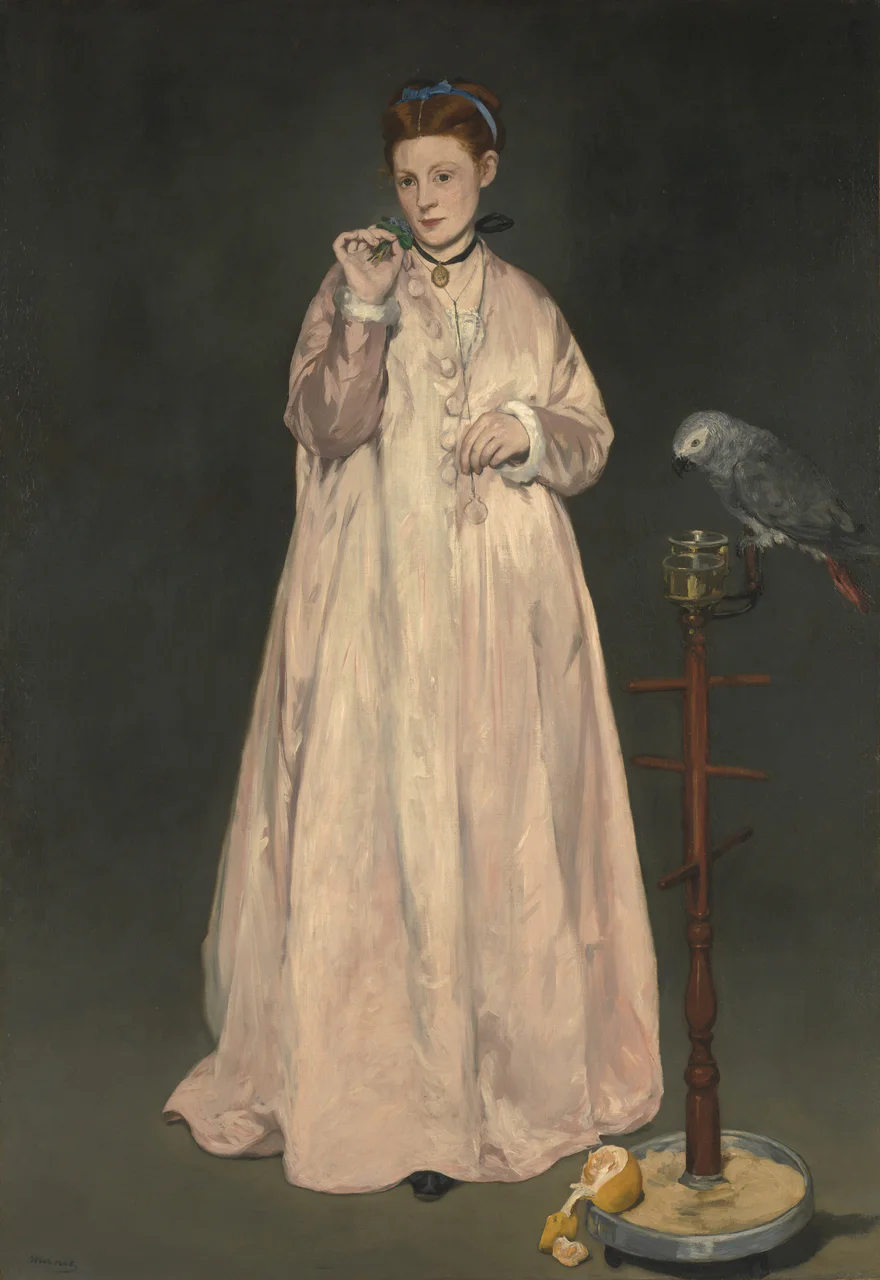
- A young woman in a pale pink dressing gown holds a little bunch of violets up near her face, while a gray parrot sits on a perch beside her.
- The French painter Édouard Manet painted it in oil on canvas in Paris in 1866.
- The canvas is just over six feet tall, and apart from the woman and the parrot's perch the dark background is empty. That makes every brushstroke easy to see.
Reading the picture
4 places to look closer
Tap a number on the painting to jump to its note, or a close-up to see that spot in the whole picture.
Zoom in on her face. Her red hair is tied up with a blue ribbon, and she holds a small posy of violets up by her chin while looking straight at us. A gold locket hangs at her throat on a black ribbon. Her face is calm, neither smiling nor frowning.
Zoom in on the hand below her chest. A round piece of glass dangles from the end of a thin cord. It looks like a monocle, a single lens worn in one eye. Her fingers and cuff are laid in with just a few broad, quick strokes.
Look at the parrot on the perch at the right. It has ash-gray feathers and a red tail, and it bends its head down. In front of it hang two small glass cups for seed and water.
Drop down to the floor. Beside the base of the perch sits a yellow fruit with its peel half pulled off. The long strip of peel trails down to the floor, and a loose segment of fruit lies nearby.
When it was painted
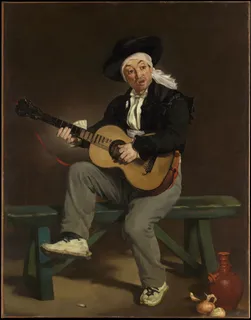
In 1866 Édouard Manet was thirty-four, and Paris loved to argue about him. A year earlier his Olympia had caused an uproar at the Salon. This year the Salon jury rejected his entry, The Fifer, outright.
One person took his side in public: the young writer Émile Zola, who defended Manet in a newspaper in 1866. The next year, when Paris held its World's Fair, Manet built his own exhibition pavilion near the fairgrounds and hung his paintings there.
At the same Salon of 1866, Gustave Courbet scored a hit with Woman with a Parrot. It shows a nude woman lying back and raising her hand as a parrot lands on it. That same year Manet painted a woman fully dressed, standing beside a parrot on its perch. Reading his picture as a reply to Courbet is a well-known interpretation.
The model is Victorine Meurent, who also posed for Luncheon on the Grass and Olympia. This painting hung at the Salon of 1868, alongside Manet's portrait of Zola. Meurent later became a painter herself and showed her own work at the Salon.
In 1881 the American painter J. Alden Weir bought this picture and Manet's Boy with a Sword on behalf of the New York collector Erwin Davis. Davis gave both paintings to the Metropolitan Museum in 1889. Today Courbet's Woman with a Parrot hangs in the same museum.
Look at the picture again. Courbet's woman lies down with the bird on her hand. Manet's woman stands up and looks straight at you, while the parrot simply bows its head on the perch beside her.
The painter
Edouard Manet
1832–1883
When painting this, the artist was about 34 years old
All paintings by Edouard Manet →More by the same painter
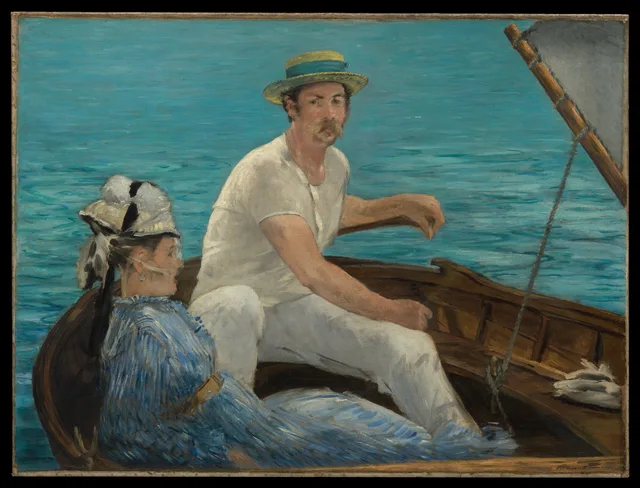
Questions to think about
- Look for itIn the dark lower left corner, can you find the painter's faint signature?
- Why?Why do you think Manet left the background an empty gray and stood the parrot right next to the woman?
- What about you?The title is Young Lady in 1866. If you painted a young woman of today, what would you put in her hands?
Same period
Painted around the same time,
somewhere else
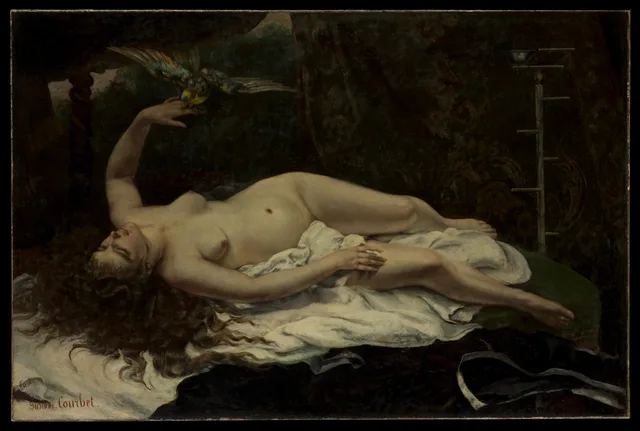 Woman with a ParrotGustave Courbet1866
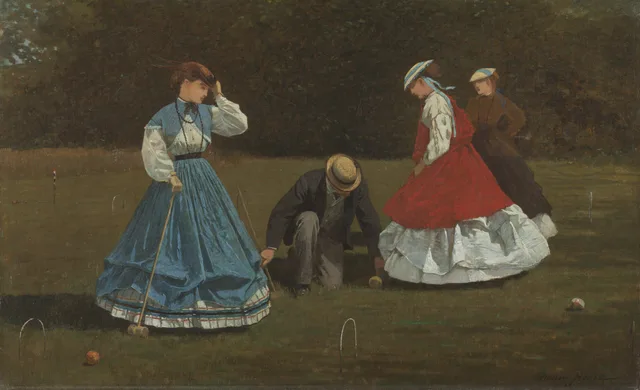 Croquet SceneWinslow Homer1866
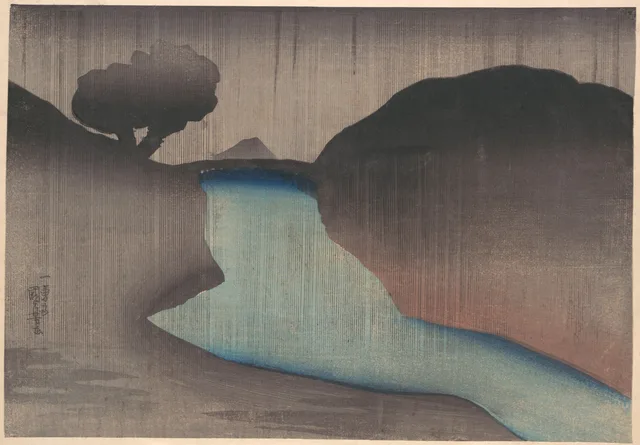 Ochanomizu in the RainUtagawa Kuniyoshimid-19th century
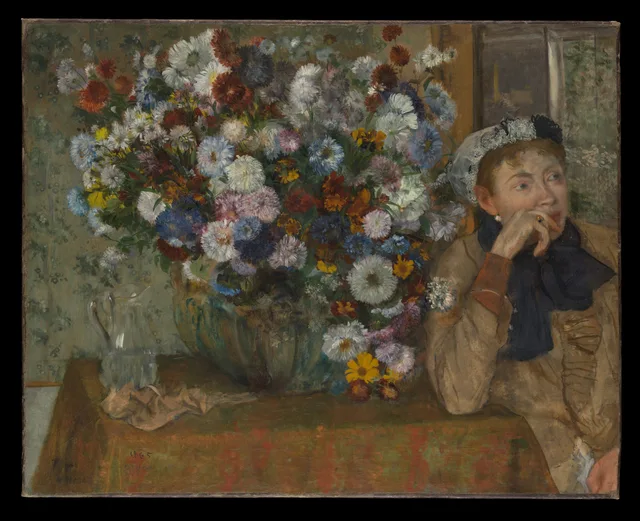 A Woman Seated beside a Vase of Flowers (Madame Paul Valpinçon?)Edgar Degas1865
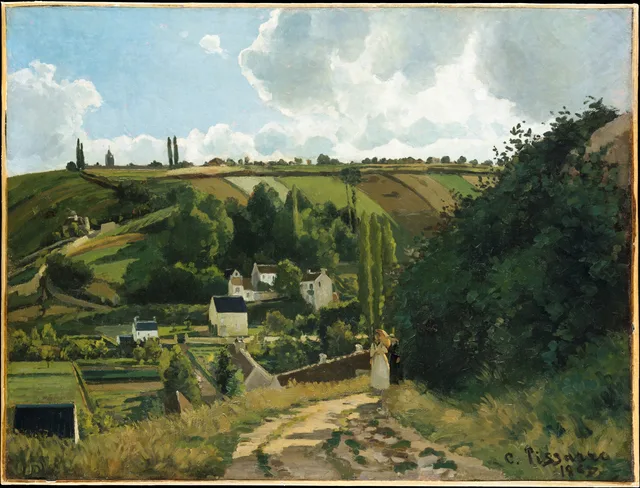 Jalais Hill, PontoiseCamille Pissarro1867
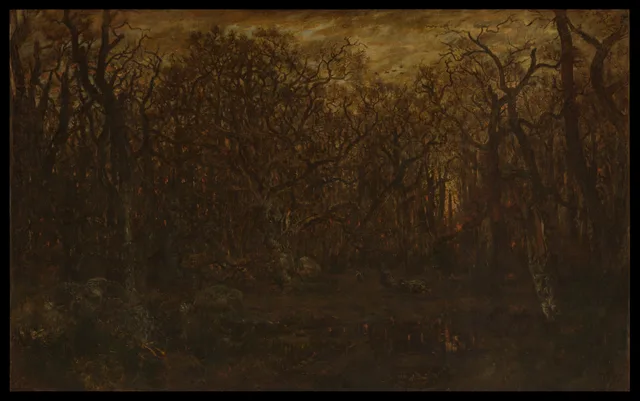 The Forest in Winter at SunsetThéodore Rousseauca. 1846–67
Too good to keep to yourself
This painting,
for someone who comes to mind
They open it at full size
and see every brushstroke.
About this work
- Artist
- Edouard Manet · 1832–1883
- Date
- 1866
- Medium
- Oil on canvas
- Size
- 185.1 × 128.6 cm
- Collection
- The Metropolitan Museum of Art
- Image
- Original long edge 3795px · shown at 2560px
- Original
- View on the museum's website ↗