 Pyeongye
Artwork · 18th century · Manaku
LeoTurn on Magnifier at the lower right and move slowly across the painting.
Full screen opens it edge to edge.Tap the painting to fill the screen.
Spread two fingers to look closer.
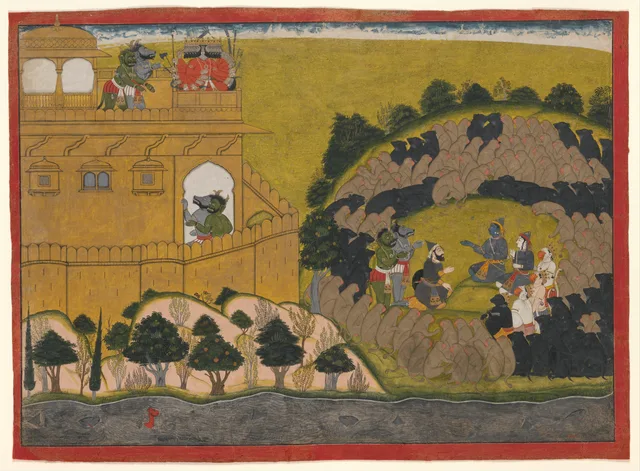
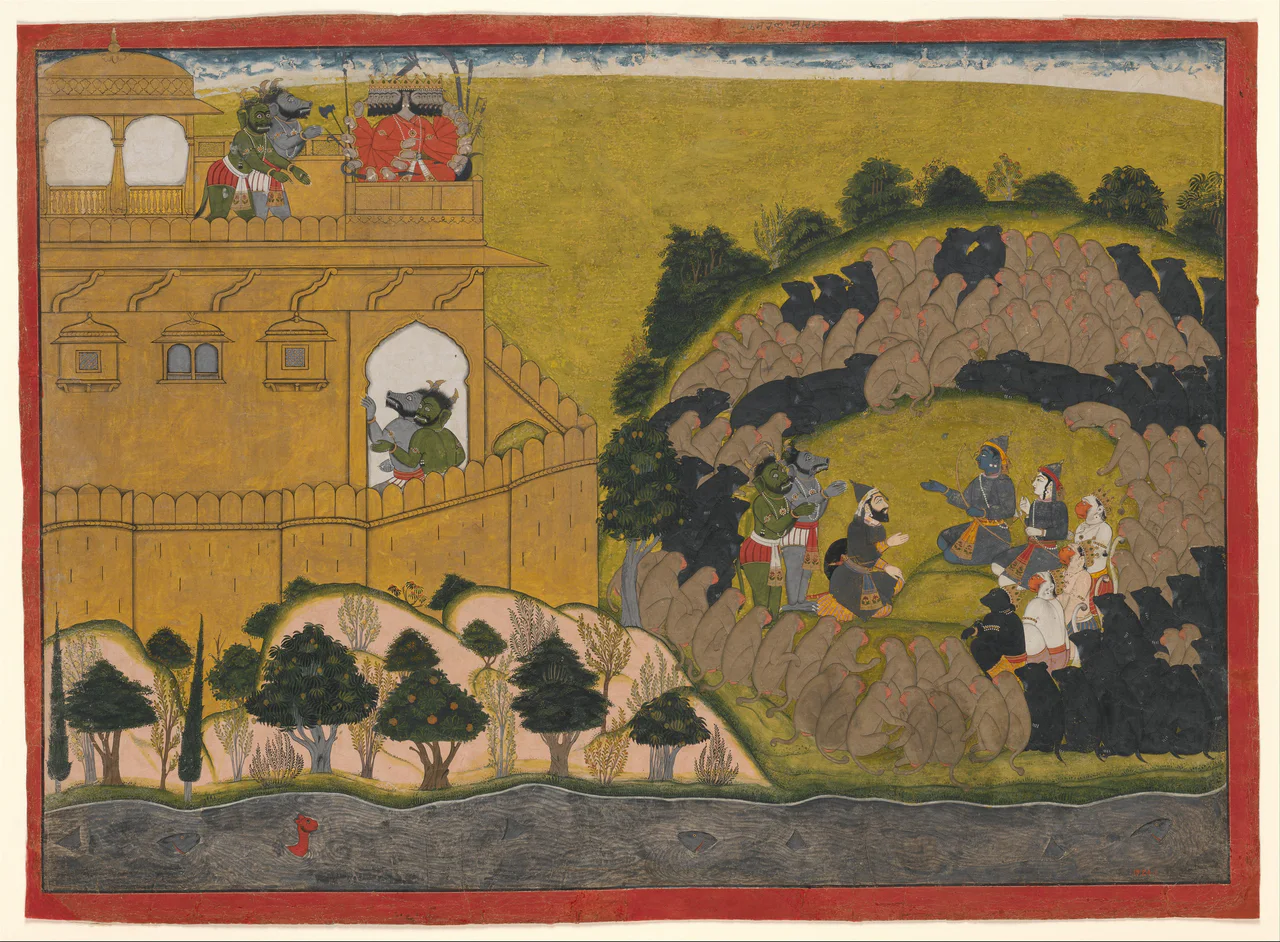
Rama Releases the Demon Spies Shuka and Sarana: Folio from the Siege of Lanka series
Manakuca. 1725Opaque watercolor, ink and gold on paper56.5 × 79.4 cm
At a glance
- In the middle of an army of monkeys and bears, blue-skinned Rama sends two captured demon spies back home.
- Manaku, a painter from the hill kingdom of Guler in northern India, made it around 1725.
- The same two spies appear three times in one picture. Follow their trail and you can read a whole chapter of the story.
Reading the picture
5 places to look closer
Tap a number on the painting to jump to its note, or a close-up to see that spot in the whole picture.
Start at the right, near the middle. Blue Rama, holding his bow, reaches out a hand as he speaks. A bearded man kneels before him. Behind stand a horned green demon and a gray demon with a boar's snout. These are the spies Shuka and Sarana, who slipped into the camp disguised as monkeys and were caught.
Now zoom in around Rama. Pink-faced monkeys and black bears sit packed together. Each one turns its head and settles its body a little differently, so you can tell they were drawn one by one. This is the army that crossed the sea with Rama.
Look at the arched window in the city wall on the left. The same green demon and boar-faced demon are scrambling over the sill and back inside. Freed, the spies hurry home.
Zoom in on the terrace at the upper left. There they are a third time, gesturing as they report. Across from them sits a king in red with a row of heads and many hands gripping an axe and a spear. He is Ravana, king of Lanka.
Drop to the sea at the very bottom. A red creature pokes its head up out of the gray waves. Even in a war story, the painter tucked a playful little detail into the corner.
When it was painted
Around 1725, in Guler, a small kingdom in the foothills of the Himalayas, the painter Manaku was at work on sheets of paper more than 80 centimeters wide. His father, Pandit Seu, was a painter, and his younger brother, Nainsukh, would become a celebrated painter too. Manaku's project was a series called the Siege of Lanka, drawn from the sixth book of the Ramayana. It tells how Rama surrounds Ravana's fortress to win back Sita.
The series was never finished. Some sheets, like this one, have their full color and gold. Others have the colors blocked in but the details missing. Some survive only as drawings in black ink with the brush. The Met presents this sheet as an example of the finished work the painter had in mind.
Being unfinished turned the series into a fine teacher. The Met bought several sheets from it together in 1919. Its staff later used infrared imaging to find the drawn lines hidden under the paint and to trace the order in which Manaku built up a picture.
In the Ramayana, the freed spies Shuka and Sarana go back and tell Ravana how strong Rama's army is. Ravana climbs to a high point of his palace to look down on the enemy, and Sarana points out the monkey chiefs one by one, naming each of them.
Now look again at the terrace at the upper left. The two spies gesturing before Ravana are reporting on the very army you just saw spread across the hill on the right.
Questions to think about
- Look for itHow many times can you find the green demon and the boar-faced demon in the picture?
- Why?Why would Rama let captured spies go, and even let them see his whole army first?
- What about you?If you caught someone secretly watching you, what would you do? Which is stronger, hiding everything or showing everything?
Same period
Painted around the same time,
somewhere else
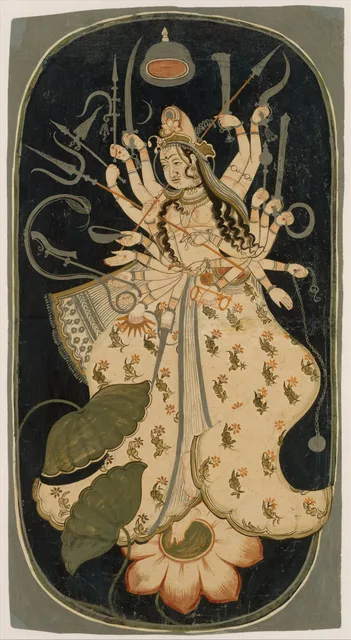 Mahadevi, the Great GoddessUnknown artist · India (Rajasthan, Bikaner)ca. 1725
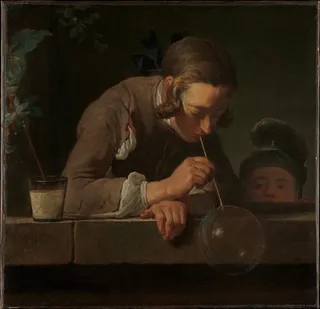 Soap BubblesJean Siméon Chardinca. 1733–34
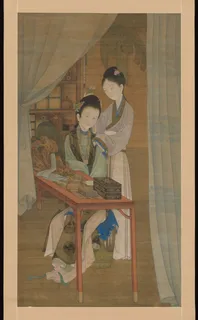 Woman at her dressing tableLeng Meiearly 18th century
 Pastoral SceneGiovanni Battista Piazzetta1740
 Imaginary View of Venice, houses at left with figures on terraces, a domed church at center in the background, boats and boat-sheds below, and a seated man observing from a wall at right in the foreground, from "Views" (Vedute altre prese da i luoghi altre ideate da Antonio Canal)Canaletto1741
 Piazza San MarcoCanalettolate 1720s
Too good to keep to yourself
This painting,
for someone who comes to mind
They open it at full size
and see every brushstroke.
About this work
- Artist
- Manaku · 1715–1770
- Date
- ca. 1725
- Medium
- Opaque watercolor, ink and gold on paper
- Size
- 56.5 × 79.4 cm
- Culture
- India, Guler, Himachal Pradesh
- Collection
- The Metropolitan Museum of Art
- Image
- Original long edge 3915px · shown at 2560px
- Original
- View on the museum's website ↗