 Pyeongye
Artwork · 18th century · Leng Mei
LeoTurn on Magnifier at the lower right and move slowly across the painting.
Full screen opens it edge to edge.Tap the painting to fill the screen.
Spread two fingers to look closer.
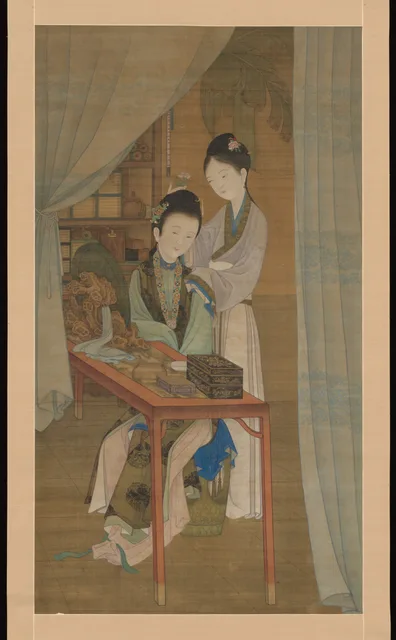
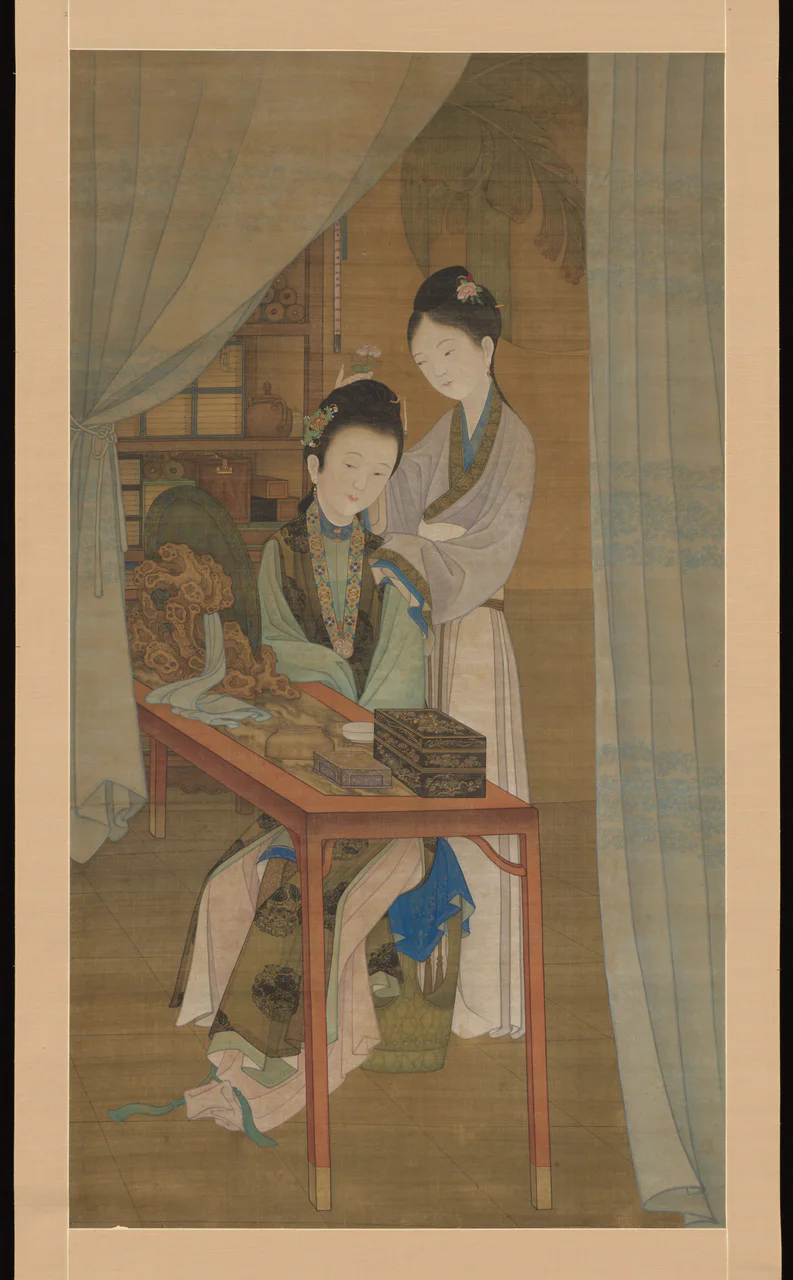
Woman at her dressing table
Leng Meiearly 18th centuryHanging scroll; ink and color on silk169.7 × 94.5 cm
At a glance
- A maid is about to tuck a pink flower into the hair of a woman seated at her dressing table.
- Leng Mei, a painter at the Qing court in China, painted it in the early 1700s in ink and color on silk.
- The painting is about five and a half feet tall, and every gold flower on a lacquer box and every pearl in a hairpin is drawn with a fine brush.
Reading the picture
5 places to look closer
Tap a number on the painting to jump to its note, or a close-up to see that spot in the whole picture.
Zoom in above the woman's head. The maid holds a single pink flower between her thumb and fingertips. Just below, a gold hairpin is pushed into the coiled black hair, with a string of pearls hanging from its end. To the left you can see a green and gold hair ornament.
Look at the black box on the table. It has two tiers, and its lid and sides are painted in gold with flowers and blossoming branches. Thin gold bands run along every edge. It looks like a lacquer box for makeup tools or jewelry.
Move to the shelves behind her. A teapot with a curved handle sits on top, and below it are a box with a metal latch and a stack of flat cases. A thin blind hangs over the window. Piece by piece, you can see what the owner of this room kept around her.
Zoom in on the lumpy shape at the left end of the table. It is full of round holes and twists over itself again and again. A pale sky-blue cloth spills down through it. It looks like an old tree root or a hole-riddled stone, set beside the dressing table as an ornament.
Look at the floor under the table legs. Thin lines run across it at a slant and seem to narrow as they go back into the room. The table legs end in metal caps, and next to them stands a green, drum-shaped stool. Those floor lines give the room its depth.
When it was painted
Beijing, in the early 1700s. The Kangxi Emperor of the Qing dynasty kept painters at court to work for him, and one of them was Leng Mei, a man from Jiaozhou in Shandong province.
His teacher was the court painter Jiao Bingzhen. Jiao worked at the Directorate of Astronomy, the office in charge of the stars and the calendar, and there he picked up Western perspective from European missionaries. For the emperor he also painted Pictures of Tilling and Weaving, scenes of farming and silk making. Leng Mei followed his teacher's manner and often used that Western way of making space shrink as it goes back.
As a court painter, Leng Mei also took on big imperial projects. One of his best-known works is a large hanging scroll looking down on the Mountain Estate for Escaping the Summer Heat at Rehe, today's Chengde, where the Kangxi Emperor spent his summers. Mountains, lakes, and halls are packed into a single view.
Still, what made his name was his pictures of beautiful women. A woman in a painting like this is less a portrait of one real person than a picture of what people of the time thought was graceful: the clothes, the manners, the way a room was furnished. The Qing imperial painting catalogue, the Shiqu Baoji, lists a number of his works. This scroll entered The Met's collection in 2024, roughly three centuries after it was painted.
Now look again. The blue-gray curtains are drawn aside on both sides, so we peek into the room as if at a stage. Framed between them, the moment just before the maid sets the flower in place has stayed exactly where it is.
Questions to think about
- Look for itCan you find the big, faint banana leaves outside the window at upper right?
- Why?Why do you think Leng Mei painted the boxes, shelves, and even the floor so carefully, rather than focusing only on the woman's face?
- What about you?The woman in the picture is being decorated with a flower someone else chooses. When we dress up today, is it mostly for ourselves, or for the eyes of others?
Same period
Painted around the same time,
somewhere else
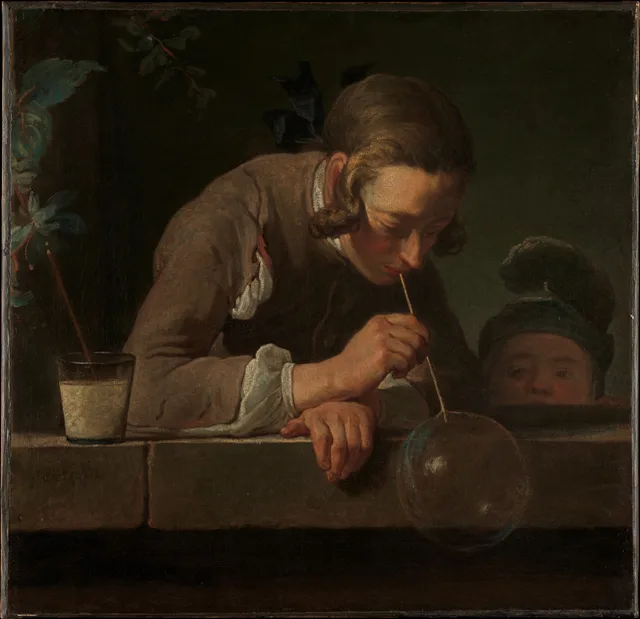 Soap BubblesJean Siméon Chardinca. 1733–34
 Mahadevi, the Great GoddessUnknown artist · India (Rajasthan, Bikaner)ca. 1725
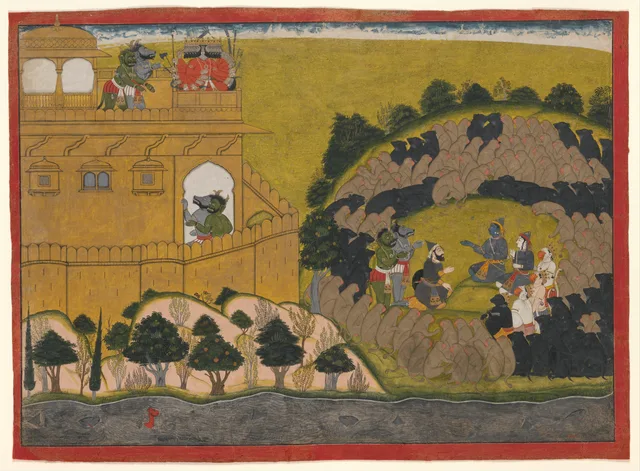 Rama Releases the Demon Spies Shuka and Sarana: Folio from the Siege of Lanka seriesManakuca. 1725
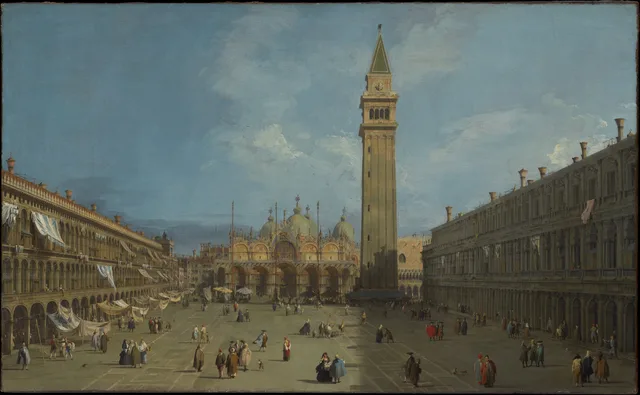 Piazza San MarcoCanalettolate 1720s
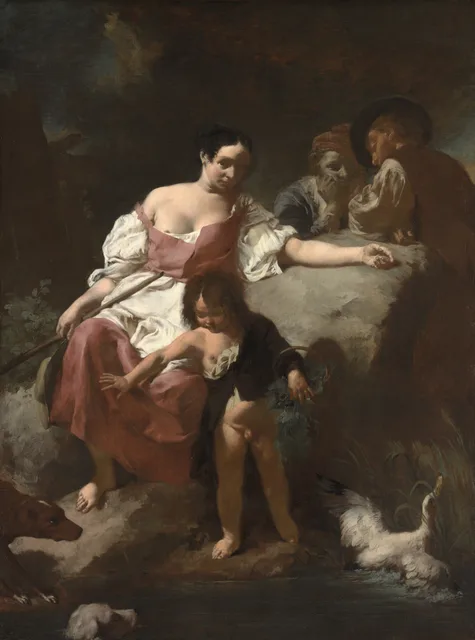 Pastoral SceneGiovanni Battista Piazzetta1740
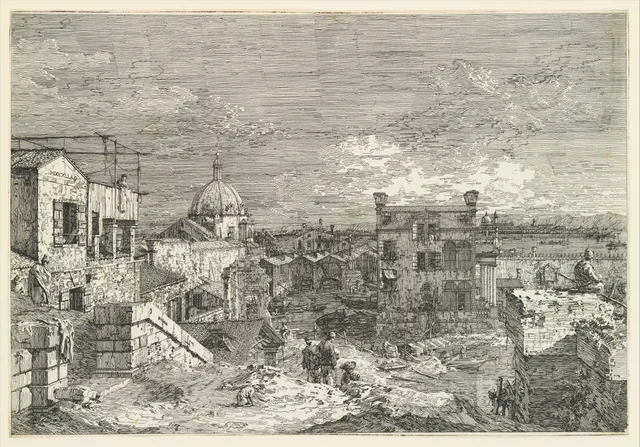 Imaginary View of Venice, houses at left with figures on terraces, a domed church at center in the background, boats and boat-sheds below, and a seated man observing from a wall at right in the foreground, from "Views" (Vedute altre prese da i luoghi altre ideate da Antonio Canal)Canaletto1741
Too good to keep to yourself
This painting,
for someone who comes to mind
They open it at full size
and see every brushstroke.
About this work
- Artist
- Leng Mei · 1677–1742
- Date
- early 18th century
- Medium
- Hanging scroll; ink and color on silk
- Size
- 169.7 × 94.5 cm
- Culture
- China
- Collection
- The Metropolitan Museum of Art
- Image
- Original long edge 4000px · shown at 2560px
- Original
- View on the museum's website ↗