 Pyeongye
Artwork · 18th century
LeoTurn on Magnifier at the lower right and move slowly across the painting.
Full screen opens it edge to edge.Tap the painting to fill the screen.
Spread two fingers to look closer.
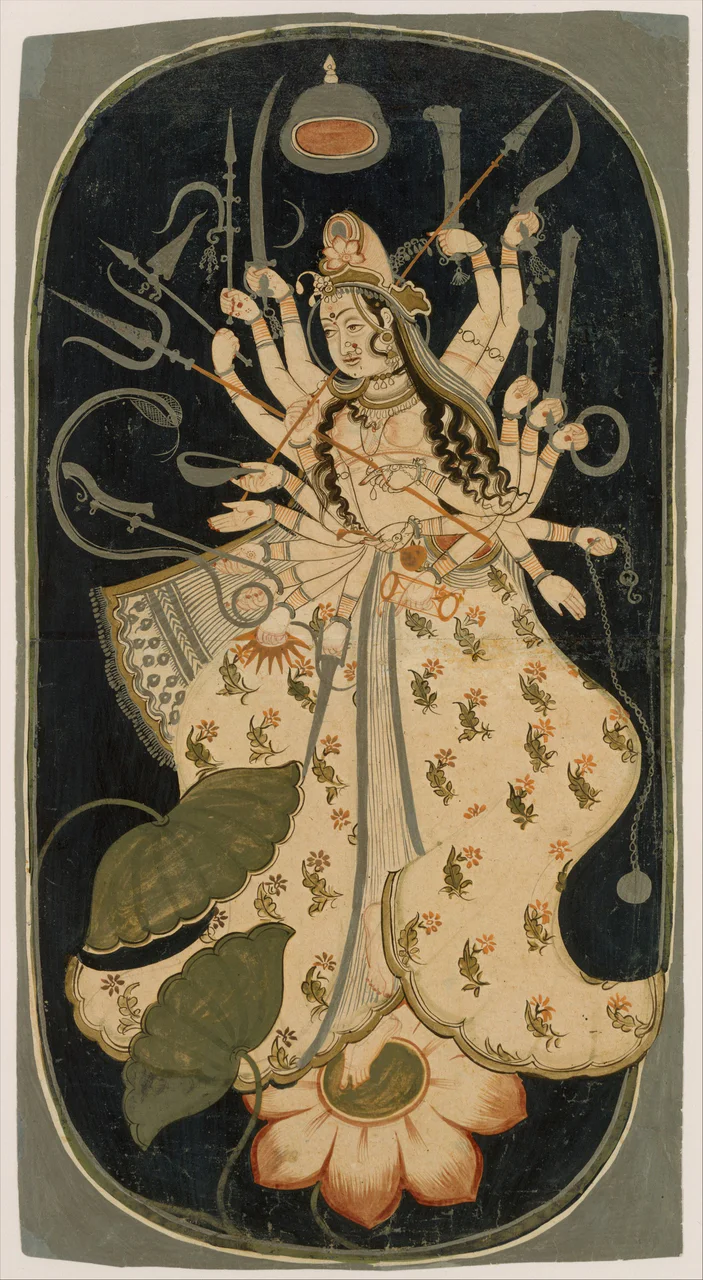
Mahadevi, the Great Goddess
Unknown artist · India (Rajasthan, Bikaner)ca. 1725Ink, opaque watercolor, and silver on paper54.6 × 29.2 cm
At a glance
- A goddess with more than ten arms balances on one foot on a lotus, holding weapons in her hands against a background as dark as a night sky.
- An unnamed painter made it around 1725 in Bikaner, Rajasthan, India, with ink, opaque watercolor and silver on paper.
- The sheet is about 21 inches tall. The weapons and ornaments that look gray now once shone silver.
Reading the picture
5 places to look closer
Tap a number on the painting to jump to its note, or a close-up to see that spot in the whole picture.
Zoom in on her face. A small dot marks the middle of her forehead, a ring hangs from her nose and round earrings sit at her ears. A pink flower crowns her head, and her black hair ripples down to her shoulders in waves. Her large eyes look off to the left.
Look at the hands reaching up and out on the left. A trident, a pointed spear and a sword fan out in every direction. All of them are a dull gray, because they were painted in silver. Silver darkens over time as it reacts with the air. When the painting was new, these weapons would have flashed against the dark ground.
Now the hands on the right. The palms and fingertips are stained red. A lower hand lets a long chain dangle, and near an upper hand floats a gray ring curved like a crescent. Each wrist is stacked with striped bracelets in orange and gray.
Find the hem of her skirt at lower left. Small sprays of orange flowers and green leaves are scattered over the cream cloth. The edge is finished with a fine gray fringe, and a huge green lotus leaf opens beside it.
Go down to her feet. One bare foot rests lightly on the green center of a fully open lotus. With all those arms and weapons, she puts her whole weight on a single flower.
When it was painted
Around 1725, in Bikaner, a city at the edge of the Thar Desert in northwestern India, a painter covered a sheet of paper with a dark ground and set a goddess at its center. The painter's name has not come down to us.
Bikaner was founded in 1488 by a Rajput prince, Rao Bika, who gave the city his name. From the sixteenth century on, its rulers served the Mughal emperors and led troops on campaigns far from home. The court took Mughal painting to heart, and families of Muslim painters trained in the Mughal manner worked there for generations.
So what did this goddess mean to that court? According to the museum, she was the protector of Bikaner's ruling family, which would have given this image special weight there. The museum also explains that the weapons in her many hands tie her to all the male gods, and that her form also links her to Durga, who slew the buffalo demon Mahisha.
Later the painting left India, and in 1996 it entered The Metropolitan Museum of Art. In 2011 it hung in the museum's exhibition on the goddess in Indian painting.
Look at her face once more. Her arms reach out in every direction with blades and spears. Yet her face stays calm, turned quietly to the side. A body ready for battle and a still face share one small sheet of paper.
Questions to think about
- Look for itHow many arms does the goddess have, and how many different objects can you count in her hands?
- Why?Why do you think the painter used silver for the weapons and made the background so dark?
- What about you?If the goddess got one weapon from each god, what would you want from the people around you when you face something hard?
Same period
Painted around the same time,
somewhere else
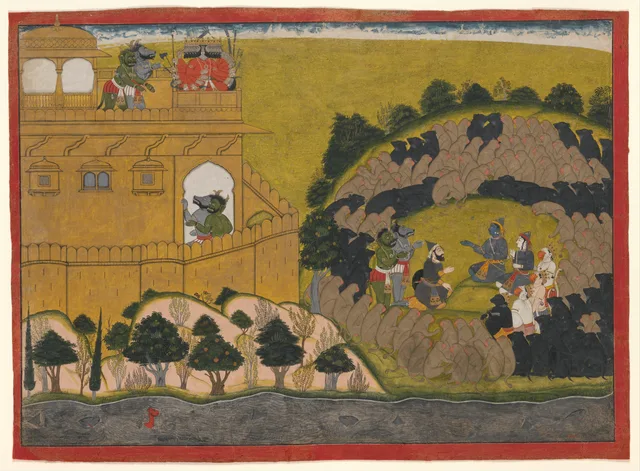 Rama Releases the Demon Spies Shuka and Sarana: Folio from the Siege of Lanka seriesManakuca. 1725
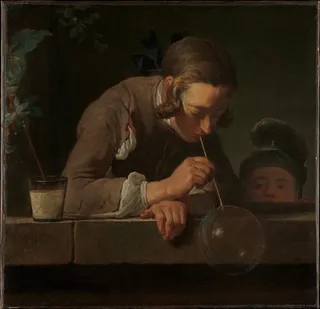 Soap BubblesJean Siméon Chardinca. 1733–34
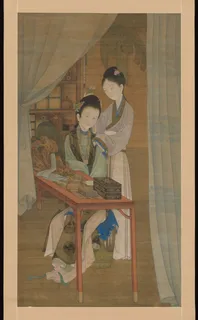 Woman at her dressing tableLeng Meiearly 18th century
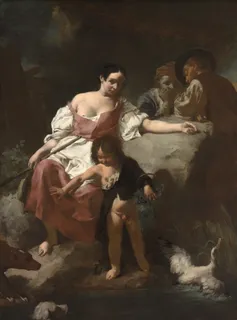 Pastoral SceneGiovanni Battista Piazzetta1740
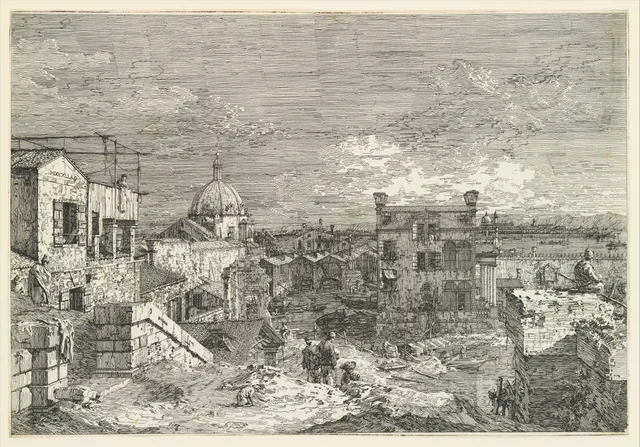 Imaginary View of Venice, houses at left with figures on terraces, a domed church at center in the background, boats and boat-sheds below, and a seated man observing from a wall at right in the foreground, from "Views" (Vedute altre prese da i luoghi altre ideate da Antonio Canal)Canaletto1741
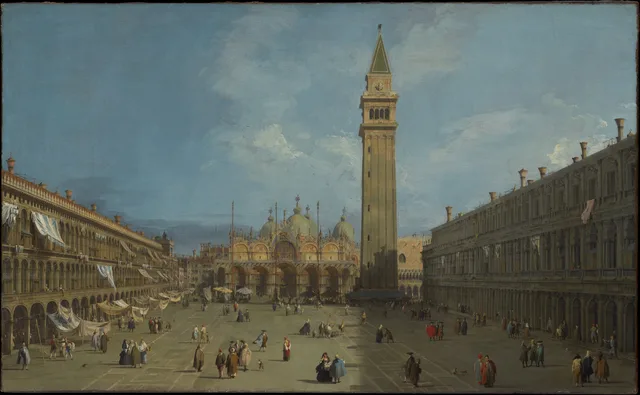 Piazza San MarcoCanalettolate 1720s
Too good to keep to yourself
This painting,
for someone who comes to mind
They open it at full size
and see every brushstroke.
About this work
- Artist
- Unknown artist · India (Rajasthan, Bikaner)
- Date
- ca. 1725
- Medium
- Ink, opaque watercolor, and silver on paper
- Size
- 54.6 × 29.2 cm
- Culture
- India (Rajasthan, Bikaner)
- Collection
- The Metropolitan Museum of Art
- Image
- Original long edge 3722px · shown at 2560px
- Original
- View on the museum's website ↗