 Pyeongye
Artwork · 15th century · Rogier van der Weyden
LeoTurn on Magnifier at the lower right and move slowly across the painting.
Full screen opens it edge to edge.Tap the painting to fill the screen.
Spread two fingers to look closer.
Francesco d'Este (born ca. 1429, died after 1486)
Rogier van der Weydenca. 1460Oil on wood31.8 × 22.2 cm
At a glance
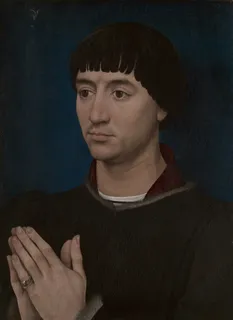
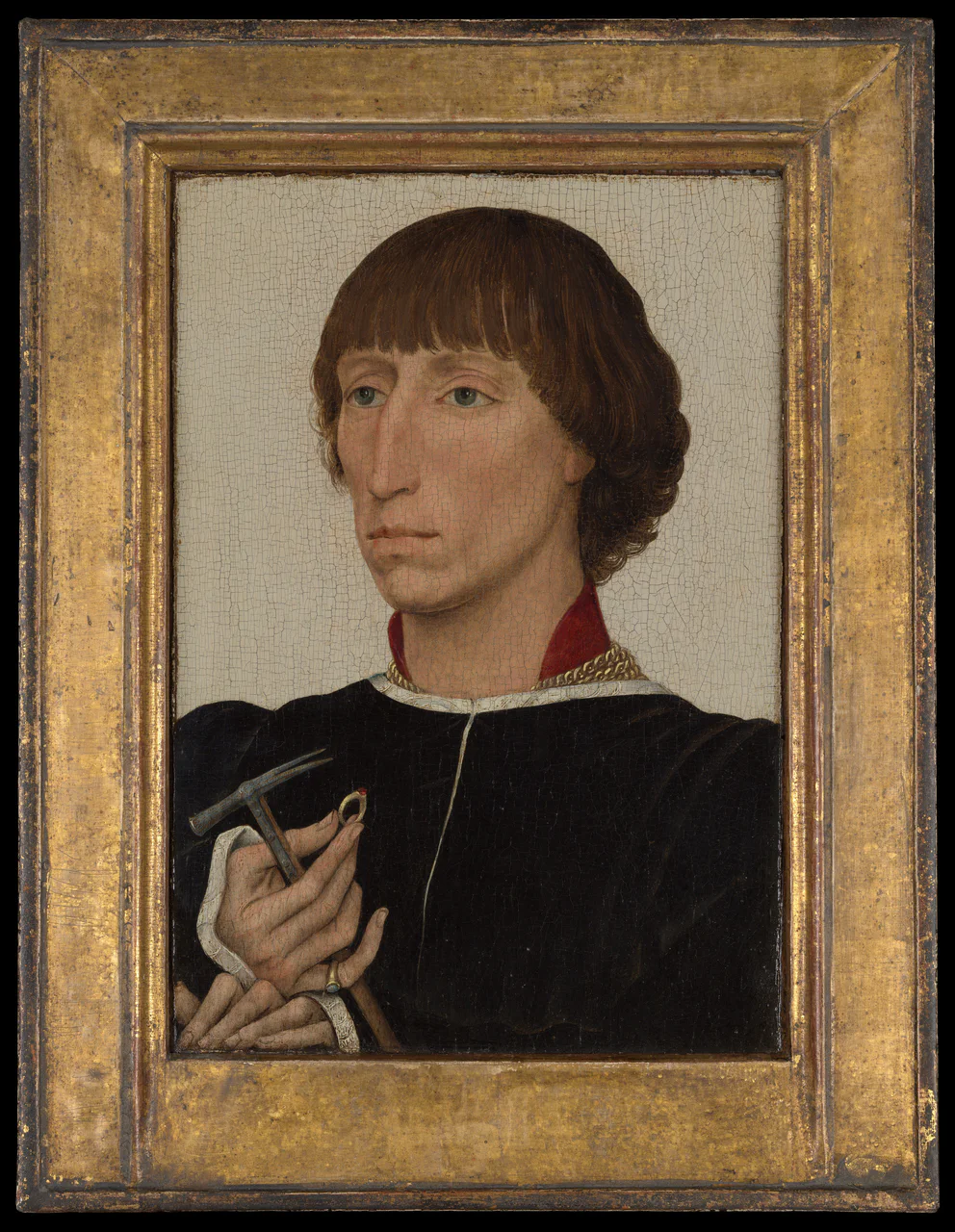
- A young nobleman in black looks off to one side, holding a small hammer and a ring in one hand.
- The Netherlandish painter Rogier van der Weyden painted this portrait of Francesco d'Este, a nobleman from Ferrara in Italy, around 1460.
- On a wooden panel only about a foot tall, every strand of hair and every fingernail is painted with care.
Reading the picture
4 places to look closer
Tap a number on the painting to jump to its note, or a close-up to see that spot in the whole picture.
Zoom in on the face. His bangs are cut in a straight line across his forehead, and a tiny white highlight sits in each of his gray-green eyes. The long nose and closed lips give him a calm, serious look. A web of fine cracks runs across the skin. These are places where the old layers of paint have split over time.
Look at the hand at the lower left. Between his fingers he holds a small iron hammer, and with his fingertips he lifts a gold ring set with a red stone. No one has yet worked out for certain what the hammer and the ring were meant to say.
Zoom in a little lower, where his hands rest on each other. He wears a ring with a bluish stone. The edge of his sleeve is trimmed with a white band covered in a fine pattern. Even the creases over his knuckles are painted one by one.
Look at his neck. A red collar rises above his black clothes, and a thick gold chain wraps around beneath it. Small dabs of bright yellow on each link make the metal seem to shine.
When it was painted
In 1444 a boy of about fifteen was sent north over the Alps. He was Francesco, a son of Leonello d'Este, the marquis who ruled Ferrara. Francesco was born outside his father's marriage, and he was sent to be educated at the court of Philip the Good, Duke of Burgundy.
The Burgundian court was one of the most splendid in Europe. Francesco grew up there. He spent the rest of his life in Burgundian lands, and records show he was still alive after 1486.
The court often stayed in Brussels, and Brussels was the city of Rogier van der Weyden. Since the 1430s Rogier had been its official city painter, famous for altarpieces and portraits. Around 1460, when he painted this panel, he was about sixty. His way of building up thin layers of oil paint, so that a small panel could hold every strand of hair, was at its height.
Here is the curious part. Nothing on the front tells you who this young man is. But the back of the panel carries the coat of arms of the Este family and the name Francisque. That is how scholars were able to recognize the sitter as Francesco.
Rogier died in Brussels in 1464, only a few years after finishing this portrait. Centuries later the panel was owned by the American collector Michael Friedsam, and it came to the Metropolitan Museum with his bequest in 1931.
Look at his eyes once more. An Italian-born nobleman who spent the rest of his life at a northern court gazes quietly off to the side, not at us.
More by the same painter
Questions to think about
- Look for itCan you find the fine cracks spreading across the pale background behind his head, too?
- Why?Why do you think he is shown holding a hammer and a ring, rather than some other objects?
- What about you?After five hundred years, nobody knows for sure what his hammer and ring meant. If someone found a photo of you with your favorite objects in five hundred years, how do you think they would read it?
Same period
Painted around the same time,
somewhere else
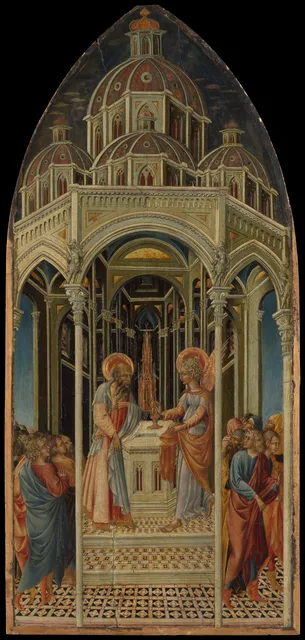 The Annunciation to Zacharias; (verso) The Angel of the AnnunciationGiovanni di Paoloca. 1455–60
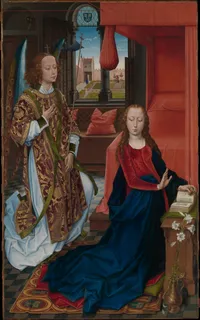 The AnnunciationHans Memlingca. 1465–70
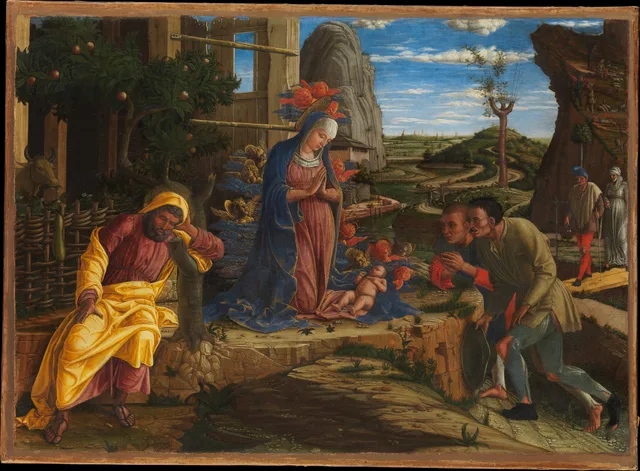 The Adoration of the ShepherdsAndrea Mantegnashortly after 1450
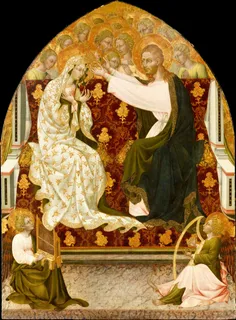 Coronation of the VirginGiovanni di Paoloca. 1455
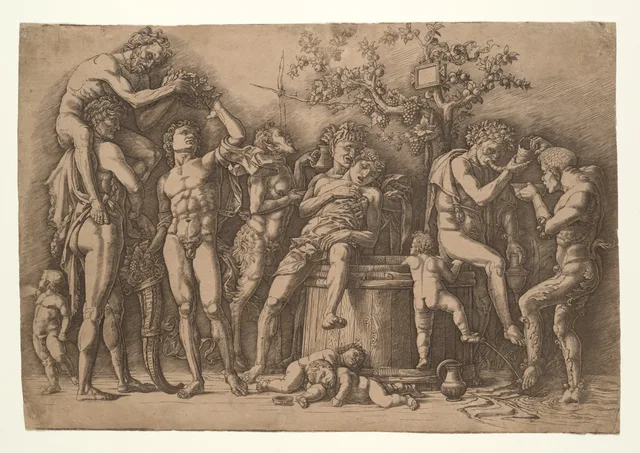 Bacchanal with a Wine VatAndrea MantegnaBefore 1475
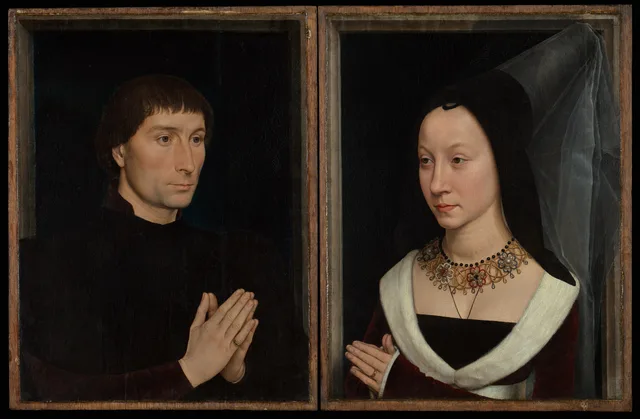 Tommaso di Folco Portinari (1428–1501); Maria Portinari (Maria Maddalena Baroncelli, born 1456)Hans Memlingca. 1470
Too good to keep to yourself
This painting,
for someone who comes to mind
They open it at full size
and see every brushstroke.
About this work
- Artist
- Rogier van der Weyden · 1399–1464
- Date
- ca. 1460
- Medium
- Oil on wood
- Size
- 31.8 × 22.2 cm
- Collection
- The Metropolitan Museum of Art
- Image
- Original long edge 4000px · shown at 2560px
- Original
- View on the museum's website ↗