 Pyeongye
Artwork · 17th century · Bartolomé Estebán Murillo
LeoTurn on Magnifier at the lower right and move slowly across the painting.
Full screen opens it edge to edge.Tap the painting to fill the screen.
Spread two fingers to look closer.
At a glance
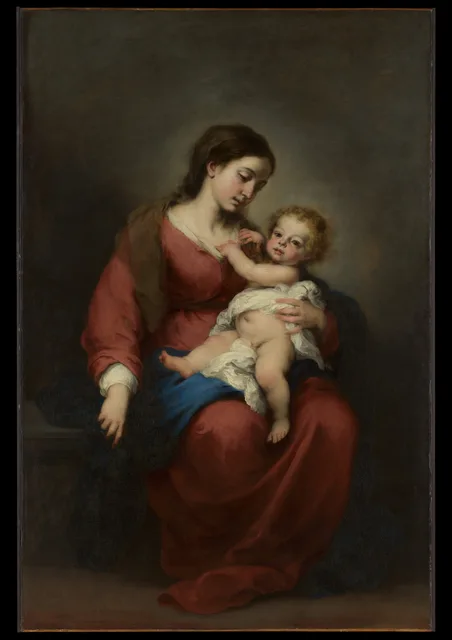
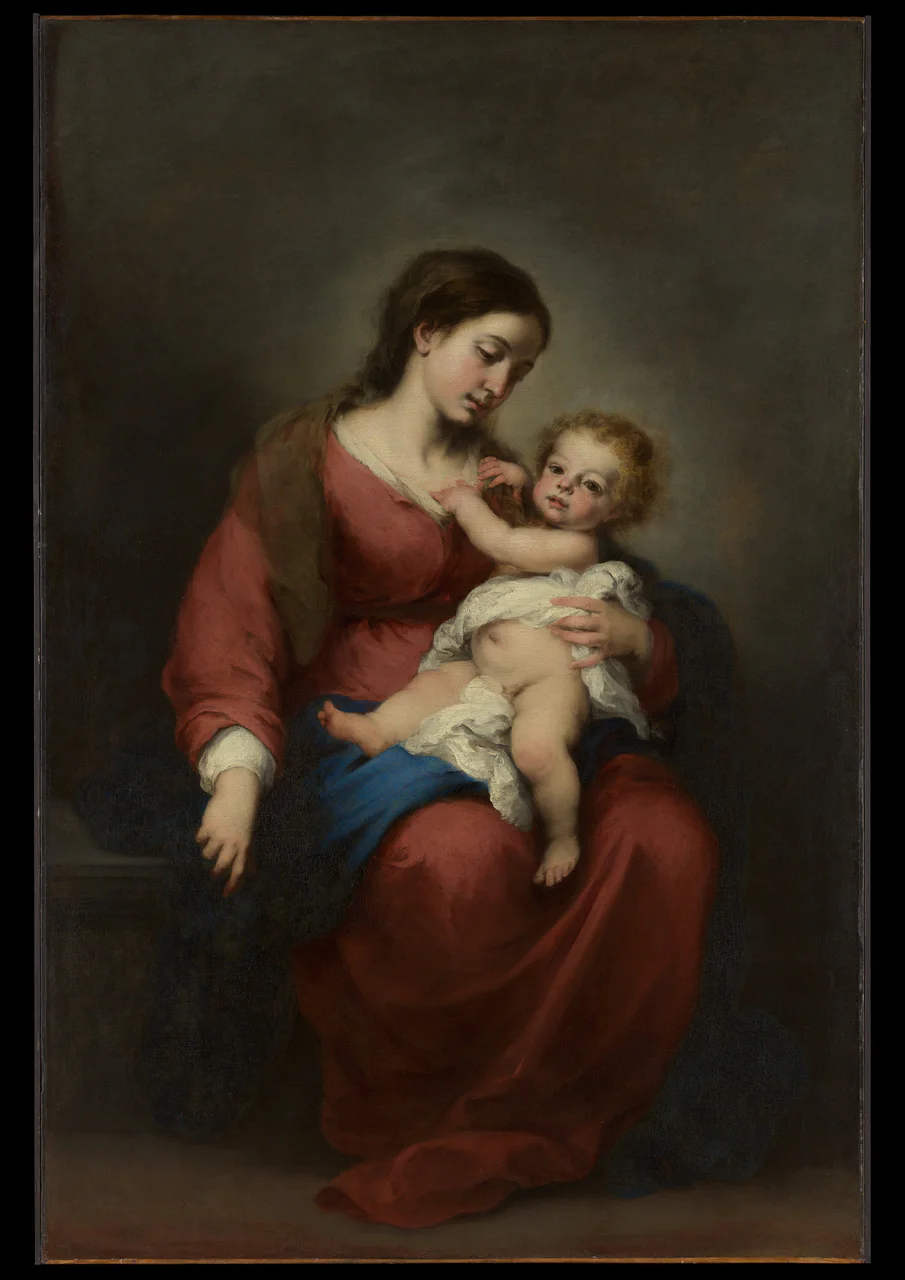
- Against a dark background, the Virgin Mary sits with the Christ Child seated on her lap, one arm wrapped around him as she looks down.
- Bartolomé Estebán Murillo, a painter from Seville in Spain, made it in the 1670s.
- The canvas is over five feet tall, yet it feels less like a solemn holy scene and more like an ordinary moment between a mother and her baby.
Reading the picture
5 places to look closer
Tap a number on the painting to jump to its note, or a close-up to see that spot in the whole picture.
Start by zooming in on Mary's face. Her eyes are lowered toward the child, and the faintest smile sits at the corner of her mouth. A soft pink glows on her cheeks and nose. Murillo did not draw hard outlines here. He blended the skin softly, as if it were melting into the shadow.
Now look at the baby. He has curly golden hair and round eyes, and he stares straight out at us. With one hand he grips the cloth at his mother's neck. It is exactly what a toddler does when a stranger appears: hold on tight and watch.
Look at Mary's hand supporting the baby's side. A white cloth is bunched between her fingers. Murillo painted its folds quickly, with dabs of white and gray. Up close, you can still see each brushstroke.
Move to Mary's other hand at the lower left. It hangs down loosely, completely relaxed. Its fingertips are painted so softly that they seem to dissolve into the dark. One hand holds the child firmly while the other rests.
Zoom in on the baby's foot. Below his chubby toes, Mary's red dress spreads out wide, with a blue mantle draped over it. Red and blue were the colors painters most often used for the Virgin's clothing.
When it was painted
By the 1670s, Murillo was in his fifties and a well-known painter in Seville. Getting there had not been easy. Born in Seville in 1617, he was the youngest of fourteen children. He lost his father when he was about ten and his mother the next year, and he grew up in the home of an older sister.
He trained with the painter Juan del Castillo. In 1645 he married Beatriz Cabrera, and they had a number of children, but several died young. In 1649 a plague swept through Seville and killed close to half the city's people. In 1663 his wife died too.
Still, he kept working. In 1660 he helped found an academy in Seville where painters could practice drawing together. From about 1667 he painted a series of large canvases on works of mercy for the church of the Hospital de la Caridad, a charity led by the nobleman Miguel Mañara.
The end came suddenly. In 1682, while painting an altarpiece for the Capuchin church in Cádiz, he fell from the scaffolding, and he died in Seville that same year. More than two and a half centuries later, in 1943, The Met bought this Virgin and Child through its Rogers Fund.
Look again at the baby's chubby feet and rosy cheeks. Painted by a father who had buried several of his own children, this child sits healthy and solid on his mother's lap, looking right back at us.
Questions to think about
- Look for itCan you find what the baby is holding on to so tightly with one hand?
- Why?Why do you think Murillo had the child look out at us instead of at his mother?
- What about you?Here Mary holds the baby with one hand and lets the other rest for a moment. Do people raising children today get that kind of moment to rest?
Same period
Painted around the same time,
somewhere else
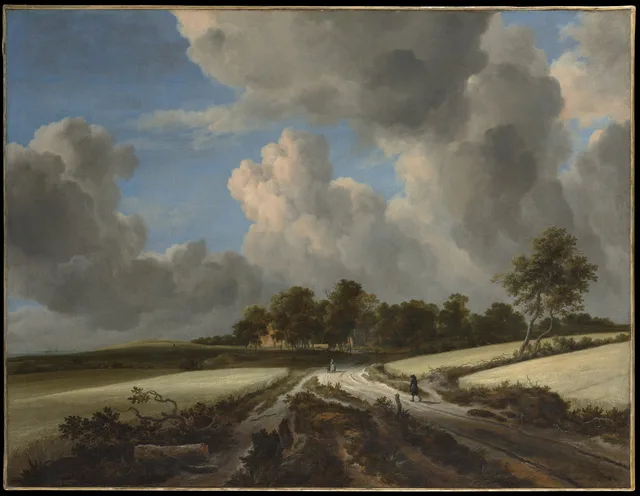 Wheat FieldsJacob van Ruisdaelca. 1670
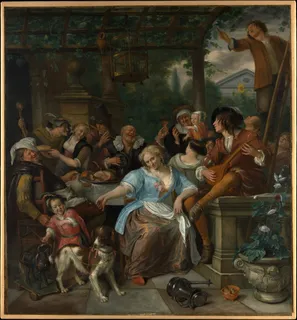 Merry Company on a TerraceJan Steenca. 1670
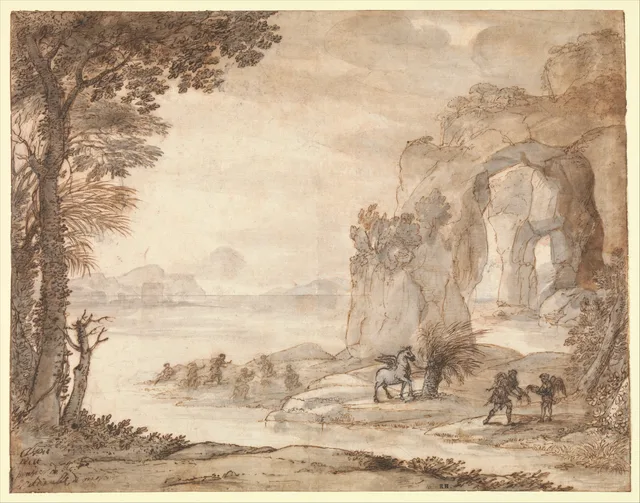 Perseus and the Origin of CoralClaude Lorrainca. 1671
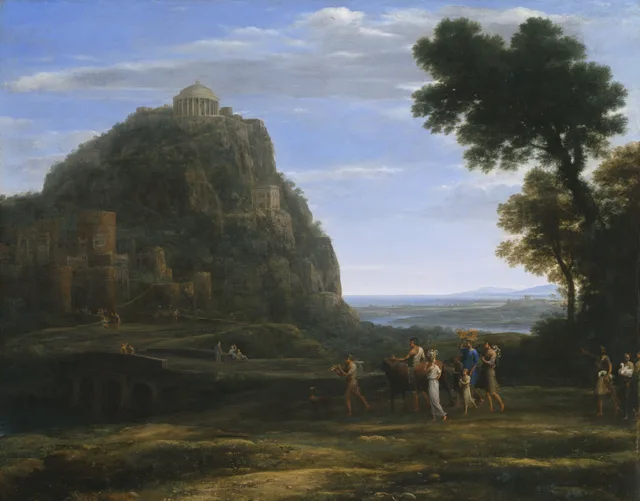 View of Delphi with a ProcessionClaude Lorrain1673
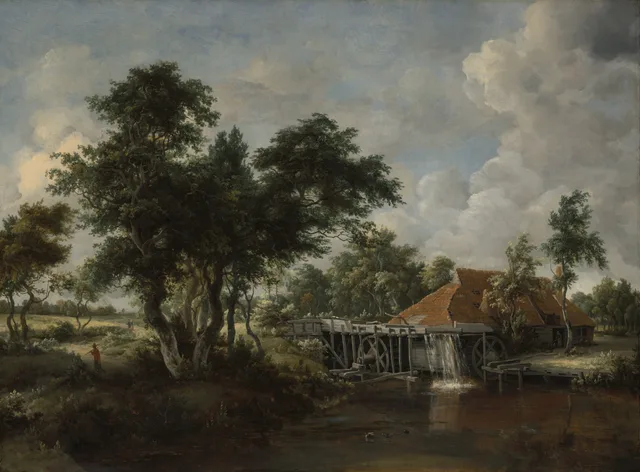 The Watermill with the Great Red RoofMeindert Hobbemac. 1665
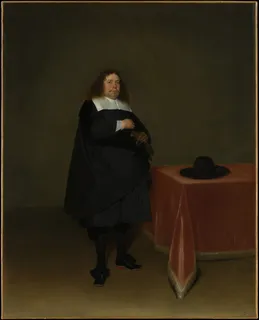 Burgomaster Jan van Duren (1613–1687)Gerard ter Borch the Youngerca. 1666–67
Too good to keep to yourself
This painting,
for someone who comes to mind
They open it at full size
and see every brushstroke.
About this work
- Artist
- Bartolomé Estebán Murillo · 1617–1682
- Date
- 1670s
- Medium
- Oil on canvas
- Size
- 165.7 × 109.2 cm
- Collection
- The Metropolitan Museum of Art
- Image
- Original long edge 4000px · shown at 2560px
- Original
- View on the museum's website ↗