 Pyeongye
Artwork · 17th century · Jacob van Ruisdael
LeoTurn on Magnifier at the lower right and move slowly across the painting.
Full screen opens it edge to edge.Tap the painting to fill the screen.
Spread two fingers to look closer.
At a glance
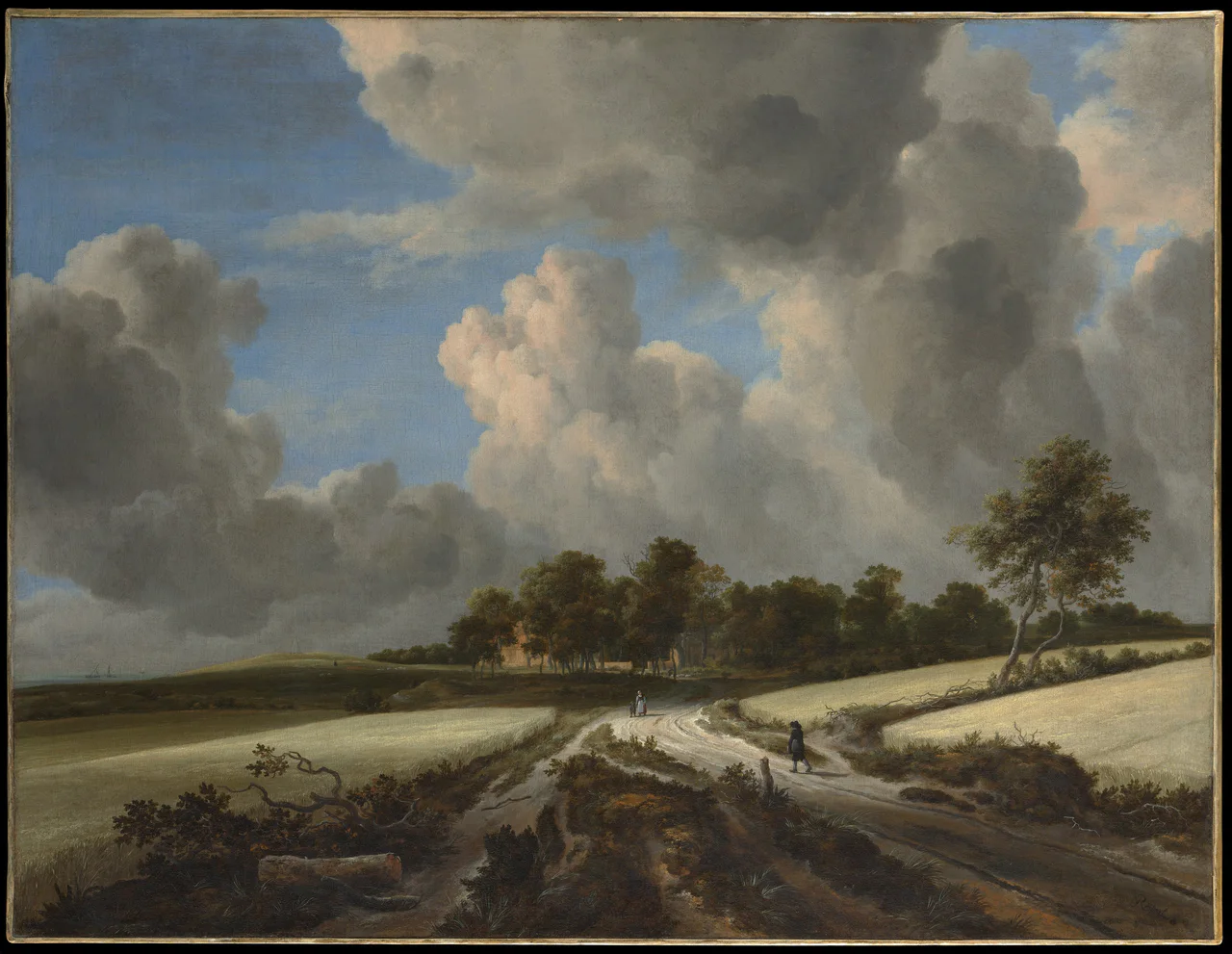
- A sandy road splits between ripe wheat fields, and enormous clouds pile up over the Dutch countryside.
- Jacob van Ruisdael painted it in oil on canvas around 1670.
- About two thirds of the canvas is sky. The land sits low, and the clouds take over as the main subject.
Reading the picture
5 places to look closer
Tap a number on the painting to jump to its note, or a close-up to see that spot in the whole picture.
Start with the big white cloud in the middle of the sky. The side catching the sun glows a warm peach, and the underside turns heavy and gray. Ruisdael built it from rounded puffs stacked on top of each other, so it has real bulk. On the right, darker clouds are moving in.
Look past the fork in the road. A woman in a white apron walks toward us, holding a small child by the hand. They are tiny, yet they still cast a shadow. Those two figures tell you how wide and dusty the road is.
Now follow the right-hand road. A man in a black hat is walking away, carrying what looks like a sack. A long shadow stretches out beside him. A broken post stands at the edge of the road.
Go to the far left edge of the horizon. Beyond a low ridge lies a gray strip of sea, with a few sailboats on it. The wheat grows almost within sight of the water.
Look at the tree on the right. Two thin trunks bend upward, leaning on each other. Touches of orange flicker among the leaves. Set against the dark clouds, it looks like the one thing in the picture standing up to the wind.
When it was painted
Around 1670, Ruisdael was in his early forties. He had grown up in Haarlem, but by now he had lived in Amsterdam for more than ten years. In a crowded port city full of ships and merchants, he kept painting quiet fields under enormous skies.
Painting ran in the family. His father, Isaack, made picture frames and painted too. His uncle, Salomon van Ruysdael, was a well-known landscape painter. Jacob joined the Haarlem painters' guild in 1648, when he was about twenty. Later, in Amsterdam, a young Meindert Hobbema came to study with him.
Ruisdael's life has a few loose threads. Arnold Houbraken, who wrote lives of Dutch painters in the early 1700s, claimed that Ruisdael also worked as a surgeon in Amsterdam. An Amsterdam register does list a Jacobus Ruijsdael who earned a medical degree in Caen, France, in 1676. But the name is crossed out, and no one can say for sure that it is the painter.
Another story stuck to him for centuries: that he died poor in the Haarlem almshouse. Later researchers went back to the records. The man who died there was his cousin, Jacob Salomonsz van Ruysdael, whose name was almost the same. The painter was buried in Haarlem's St. Bavo's Church in March 1682.
This canvas crossed the Atlantic in the early twentieth century. Benjamin Altman, the New York department store owner, bought it in 1909. When he died in 1913, he left it to the Metropolitan Museum.
Now go back to the road. A few tiny people walk through the wheat, and above them a city painter piled up clouds like mountains.
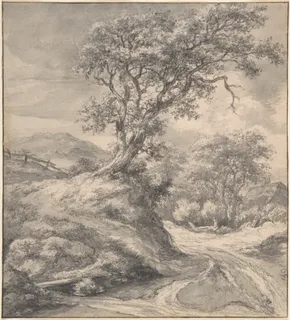
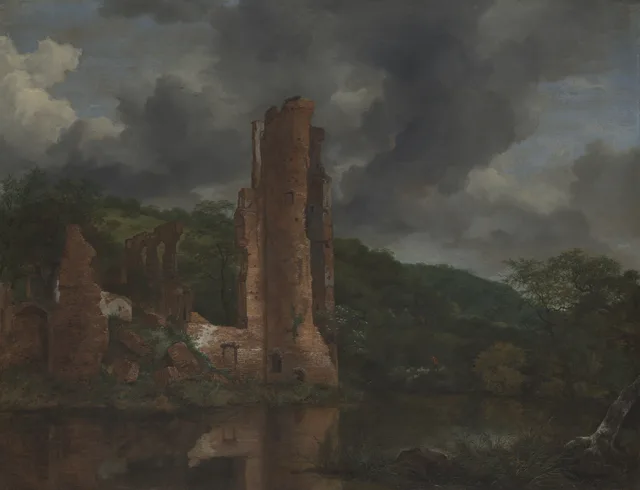
More by the same painter
Questions to think about
- Look for itCan you find the painter's faint signature on the ground at the lower right?
- Why?Why do you think Ruisdael kept the land so low and gave so much room to the sky?
- What about you?Most of us rarely look up at the sky anymore, so when was the last time you watched clouds for a while instead of a screen?
Same period
Painted around the same time,
somewhere else
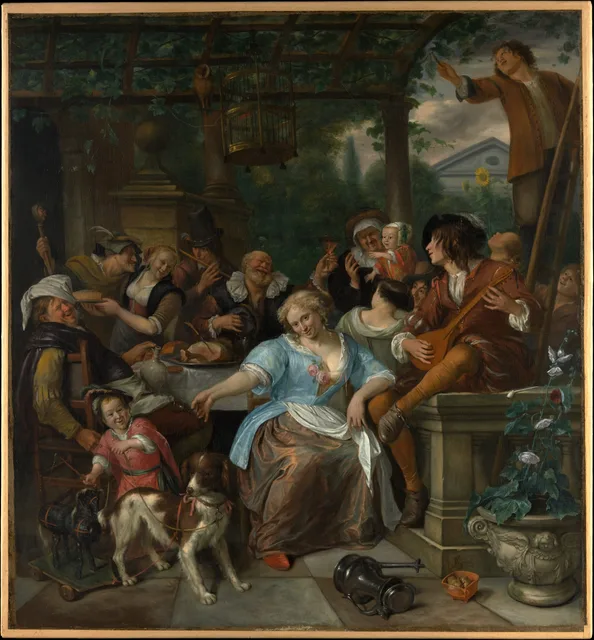 Merry Company on a TerraceJan Steenca. 1670
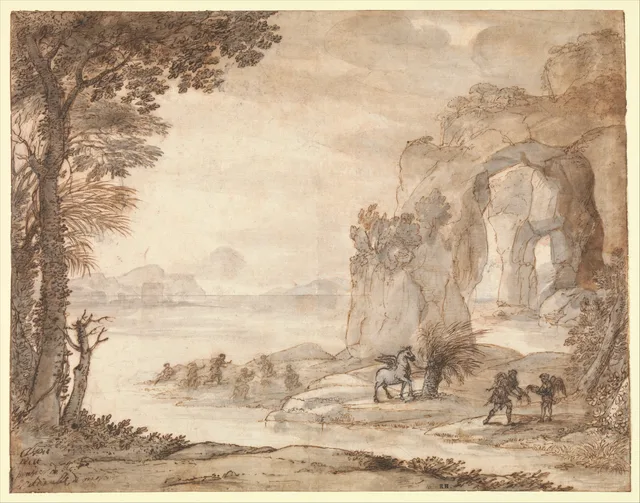 Perseus and the Origin of CoralClaude Lorrainca. 1671
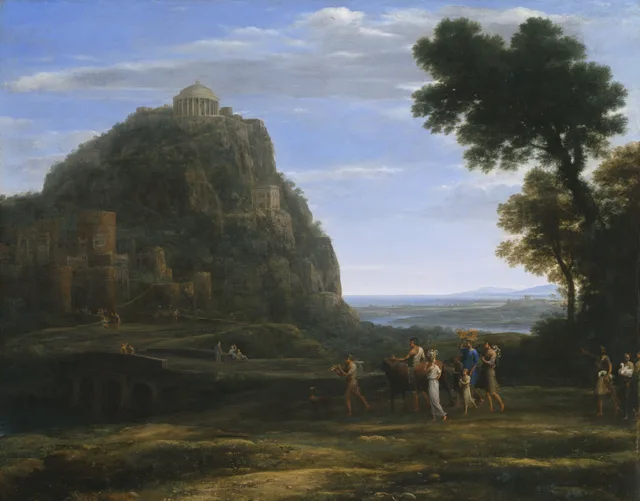 View of Delphi with a ProcessionClaude Lorrain1673
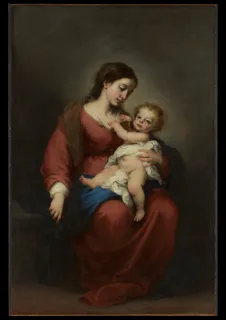 Virgin and ChildBartolomé Estebán Murillo1670s
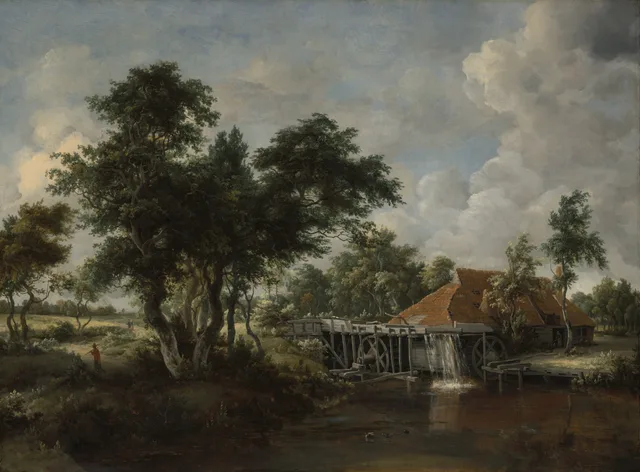 The Watermill with the Great Red RoofMeindert Hobbemac. 1665
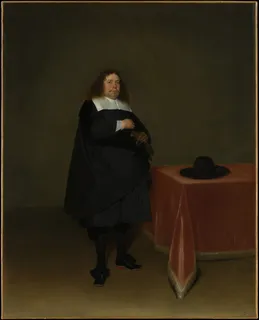 Burgomaster Jan van Duren (1613–1687)Gerard ter Borch the Youngerca. 1666–67
Too good to keep to yourself
This painting,
for someone who comes to mind
They open it at full size
and see every brushstroke.
About this work
- Artist
- Jacob van Ruisdael · 1628–1682
- Date
- ca. 1670
- Medium
- Oil on canvas
- Size
- 100 × 130.2 cm
- Collection
- The Metropolitan Museum of Art
- Image
- Original long edge 3811px · shown at 2560px
- Original
- View on the museum's website ↗