 Pyeongye
Artwork · 17th century · Gerard ter Borch the Younger
LeoTurn on Magnifier at the lower right and move slowly across the painting.
Full screen opens it edge to edge.Tap the painting to fill the screen.
Spread two fingers to look closer.
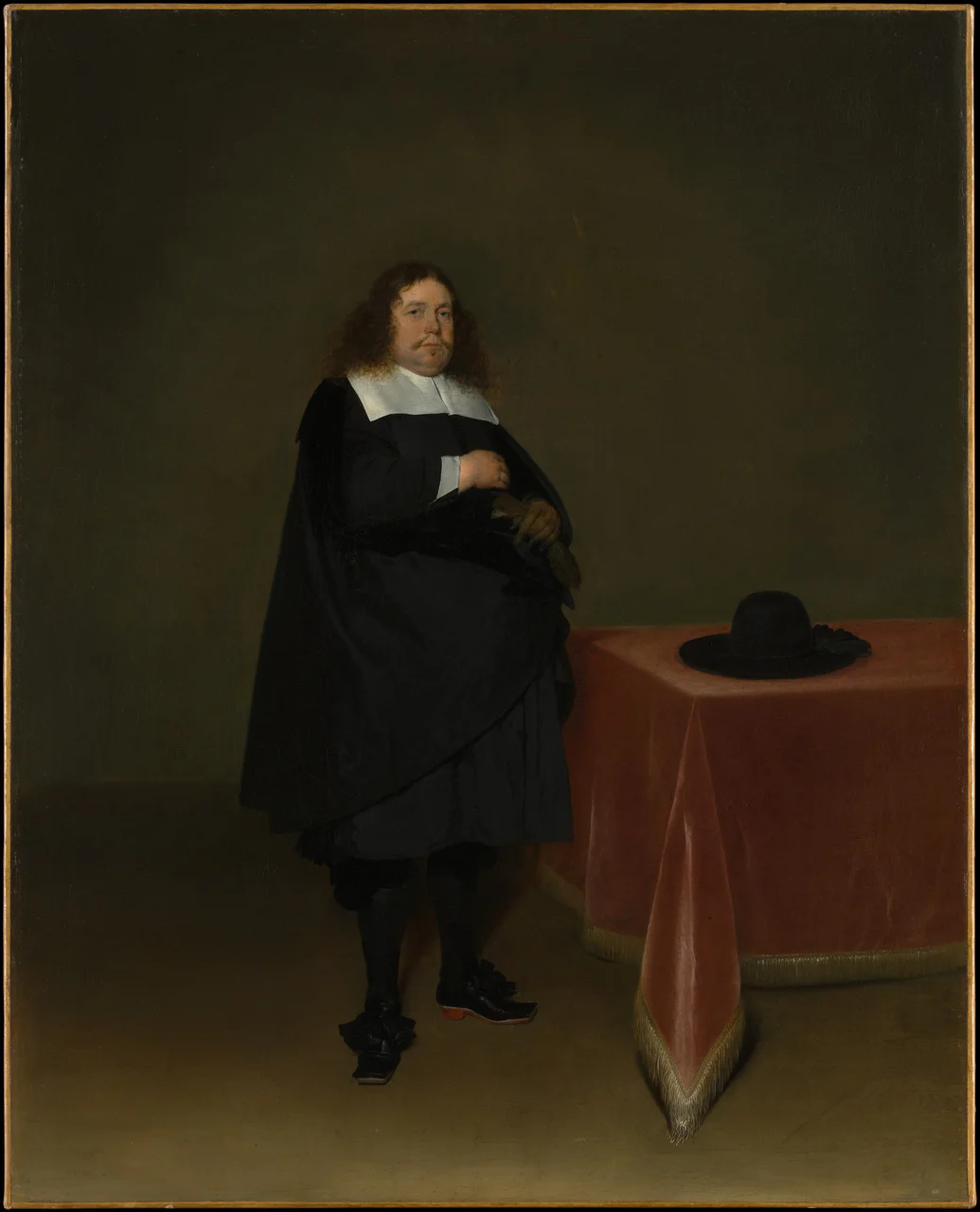
Burgomaster Jan van Duren (1613–1687)
Gerard ter Borch the Youngerca. 1666–67Oil on canvas81.5 × 65.5 cm
At a glance
- Jan van Duren, a burgomaster in black with a white collar, stands alone in a bare room and looks straight at us.
- The Dutch painter Gerard ter Borch painted this full-length portrait in oil on canvas around 1666–67.
- Apart from the man, there is just a red table and a hat. The way those two catch the light is the quiet star of the picture.
Reading the picture
5 places to look closer
Tap a number on the painting to jump to its note, or a close-up to see that spot in the whole picture.
Start with the face. Long curly hair falls to his shoulders. He has a thin mustache and a small tuft under his lip. His eyelids droop a little, and his mouth is set firm. He was born in 1613, so here he is in his early fifties.
Now the hands at his chest. One is bare and rests on his black cloak. The other still wears a glove and holds the glove he has already taken off. A single white cuff peeks out from all that black. Look closely: the black of the cloak and the black of the coat are not quite the same.
Turn to the hat on the table at the right. It is black and wide-brimmed, with a dark trim bunched at one side. It sits there as if he has only just put it down. Beneath it, the red tablecloth rolls over the edge of the table.
Follow the tablecloth down to its pointed corner. A streak of pale light runs down the fold, and a fine golden fringe hangs from the edge. Below it, the fringe casts a shadow on the floor. Ter Borch was famous for exactly this: the shine and weight of fabric in light.
Last, look at his feet. His square-toed black shoes carry big ribbon bows. On the right shoe you can spot a red heel. In such a sober outfit, those shoes hint that he cared quite a bit about how he looked.
When it was painted
In 1666, Gerard ter Borch was nearing fifty, and he took on a new job. He became a member of the town council of Deventer, a city in the east of the Netherlands. He sat as the representative of one of the city's wards, and he kept the seat until he died. The painter was now one of the people who ran the town.
Deventer had been his home since 1654, when he married and settled there. Over the years he painted many of its leading citizens. Jan van Duren was one of them. The Met describes Van Duren and his wife, like the artist himself, as prominent citizens of Deventer.
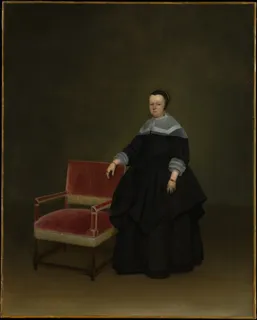
Van Duren ordered this portrait himself. He also asked for a matching portrait of his wife, Margaretha van Haexbergen, so the two could hang as a pair. The Met ranks the couple among the most important works by ter Borch in any American collection. Margaretha's portrait is on this site too, so try looking at them side by side.
These were also sad years for the painter's family. In 1667 his youngest half-brother, Moses, was killed in the war with England. Gerard and his half-sister Gesina painted a full-length portrait in Moses's memory. Gerard painted his brother's likeness, and Gesina painted the background and the objects around him. That picture now hangs in the Rijksmuseum in Amsterdam.
Van Duren's portrait stayed in his family for generations, passing first to his son Damiaan. In 1912 the American banker Philip Lehman bought it. It came to the Met in 1975 with the collection of his son, Robert Lehman.
Now look again. A painter who had just joined the town council is painting one of the town's burgomasters. Picture this lone man in his bare room hanging beside his wife, just as the pair was meant to be seen.
More by the same painter
Questions to think about
- Look for itWhat is each of Jan van Duren's hands doing?
- Why?Why do you think ter Borch left most of the room empty, with only a table and a hat?
- What about you?If a mayor today had an official photo taken, what clothes and objects would make people trust them?
Same period
Painted around the same time,
somewhere else
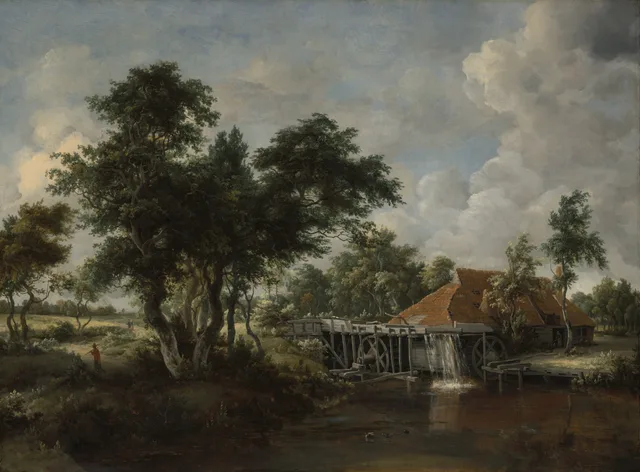 The Watermill with the Great Red RoofMeindert Hobbemac. 1665
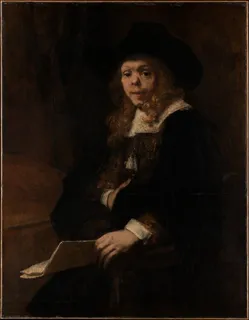 Portrait of Gerard de LairesseRembrandt1665–67
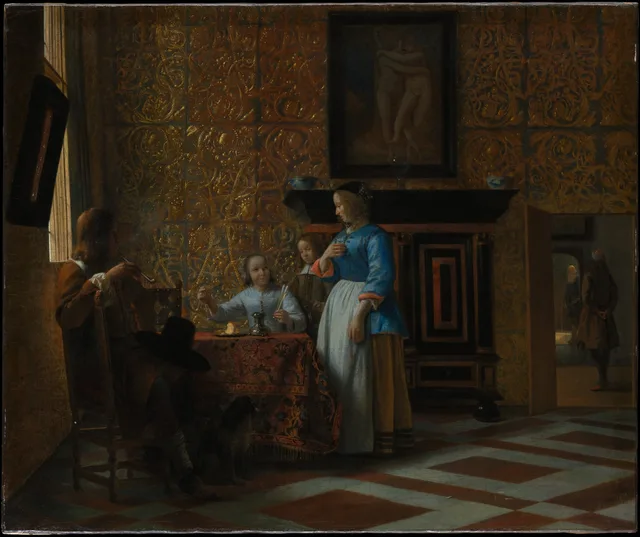 Leisure Time in an Elegant SettingPieter de Hoochca. 1663–65
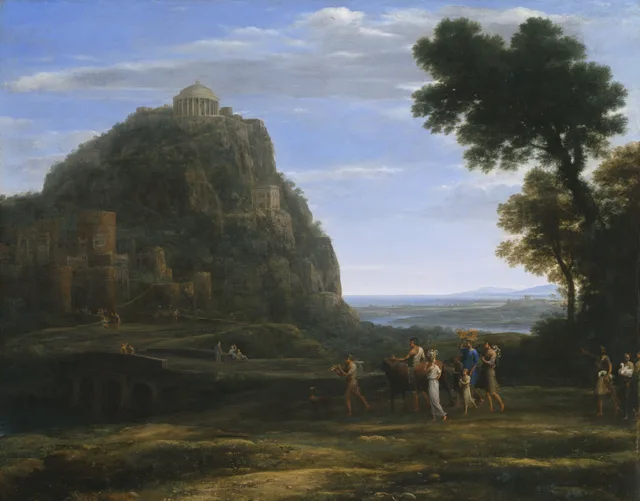 View of Delphi with a ProcessionClaude Lorrain1673
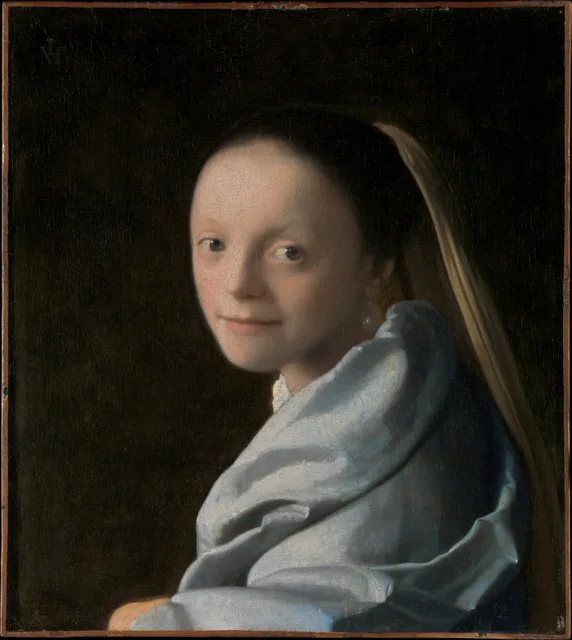 Study of a Young WomanJohannes Vermeerca. 1665–67
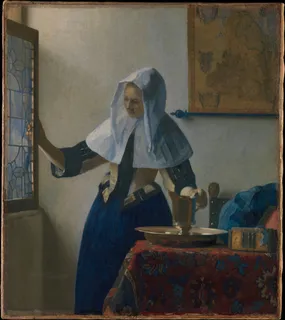 Young Woman with a Water PitcherJohannes Vermeerca. 1662
Too good to keep to yourself
This painting,
for someone who comes to mind
They open it at full size
and see every brushstroke.
About this work
- Artist
- Gerard ter Borch the Younger · 1617–1681
- Date
- ca. 1666–67
- Medium
- Oil on canvas
- Size
- 81.5 × 65.5 cm
- Collection
- The Metropolitan Museum of Art
- Image
- Original long edge 3719px · shown at 2560px
- Original
- View on the museum's website ↗