 Pyeongye
Artwork · 19th century · John Henry Twachtman
LeoTurn on Magnifier at the lower right and move slowly across the painting.
Full screen opens it edge to edge.Tap the painting to fill the screen.
Spread two fingers to look closer.
At a glance
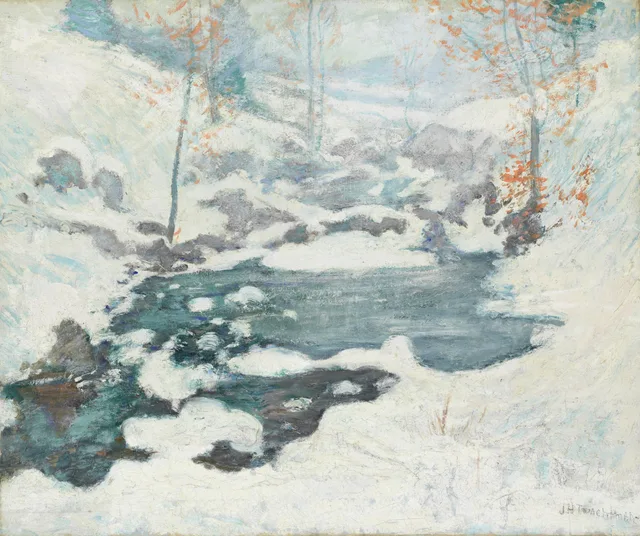
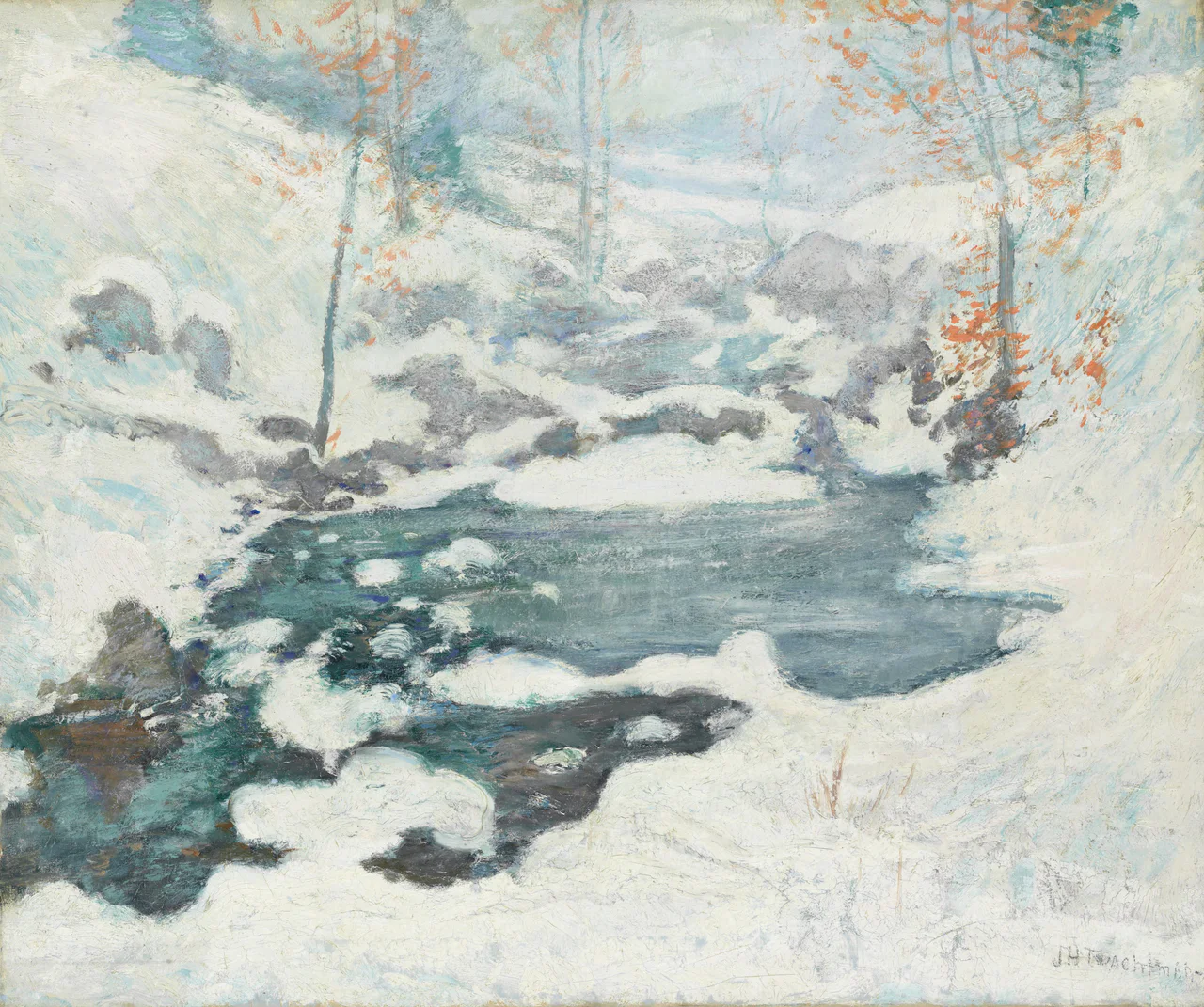
- A half-frozen stream winds between snowy banks on a quiet winter day.
- The American painter John Henry Twachtman painted it around 1889, near his home in Greenwich, Connecticut.
- Using little more than white and blue-green, he separates snow, ice, and open water with the brush alone.
Reading the picture
5 places to look closer
Tap a number on the painting to jump to its note, or a close-up to see that spot in the whole picture.
Zoom into the tree at the upper right. Dabs of orange cling around its gray trunk. On this almost white canvas, these leaves are nearly the only warm color. Dry leaves that held on into winter glow in the snow like embers.
Look at the water left of center. Rounded mounds of white paint float there, laid on in curling strokes. They could be snow piled on hidden rocks, or water swirling past them. In this still scene, those curves give the eye something moving.
Now go down to the dark water at the lower left. Brown shows through the blue-green. It feels as if you can see stones and mud on the bottom where the stream has not frozen. The paint is layered and dragged, so the water looks deep and cold.
Zoom into the snowfield at the lower right. A few stalks of dry grass poke up as brown strokes. The snow around them is not plain white. Pale blue and gray are mixed into it.
Look into the bottom right corner. A thin signature, J. H. Twachtman, runs across the snow.
When it was painted
Around 1889 Twachtman was thirty-six. Born in Cincinnati, he had trained in Munich and Paris and was now settling near New York. He found a home on rural land in Greenwich, Connecticut. For the rest of his life, a little over a decade, he painted the land around that house again and again.
He lived there with his wife, Martha, and their children. Paintings alone did not pay the bills, so he taught at the Art Students League in New York. Between classes he came back to the same stream and the same hillsides and looked at them once more.
Twachtman loved snow above all. In a letter to a friend he wrote that nature is never lovelier than when it is snowing. Winter was often painted as bleak, but he saw frozen ground as a time for quiet thought and renewal.
His close friend was the painter J. Alden Weir, who also kept a farm in Connecticut. The two stayed near each other for years. In 1897 they joined other artists to form a group known as the Ten American Painters, which held its own exhibitions.
Twachtman died in 1902 in Gloucester, Massachusetts, at forty-nine. Fifteen years later, in 1917, this picture entered the Art Institute of Chicago.
Look again at the white swirls on the stream. The stream he painted again and again near his house is not fully frozen. It is still breathing under the snow.
Questions to think about
- Look for itHow many colors that are not white can you find in this snowy scene?
- Why?Why do you think Twachtman kept painting the stream by his own house instead of famous faraway views?
- What about you?He saw winter not as a sad season but as time to rest and think. In a life that always seems busy, when do you get a winter-like pause of your own?
Same period
Painted around the same time,
somewhere else
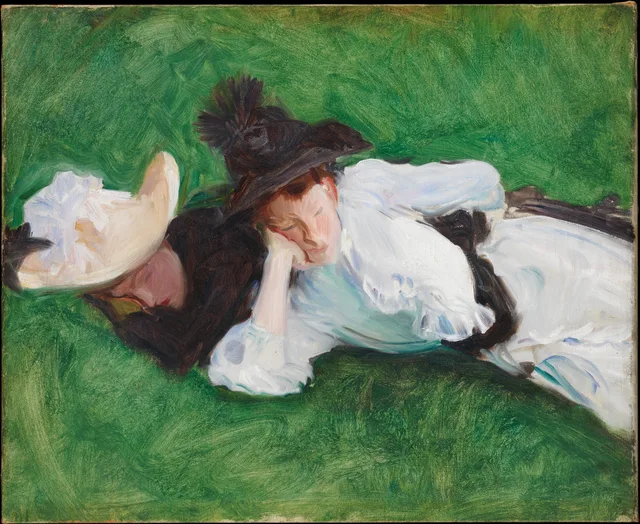 Two Girls on a LawnJohn Singer Sargentca. 1889
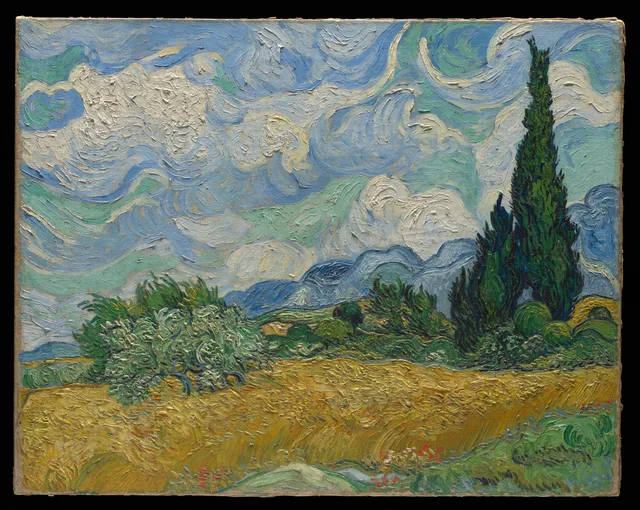 Wheat Field with CypressesVincent van Gogh1889
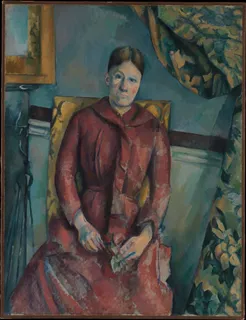 Madame Cézanne (Hortense Fiquet, 1850–1922) in a Red DressPaul Cézanne1888–90
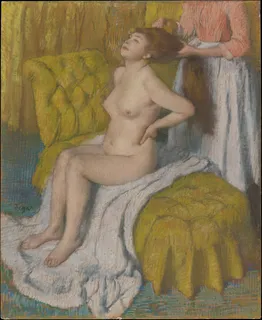 Woman Having Her Hair CombedEdgar Degasca. 1886–88
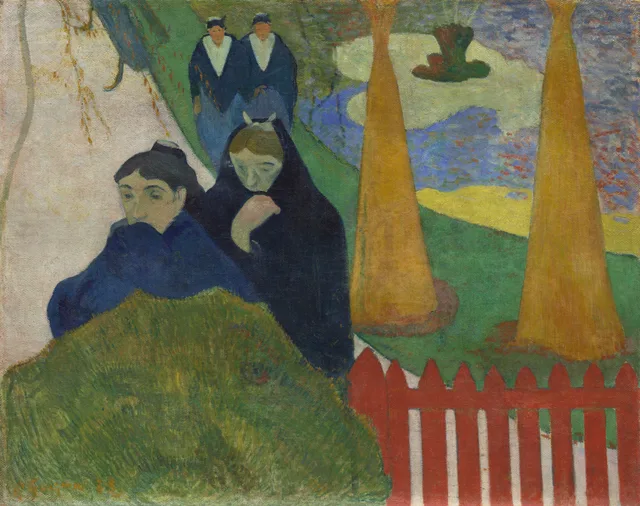 Arlésiennes (Mistral)Paul Gauguin1888
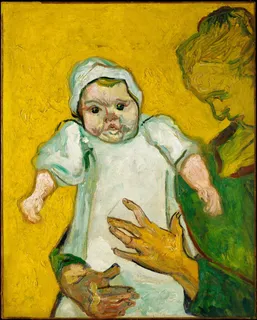 Madame Roulin and Her BabyVincent van Gogh1888
Too good to keep to yourself
This painting,
for someone who comes to mind
They open it at full size
and see every brushstroke.
About this work
- Artist
- John Henry Twachtman · 1853–1902
- Date
- c. 1889
- Medium
- Oil on canvas
- Size
- 64.2 × 76.6 cm
- Culture
- Greenwich
- Collection
- The Art Institute of Chicago
- Image
- Original long edge 4707px · shown at 2560px
- Original
- View on the museum's website ↗