 Pyeongye
Artwork · 19th century · Edgar Degas
LeoTurn on Magnifier at the lower right and move slowly across the painting.
Full screen opens it edge to edge.Tap the painting to fill the screen.
Spread two fingers to look closer.
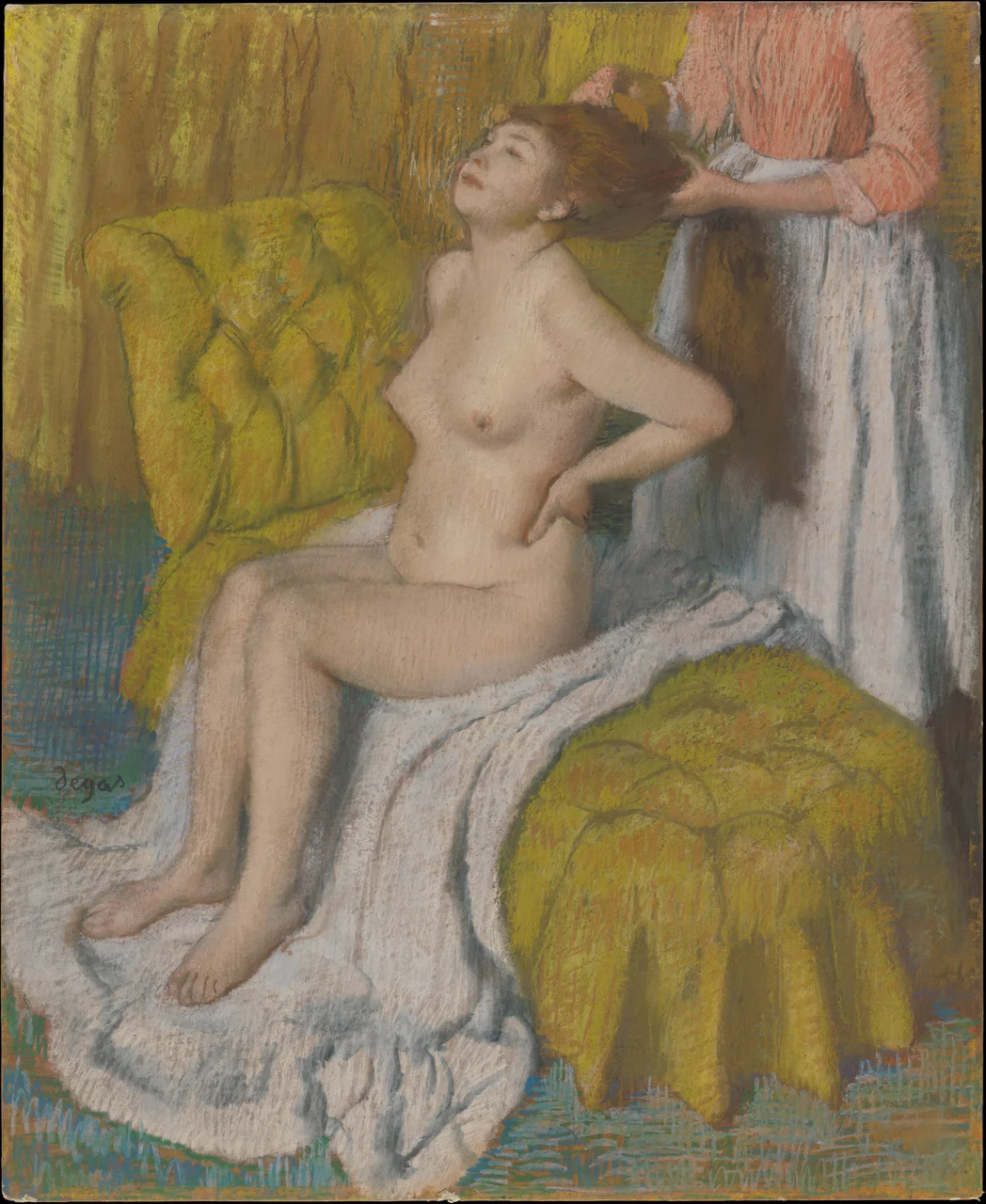
Woman Having Her Hair Combed
Edgar Degasca. 1886–88Pastel on light green wove paper, now discolored to warm gray, affixed to original pulpboard mount74 × 60.6 cm
At a glance
- A woman sits on a white sheet with her head tipped back while a maid standing behind her combs her hair.
- Edgar Degas made it in pastel on paper around 1886 to 1888.
- It catches an ordinary, private moment, built up from layer after layer of yellow, pink, and green pastel strokes.
Reading the picture
5 places to look closer
Tap a number on the painting to jump to its note, or a close-up to see that spot in the whole picture.
Zoom in on the hair at the top. The woman's eyes are closed and her chin is lifted, while the maid's hand grips a thick hank of reddish-brown hair. Just above that hand is a small yellow object that looks like a grooming tool. You can almost feel the pull of the comb in the way her head tilts back.
Look at the maid in the upper right. She wears a pink blouse and a white apron, but her face is cut off by the top edge of the picture. So our eyes go to her working hands rather than to who she is. Even the white apron is not one flat color. It is made of many fine vertical lines.
Zoom in on the round, padded footstool at the lower right. Orange and brown strokes rain down at a slant across a yellow base. The tufted seams are marked with only a few dark curves. You can see how fast the pastel stick was dragged across the paper.
Now look at the white sheet under the woman's foot. Gray and blue lines are mixed into the white to make the folds. On the floor below, green and blue strokes shoot upward like blades of grass. Degas does not draw this white cloth with white alone.
At the left edge, on the green floor, you will find the word Degas in black. That is the artist's signature.
When it was painted
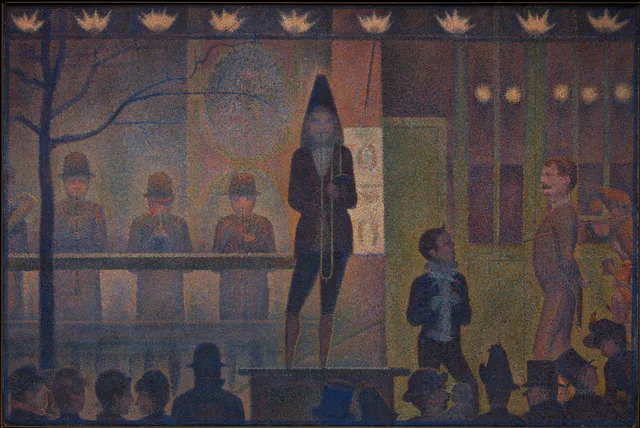
Picture Degas in the spring of 1886. He is fifty-one, and the Impressionists are about to open their eighth group show in Paris. It turns out to be their last. In the same rooms hangs a huge new canvas by the young Georges Seurat, A Sunday on La Grande Jatte.
Degas sent in a whole group of pastels of women. The catalogue described them as a series of nudes of women bathing, washing, drying and wiping themselves, combing their hair, or having it combed. That last phrase is exactly the scene in front of you.
The Met thinks this pastel may have been meant for that show. It is the only pastel of this subject that Degas made in the mid-1880s. By then he was reaching for pastel far more often than oil paint. With pastel he did not have to wait for anything to dry. He could lay one line over another right away.
Later the picture crossed the Atlantic to New York, to the collectors Louisine and Henry Havemeyer. The person who urged Louisine to buy Degas was the painter Mary Cassatt, his longtime friend. When Louisine died, she left much of her collection to the Metropolitan Museum, and this pastel arrived there in 1929.
Now look again at the paper showing between the strokes. The museum's records say it started out light green. Over the years it has turned the warm gray you see today, a quiet sign of how long this moment has lasted.
Questions to think about
- Look for itCan you find the small yellow object just above the maid's hand?
- Why?Why do you think Degas cut the maid's face out of the picture?
- What about you?The maid in this picture is all hands and no face. Today, how well do we know the faces and names of the people whose job is to take care of others?
Same period
Painted around the same time,
somewhere else
Too good to keep to yourself
This painting,
for someone who comes to mind
They open it at full size
and see every brushstroke.
About this work
- Artist
- Edgar Degas · 1834–1917
- Date
- ca. 1886–88
- Medium
- Pastel on light green wove paper, now discolored to warm gray, affixed to original pulpboard mount
- Size
- 74 × 60.6 cm
- Collection
- The Metropolitan Museum of Art
- Image
- Original long edge 3865px · shown at 2560px
- Original
- View on the museum's website ↗