 Pyeongye
Artwork · 19th century · Paul Gauguin
LeoTurn on Magnifier at the lower right and move slowly across the painting.
Full screen opens it edge to edge.Tap the painting to fill the screen.
Spread two fingers to look closer.
At a glance
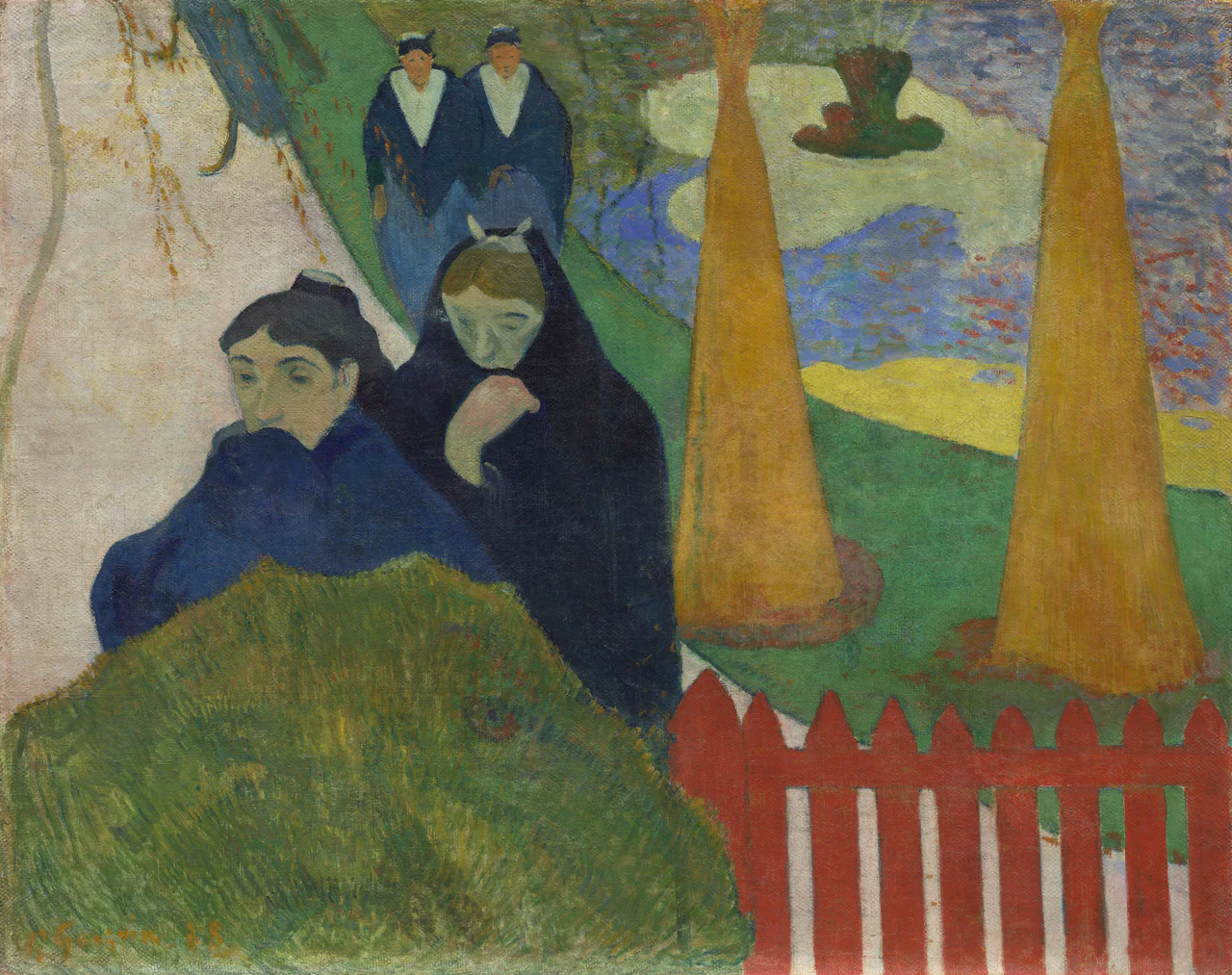
- Four women of Arles wrapped in dark shawls file through a public garden, beside two tall yellow cones and a bright red fence.
- Paul Gauguin painted it in 1888, during the two months he spent living with Vincent van Gogh in Arles, in the south of France.
- The garden was right across the street from the house the two painters shared, and a strange face hides in the bush in front.
Reading the picture
5 places to look closer
Tap a number on the painting to jump to its note, or a close-up to see that spot in the whole picture.
Zoom in on the face of the woman in front. She has pulled her deep blue shawl up over her mouth, and her eyes are cast down. Her skin is a greenish yellow. The Art Institute of Chicago explains that the two nearest women are covering their mouths against the freezing air.
Look up to the top of the picture at the two women coming behind. Each wears a white shawl folded into a V and a dark cap, and they look almost identical. Their faces are simple orange ovals with a few dots for features. They walk side by side like two figures cut from the same pattern.
Find the big yellow cone on the right. The museum suggests these were straw covers put over plants to protect them from frost. Gauguin painted them as flat yellow shapes, with almost no sense of volume. Stare for a moment and they start to look like tall, silent people.
Zoom in on the large green bush in the foreground. Look for a dark dot ringed in red, shaped like an eye. The museum says Gauguin painted a face into this bush on purpose. Once you find it, the bush seems to be watching.
Look at the red fence in the lower right. Its pointed pickets stand close together and block the path the women are walking. White ground shows between them in stripes. You can also see the rough weave of the canvas showing through the paint.
When it was painted
At the end of October 1888, Gauguin, then forty, stepped off the train in Arles. Van Gogh had been urging him for months to come south and help start a studio for artists. Van Gogh's brother Theo, an art dealer, agreed to support Gauguin in exchange for paintings, and that made the move possible. To welcome his guest, Vincent hung paintings of sunflowers in the room Gauguin would use.
The two men ate and worked together in the Yellow House. Gauguin bought a roll of coarse jute, and they cut it up and shared it. This painting is on that jute. Gauguin pushed Van Gogh to paint from memory and imagination rather than straight from what was in front of him.
But the friendship grew tense. The Art Institute calls their stay together a troubled two months. On the night of December 23, Van Gogh suffered a severe breakdown and cut off part of his own ear. Gauguin left for Paris a few days later, and the two never saw each other again.
Gauguin finished seventeen canvases during his weeks in Arles. This one entered the Art Institute of Chicago in 1934. In 2001 it hung beside Van Gogh's paintings in an exhibition about the two artists' time in the south.
Go back and find the eye in the bush. While the women bow their heads against the wind, something in the garden is quietly watching them.
The painter
Paul Gauguin
1848–1903
When painting this, the artist was about 40 years old
All paintings by Paul Gauguin →
Questions to think about
- Look for itHow many of the women in the picture show their hands?
- Why?Why do you think Gauguin hid a face inside the bush?
- What about you?Gauguin and Van Gogh moved in together full of hope and split up after two months. When you work closely with a friend or colleague, how much of their different way of doing things should you accept?
Same period
Painted around the same time,
somewhere else
Too good to keep to yourself
This painting,
for someone who comes to mind
They open it at full size
and see every brushstroke.
About this work
- Artist
- Paul Gauguin · 1848–1903
- Date
- 1888
- Medium
- Oil on jute canvas
- Size
- 73 × 92 cm
- Culture
- France
- Collection
- The Art Institute of Chicago
- Image
- Original long edge 21953px · shown at 2560px
- Original
- View on the museum's website ↗