 Pyeongye
Artwork · 19th century · Vincent van Gogh
LeoTurn on Magnifier at the lower right and move slowly across the painting.
Full screen opens it edge to edge.Tap the painting to fill the screen.
Spread two fingers to look closer.
At a glance
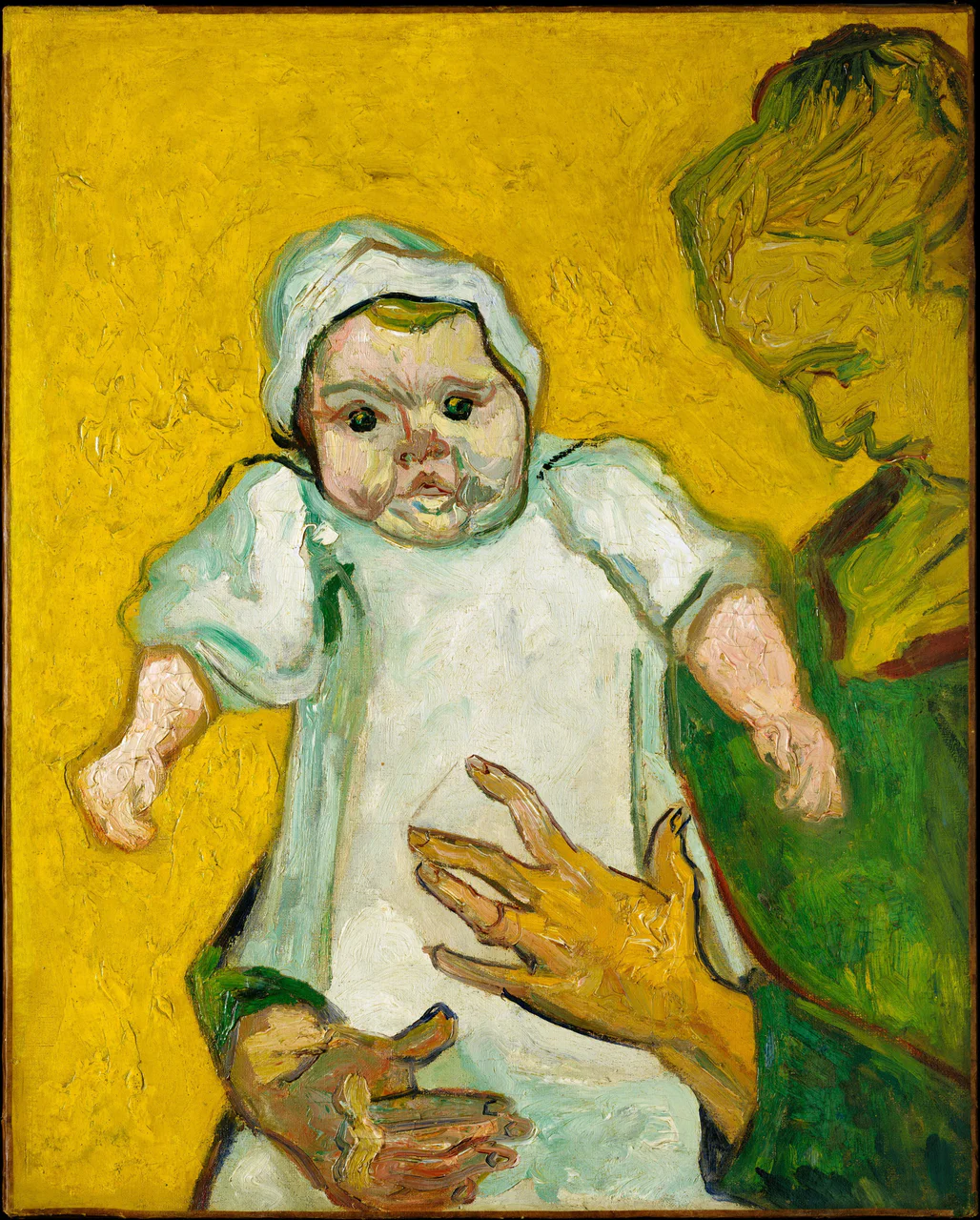
- Against a blazing yellow ground, a mother holds up her baby in a white dress with both hands.
- Vincent van Gogh painted it in 1888 in Arles, in the south of France, as part of a series on his neighbors, the Roulin family.
- The mother's face is cut off at the edge, while the baby stares straight at us. There is no doubt who the star is.
Reading the picture
5 places to look closer
Tap a number on the painting to jump to its note, or a close-up to see that spot in the whole picture.
Zoom in on the baby's face. The round cheeks are built up from strokes of pink, yellow, and pale green. Each black eye holds a dot of green and yellow. A single dark line runs around the edge of the bonnet.
Now go to the mother's face at the upper right. It is sliced by the edge of the canvas and painted in nearly the same yellow as the background. A few green strokes stand for her hair and brows. She is looking down at the baby, so her expression is hard to read.
Look at the two hands holding the baby. The upper hand spreads its fingers wide across the baby's body. Van Gogh piled on thick yellow paint and outlined each finger with a dark line. The lower hand, in a darker brown, supports the baby from below.
Zoom in on the empty yellow background. It is not flat at all. The paint is so thick that every stroke left little ridges and grooves. When light hits it, the surface glints.
Look at the baby's small hand reaching out to the left. Short strokes of pink and white make the chubby back of the hand and the fingers. The fist is half closed, reaching into the air. It is as if the baby is about to grab something.
When it was painted
In the autumn of 1888, Van Gogh was 35 and living in the Yellow House in Arles. He had come south from Paris that February, and from late October Paul Gauguin was staying with him. Van Gogh longed to paint portraits. But in a town where he was a stranger, finding people willing to pose was a constant struggle.
One family kept saying yes. Joseph Roulin, a postal worker with a great bushy beard, sat for Van Gogh that summer. In July, Joseph's wife Augustine gave birth to a baby girl, Marcelle. Over the following months Van Gogh painted the whole household: Joseph, Augustine, their two sons, and the baby.
Marcelle appears in five of his paintings, twice in her mother's arms and three times on her own. Augustine posed for Gauguin, too. His portrait of her from those same months now hangs in the Saint Louis Art Museum. Two painters under one roof looked at the same woman and came away with very different pictures.
The household fell apart in late December. Van Gogh injured his own ear and was taken to the hospital, and Gauguin soon left for Paris. Roulin visited his friend and sent news to Vincent's brother Theo. Then, in January 1889, Roulin was transferred to Marseille and left Arles.
This canvas came to the Metropolitan Museum in 1975 with the Robert Lehman Collection. Look again at the big hands holding up the baby. They belong to a neighbor who opened her door to a painter far from home.
The painter
Vincent van Gogh
1853–1890
When painting this, the artist was about 35 years old
All paintings by Vincent van Gogh →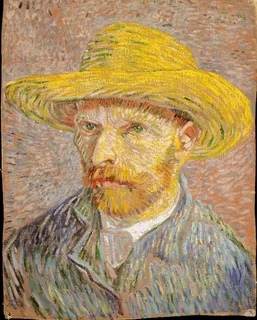
Questions to think about
- Look for itWhere on the yellow background do the brushstrokes stand up most clearly?
- Why?Why do you think Van Gogh cut off the mother's face and put the baby right in the middle?
- What about you?In a town where he was a stranger, some of Van Gogh's closest friends were a postal worker's family. In neighborhoods today where many people live alone, what can neighbors be for one another?
Same period
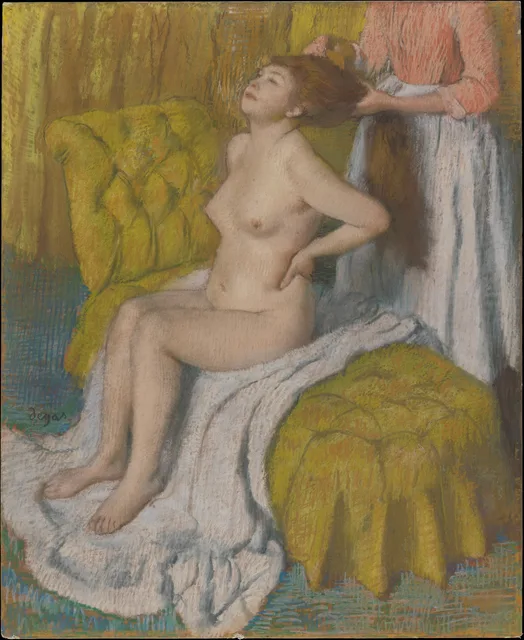
Painted around the same time,
somewhere else
Too good to keep to yourself
This painting,
for someone who comes to mind
They open it at full size
and see every brushstroke.
About this work
- Artist
- Vincent van Gogh · 1853–1890
- Date
- 1888
- Medium
- Oil on canvas
- Size
- 63.5 × 50.8 cm
- Collection
- The Metropolitan Museum of Art
- Image
- Original long edge 3721px · shown at 2560px
- Original
- View on the museum's website ↗