Pyeongye
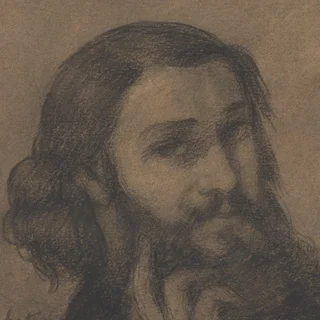
Painters · 19th century
Gustave Courbet
1819–1877
A stubborn Realist who painted his neighbors, his sisters and the valleys of a small mountain town at full scale, shook Paris with them, and died in exile across the border.
Scenes from a life
The life of Gustave Courbet,
scene by scene
- 1844Paris
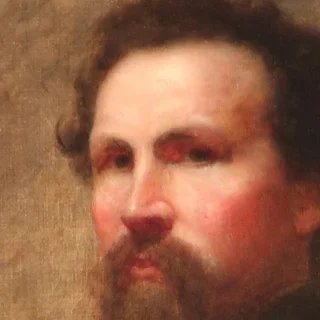
At the Salon of 1844, Courbet's work finally hangs on the wall. It is a self-portrait: a long-haired young man leaning against a rock, a black dog sitting beside him. After several years of rejected entries, it was the first painting the Salon jury accepted from him.
He had been born in 1819 in Ornans, a small town in the Jura hills of eastern France, the son of a landowning family. His father wanted him to study law in Paris. The son arrived already set on becoming a painter.
- 1849Ornans
At the Salon of 1849, After Dinner at Ornans wins a medal. It shows men in his hometown lingering after a meal while one of them plays the violin. The French state bought the picture and sent it to the museum in Lille. The medal meant Courbet could show at the next Salons without facing the jury.
That year he went home to Ornans and began A Burial at Ornans. Townspeople came, one after another, to pose for it. The canvas is more than six meters wide, a country funeral at life size. When it reached the Salon late the next year, it caused an uproar.
- 1852Paris
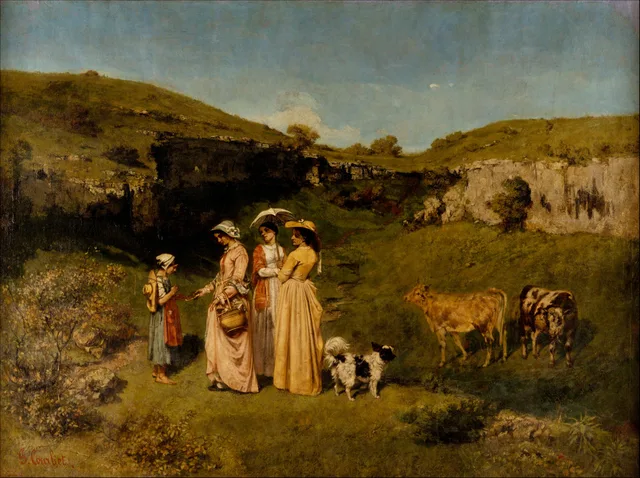
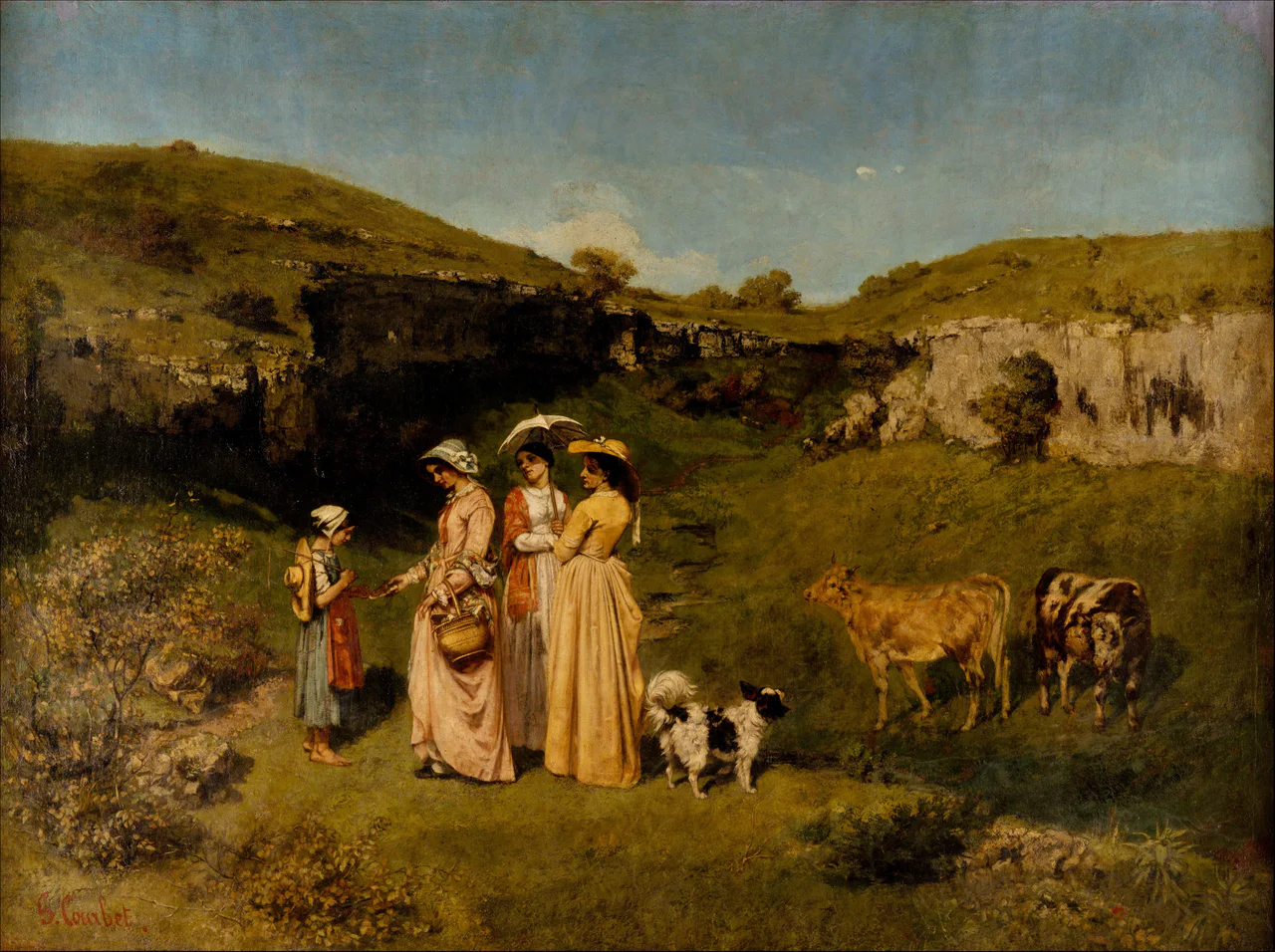
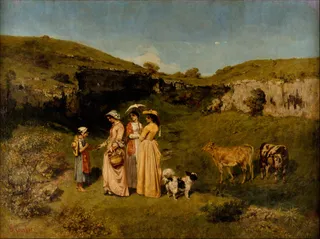
Young Ladies of the Village goes up at the Salon of 1852. In a valley near Ornans, three dressed-up young women hand something to a barefoot girl tending cows. The three were the painter's sisters, Zélie, Juliette and Zoé.
Critics called the picture tasteless and clumsy. They even mocked the sisters' plain faces and clothes. Some also objected to the title, which called country girls "demoiselles," a word for young ladies of good standing.
 Painted around this timeYoung Ladies of the Village
- 1854Montpellier
In May 1854, Courbet arrives in Montpellier in the south of France. The wealthy collector Alfred Bruyas, who had bought his work, invited him. He stayed through the summer.
That summer he painted The Meeting. The painter, his gear strapped to his back, meets Bruyas and a servant on a country road. Bruyas holds his hat in his hand. Courbet keeps his head high. Bruyas rarely showed the picture to others, and in 1868 he gave it to the Musée Fabre in Montpellier.
- 1855Paris
Paris hosts a World's Fair in 1855. Courbet sends in a group of pictures, but A Burial at Ornans and his huge new canvas, The Painter's Studio, are turned down. So he builds his own exhibition hall close by, pays for it himself, and puts up a sign: Realism. Dozens of his paintings hang inside.
Eugène Delacroix, the senior master, came and studied The Painter's Studio for a long time. In his journal he lamented that the jury had rejected it.
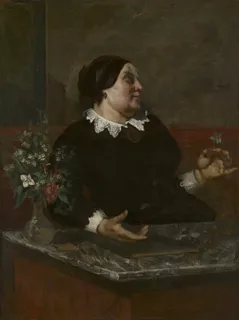
That same year Courbet started Mère Grégoire as a single head. A few years later he enlarged the canvas into a scene at a marble counter, with coins and a ledger. The woman holds a small flower.
 Painted around this timeMère Grégoire
- 1866Paris
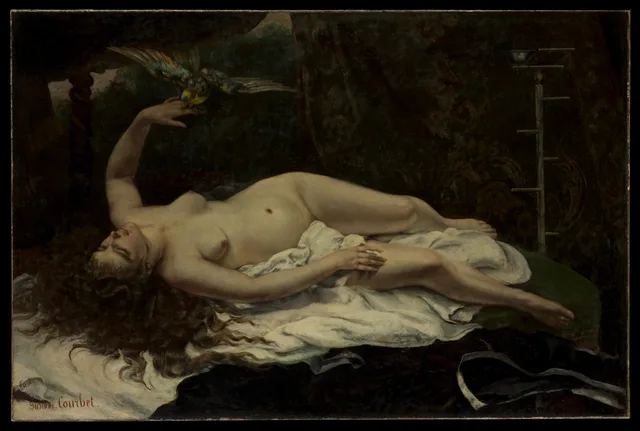
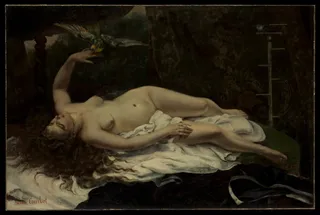
Woman with a Parrot hangs at the Salon of 1866. Two years earlier, the Salon had refused his nude Venus and Psyche as indecent. This time the jury let him in.
Reactions were split. Some critics scolded his lack of taste, the model's ungainly pose and her disheveled hair. Yet the French state briefly considered buying the painting. In the end it did not.
 Painted around this timeWoman with a Parrot
- 1871Paris
On May 16, 1871, the column honoring Napoleon in the Place Vendôme is pulled down with ropes. That spring Paris was run by the Commune, a city government set up by its citizens, and Courbet was one of its elected members. He had earlier proposed taking the column down.
After the Commune fell, he was arrested in June. A court gave him six months in prison and a 500-franc fine, and he served his time in the Sainte-Pélagie prison in Paris.
- 1877La Tour-de-Peilz
Courbet was already living in Switzerland. He had crossed the border in July 1873 and settled in La Tour-de-Peilz on Lake Geneva. A French court ordered him to pay more than 320,000 francs, in yearly installments, to rebuild the column.
He died in La Tour-de-Peilz on December 31, 1877, at fifty-eight. His pictures later crossed the ocean. Woman with a Parrot was bought in 1898 by Louisine and Henry Havemeyer of New York, and it came to the Metropolitan Museum in 1929.
People around them
- Régis CourbetHis father, who wanted his son to study law in Paris.
- Juliette CourbetHis youngest sister, one of the three sisters who posed for Young Ladies of the Village.
- Alfred BruyasA collector in Montpellier who bought his work and invited him south in 1854.
- Eugène DelacroixThe senior painter who visited the Realism pavilion in 1855 and wrote about The Painter's Studio in his journal.
Works