Pyeongye
Painters · 19th century
John Constable
1776–1837
A miller's son who spent his life painting the rivers, fields and wet, shifting skies of his home county of Suffolk.
Scenes from a life
The life of John Constable,
scene by scene
- 1795Dedham
A young man from the Stour valley is shown a famous picture. Sir George Beaumont, a wealthy collector and amateur painter, was staying in Dedham, and he had with him Claude Lorrain's Landscape with Hagar and the Angel. John Constable saw it there, in his own corner of the countryside.
His father, Golding Constable, was a corn merchant who ran mills on the River Stour at Flatford and Dedham. He hoped his son would go into the family business. A few years later John was copying that same Claude in Beaumont's London house.
- 1799London
In 1799 Constable, now twenty-two, was admitted to the Royal Academy Schools. His father had deep doubts, but in the end agreed to pay for his training. The mill would have to manage without him.
In London he kept calling on Joseph Farington, a landscape painter and member of the Royal Academy. Farington noted the young man's visits in his diary that year. He went on to be one of Constable's steadiest advisers.
- 1816London
On 2 October 1816, at St Martin-in-the-Fields, Constable married Maria Bicknell. They had been courting for about seven years. Her grandfather, Dr Durand Rhudde, the rector of East Bergholt, thought a painter with no secure income a poor match and threatened to cut her out of his will.
What finally made the wedding possible was a death. Golding Constable died that spring and left his son a share of the family money. Constable's close friend, the Reverend John Fisher, performed the ceremony, and the couple spent their honeymoon at Fisher's vicarage in Osmington, on the Dorset coast.
- 1818Woodbridge
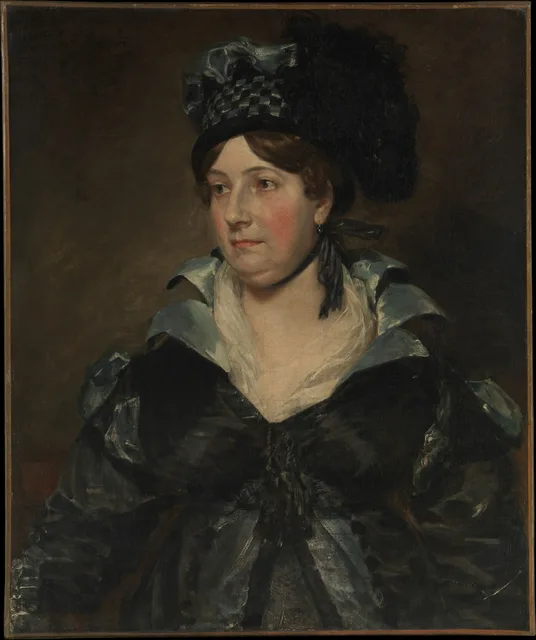
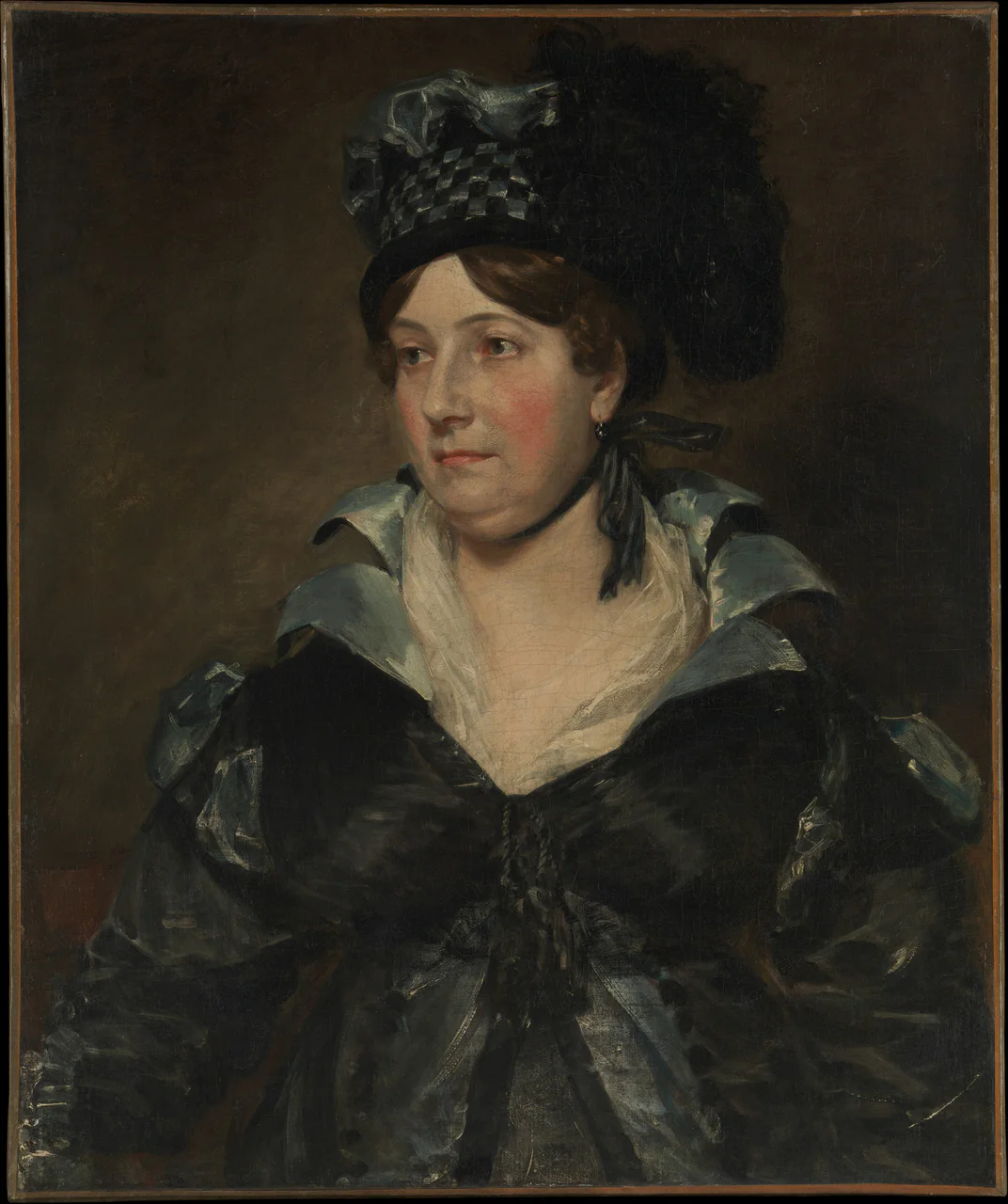
On 30 April 1818, James Pulham, an attorney in the Suffolk town of Woodbridge, sat down to thank Constable. The painter had made a portrait of his wife, Frances, and Pulham called it a compliment handsomely bestowed on her. Frances was an amateur portrait painter herself.
Landscapes were hard to sell. For a newly married man, portraits paid real money. Look at the silver bow on her hat band, flicked in with a few quick strokes of pale paint.
 Painted around this timeMrs. James Pulham Sr. (Frances Amys, ca. 1766–1856)
- 1824Paris
In 1824 a big English country scene hung on the walls of the Paris Salon. A hay cart splashes across a shallow river beside a cottage. The picture caused a stir in Paris, and King Charles X awarded it a gold medal. Today we call it The Hay Wain.
Three years earlier London had shrugged at it. Shown at the Royal Academy in 1821 as Landscape: Noon, it found no buyer. It was the dealer John Arrowsmith who bought it in 1824 and took it to the Salon. Constable himself never set foot outside England.
- 1829London
On 23 November 1828 Maria died of tuberculosis. She left seven children, the youngest born only that January. She was buried in the churchyard of St John-at-Hampstead.
Three months later, in February 1829, Constable was elected a full member of the Royal Academy, at fifty-two, by a single vote. When the president, Sir Thomas Lawrence, congratulated him, he told Constable he was fortunate to be chosen over several deserving history painters. Constable felt the honor had come too late.
- 1836London
In May and June 1836 Constable stood at the lectern of the Royal Institution in London and gave four lectures on the history of landscape painting. A few years earlier he had worked with the engraver David Lucas on English Landscape, a series of mezzotints after his paintings. It sold poorly and cost him money.
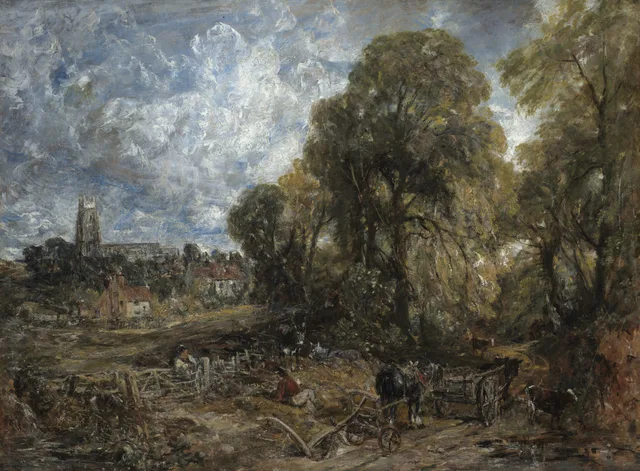
That same year he painted Stoke-by-Nayland, a village a few miles from East Bergholt. On the left a church tower rises above the houses. On the right a shady lane runs into a tunnel of trees. Down in front stand a dark horse, a cart and a plough, all scraped into being as much with a palette knife as with brushes.
Painted around this timeStoke-by-Nayland - 1837London
On 31 March 1837, at his house in Charlotte Street, Constable was suddenly taken ill, and he died that night. He was sixty. He was buried beside Maria at Hampstead.
That year his friends raised money to buy his painting The Cornfield and give it to the National Gallery in London. Today the Woodbridge attorney's wife hangs in the Metropolitan Museum of Art in New York, and the dewy lane at Stoke-by-Nayland is in the Art Institute of Chicago.
In their own words
What say you to a summer morning?
From a letter to a friend about Stoke-by-Nayland. He went on to pin down the moment: July or August, eight or nine in the morning, after a light shower in the night.
People around them
- Golding Constablehis father, a miller and corn merchant on the Stour, who in the end paid for his training.
- Maria Bicknellhis wife after a seven-year courtship, mother of their seven children, who died in 1828.
- John Fishera clergyman and nephew of the Bishop of Salisbury, who married the couple and wrote to Constable for years.
- Dr Durand RhuddeMaria's grandfather and rector of East Bergholt, who opposed the marriage.
- Joseph Faringtonthe Royal Academician who advised the young Constable in London.
- David Lucasthe engraver who turned his paintings into the English Landscape mezzotints.
Works