Pyeongye
Painters · 16th century
Raphael
1483–1520
An orphan from Urbino who, in only thirty-seven years, went from small-town altarpieces to painting the pope's rooms and running the rebuilding of St. Peter's in Rome.
Scenes from a life
The life of Raphael,
scene by scene
- 1494Urbino
In August 1494, Giovanni Santi dies in Urbino. He was a painter at the court of the Montefeltro dukes, and also a poet who wrote a long rhymed chronicle in their honor. His son Raphael was eleven.
Raphael's mother, Magia, had already died three years earlier, in 1491. The boy had grown up around his father's workshop, among brushes, panels, and the painters who worked there.
- 1500Città di Castello
On December 10, 1500, a contract is drawn up in the small town of Città di Castello. A wool merchant, Andrea Baronci, wants an altarpiece of Saint Nicholas of Tolentino for his family chapel in the church of Sant'Agostino.
Two painters sign on. One is Evangelista da Pian di Meleto, an older man from Raphael's father's workshop. The other is Raphael, just seventeen. The picture was delivered the next September. An earthquake in 1789 badly damaged it, and its surviving pieces are now scattered among several museums.
- 1504Perugia
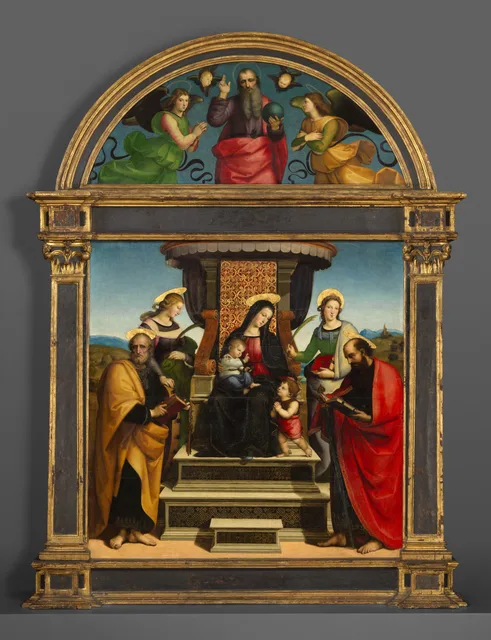
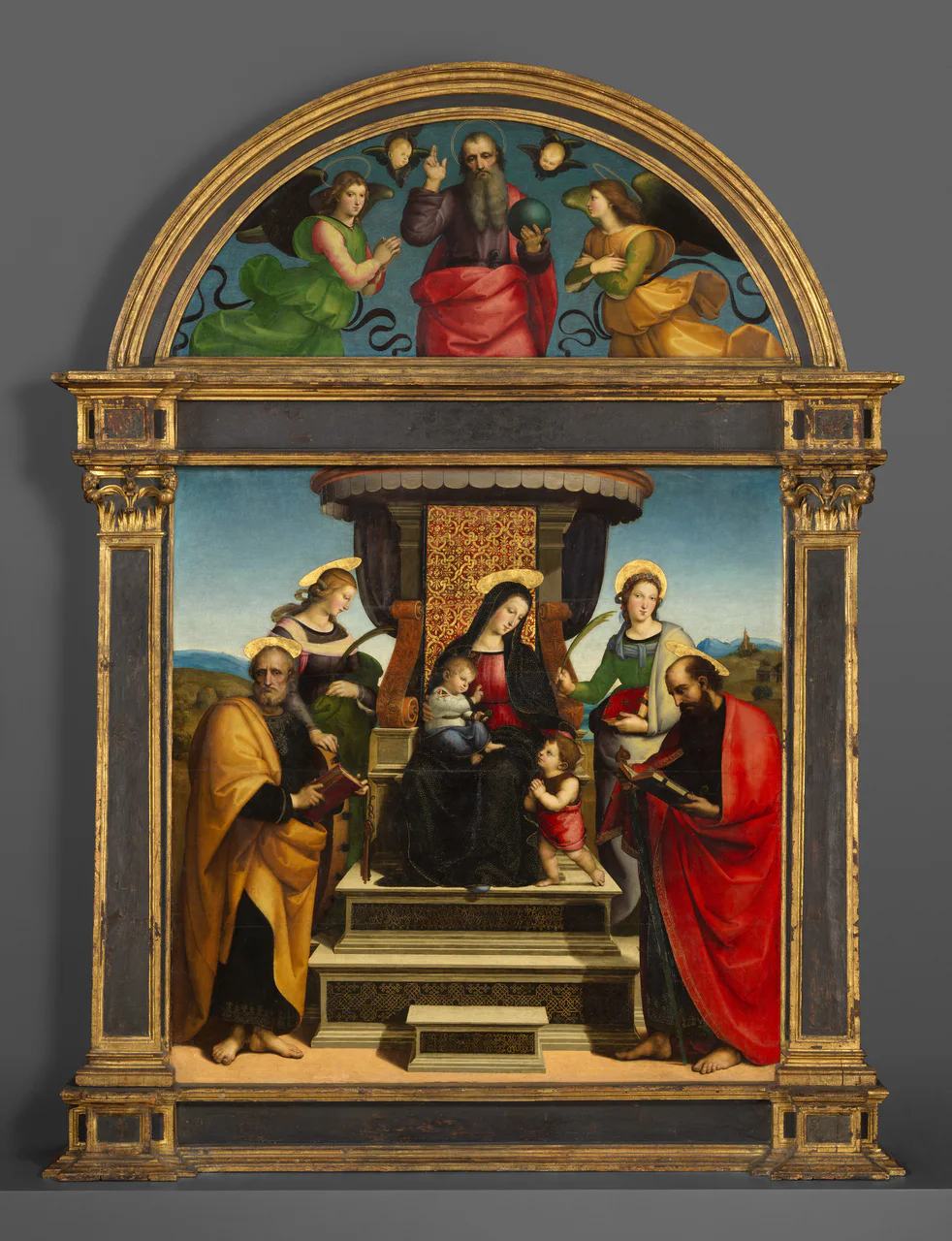
In Perugia, the nuns of the Franciscan convent of Sant'Antonio are waiting for an altarpiece. Raphael, about twenty, paints the Madonna on a high throne with saints around her. That same year he signed and dated another altarpiece, The Marriage of the Virgin, 1504.
The sixteenth-century biographer Giorgio Vasari wrote that the Christ Child was painted clothed because the nuns wanted it that way. So the baby sits on his mother's lap in a white shirt, while the little John the Baptist folds his hands and looks up at him.
 Painted around this timeMadonna and Child Enthroned with Saints
- 1508Rome
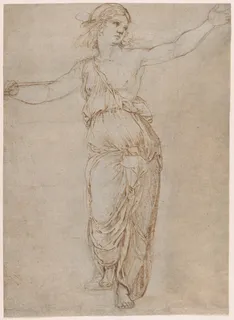
In 1508 Pope Julius II calls Raphael to Rome to paint the walls of a room in the Vatican palace, the room now known as the Stanza della Segnatura. Around these years he draws Lucretia in pen and brown ink. The heroine of an old Roman story grips a dagger in her right hand and flings her left arm out and up.
The engraver Marcantonio Raimondi cut this design into a copper plate. Vasari wrote that Marcantonio, soon after reaching Rome, engraved a beautiful sheet by Raphael. The back of the drawing is rubbed with black chalk, and its lines were pressed through with a stylus. The Met reads these as signs of a working drawing used to transfer the design.
Painted around this timeLucretia - 1514Rome
In the spring of 1514, Donato Bramante, the architect of the new St. Peter's, dies. Pope Leo X hands the job to Raphael, who is thirty-one. A painter is now in charge of building the great church.
Around the same time, his close patron Cardinal Bibbiena arranges for Raphael to be engaged to his niece, Maria. The wedding never happened. Maria died unmarried, and she is buried near Raphael in the Pantheon in Rome.
- 1520Rome
On Good Friday, April 6, 1520, Raphael dies in Rome after a short illness. He was thirty-seven.
Vasari wrote that his last painting, The Transfiguration, was set up at the head of the room where his body lay. As he had wished, he was buried in the Pantheon, the ancient temple that had become a church. The convent altarpiece and the Lucretia drawing on this site both come from the early part of that short life, from his Perugia years and his first years in Rome.
People around them
- Giovanni Santihis father, a court painter and poet in Urbino, who died when Raphael was eleven.
- Evangelista da Pian di Meletoa painter from his father's workshop who shared the 1500 Baronci commission with him.
- Julius IIthe pope who called Raphael to Rome in 1508 to paint the Vatican rooms.
- Marcantonio Raimondithe engraver whose prints spread Raphael's designs far beyond Rome.
- Cardinal Bibbienaa close patron who arranged Raphael's engagement to his niece Maria.