Pyeongye

Painters · 19th century
Winslow Homer
1836–1910
An American painter who started out sketching the Civil War for a magazine and ended up on a rocky Maine shore, painting people who work against the sea.
Scenes from a life
The life of Winslow Homer,
scene by scene
- 1857Boston
A young man of twenty-one walks out of a print shop for good. Born in Boston in 1836, Winslow had been placed at nineteen, through his father, as an apprentice in John Bufford's lithography shop. The work was steady and dull: sheet music covers and other commercial jobs, day after day. His father, a hardware merchant, had sailed off to the California gold rush a few years earlier and come home with nothing.
When the apprenticeship ended, Homer went freelance and sold his drawings to magazines. Harper's Weekly offered him a staff job, and he turned it down. Years later he compared his time at Bufford's to slavery and said he never wanted to be bound to anyone again.
- 1862Yorktown
April 1862, a peach orchard in front of Yorktown, Virginia. Homer was traveling with the Union's Army of the Potomac, drawing for Harper's Weekly. One day he looked through a sharpshooter's rifle with a telescopic sight. The scene ran in the magazine as an engraving that November.
In 1896 he described that moment in a letter to his friend George Briggs. What he saw through the sight, he wrote, seemed closer to murder than anything else he connected with the army, and he had always had a horror of that branch of the service. The year before, in March 1861, he had drawn Lincoln's inauguration across two pages of the same magazine.
- 1866New York
Visitors crowd into the National Academy of Design in New York to see Homer's Prisoners from the Front. A Union officer faces three captured Confederate soldiers. The picture drew wide attention, and at thirty Homer was suddenly known as a painter.
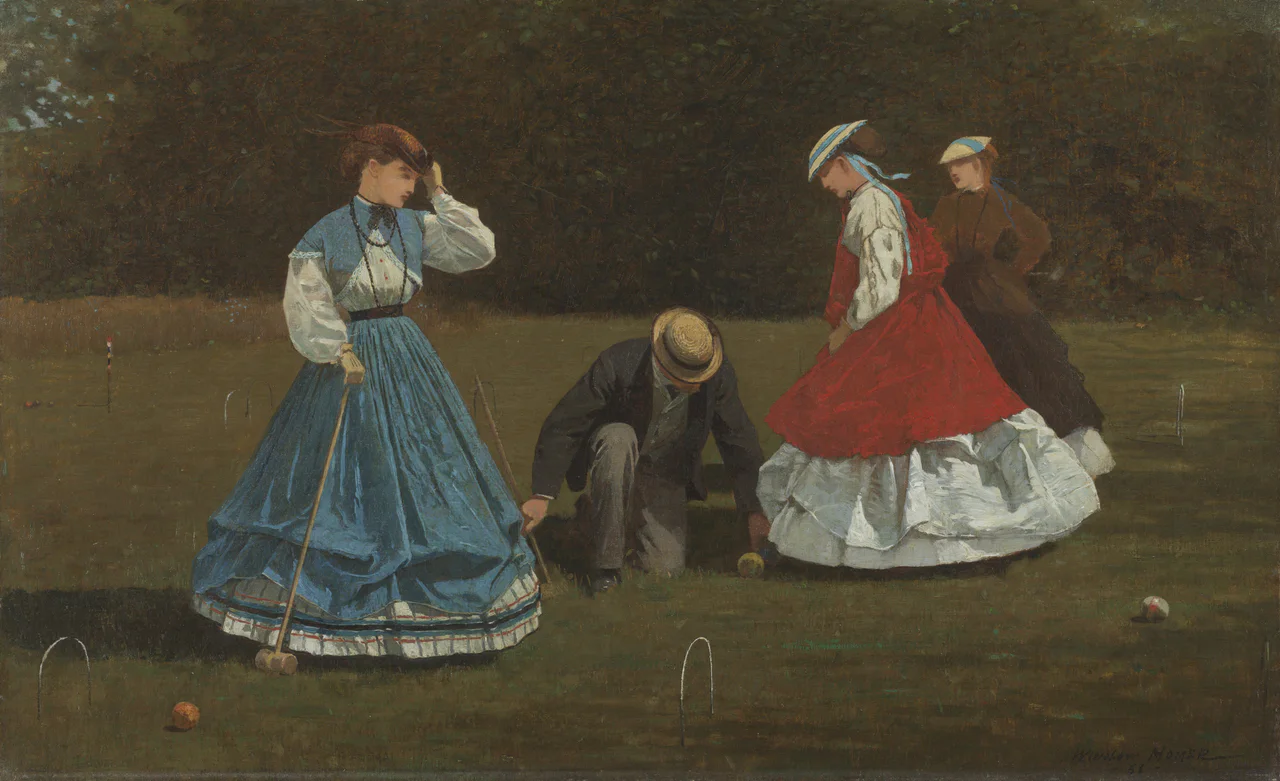
Around the same time he painted croquet, a game just arrived from the British Isles, five times over. Look at Croquet Scene. The woman in blue raises a hand to her hat against the bright sun. A man in a straw hat crouches to set the ball for the woman in red. His signature sits in the lower right corner.
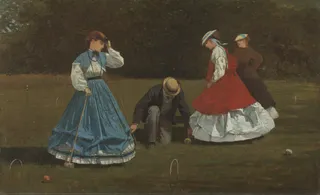 Painted around this timeCroquet Scene
- 1867Paris
Late in 1866 Homer crossed the Atlantic to Paris. At the Exposition Universelle the next year, two of his paintings hung in the American section: Prisoners from the Front and The Bright Side. He spent about ten months in Paris and the French countryside before heading home.
On July 11, 1868, Harper's Weekly printed his Fire-Works on the Night of the Fourth of July. The whole page is packed with faces turned to the sky. Look at the right side. A spent rocket stick has come down and speared a gentleman's tall hat. Near the bottom center, a bald man peers up through his pince-nez.
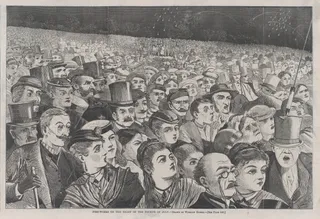 Painted around this timeFire-Works on the Night of the Fourth of July (from "Harper's Weekly," Vol. XII)
- 1881Cullercoats
In October 1881 a heavy storm blew in off the North Sea. Homer was living in Cullercoats, a fishing village on England's northeast coast, when word came that a ship, the Iron Crown, had been driven onto the shoals off nearby Tynemouth. He watched the rescue from the shore and recorded it in watercolor.
He stayed in the village until November 1882. He painted the fishermen's wives and daughters again and again, mending nets and watching the water for the boats. After this stay, his pictures turned almost entirely to people and the sea.
- 1884Prouts Neck
In 1884 an unusually large school of herring showed up off Prouts Neck, Maine. Homer had moved his studio to this stretch of coast the year before. He hired a local boy to row his boat and went out among the fishing fleet to sketch the men hauling their nets.
From those sketches came The Herring Net, finished in 1885. In a small boat, one man pulls up a net full of shining fish while the other unloads the catch. Ghostly schooners sit in the fog on the horizon. A red buoy bobs in the waves just in front of the boat.
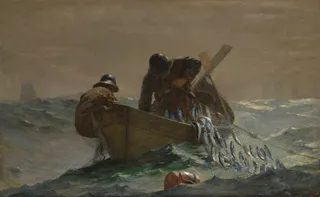 Painted around this timeThe Herring Net
- 1908Prouts Neck
In 1906 the Metropolitan Museum of Art in New York bought his sea painting The Gulf Stream. Two years later, in 1908, Homer suffered a stroke. He recovered enough to pick up his brushes again.
He lived and worked in a converted carriage house above the rocky shore. In September 1910 he died there, at seventy-four. The Herring Net, painted in 1885, is now in the collection of the Art Institute of Chicago.
People around them
- Henrietta Benson Homerhis mother, an amateur painter of flowers and birds, often named as his first teacher.
- Charles Savage Homerhis father, a hardware merchant who left for the California gold rush in 1849.
- Charles Savage Homer Jr.his older brother and frequent correspondent, who kept a number of his pictures.
- John Buffordthe Boston lithographer whose shop took Homer on as an apprentice at nineteen.
- George Briggsthe friend to whom Homer wrote in 1896 about the sharpshooter at Yorktown.
Works
Paintings by
Winslow Homer on Pyeongye
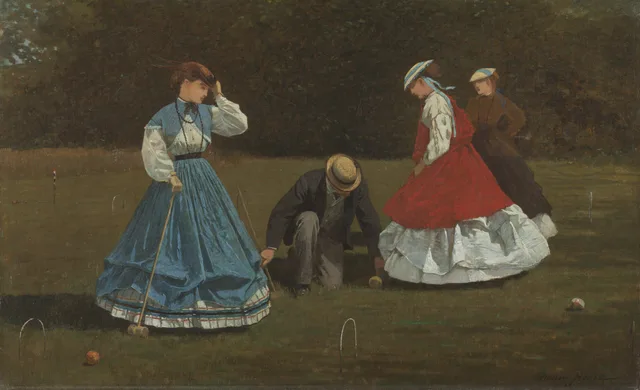 Croquet Scene1866
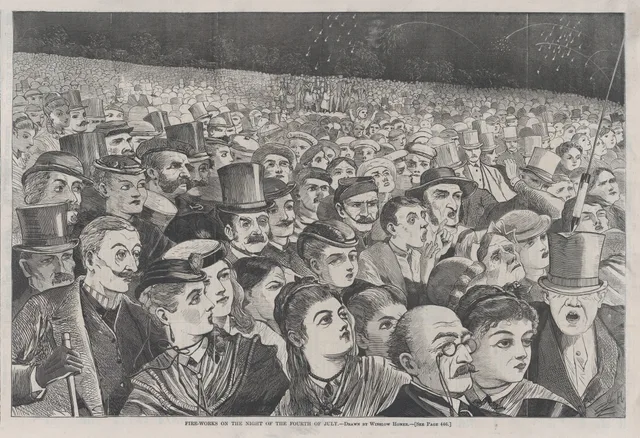 Fire-Works on the Night of the Fourth of July (from "Harper's Weekly," Vol. XII)July 11, 1868
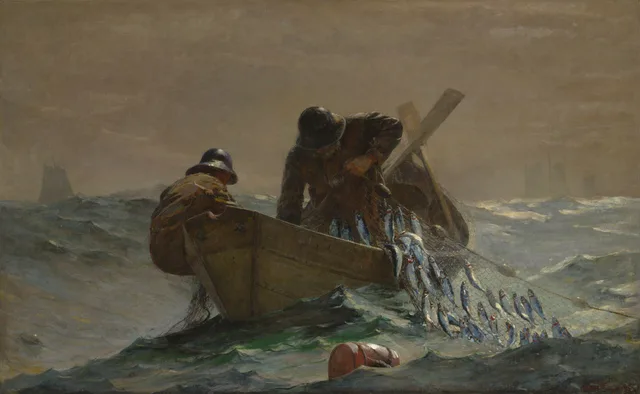 The Herring Net1885
Hidden stories in Winslow Homer's paintings
Contemporaries