 Pyeongye
Artwork · 19th century · Georges Seurat
LeoTurn on Magnifier at the lower right and move slowly across the painting.
Full screen opens it edge to edge.Tap the painting to fill the screen.
Spread two fingers to look closer.
At a glance
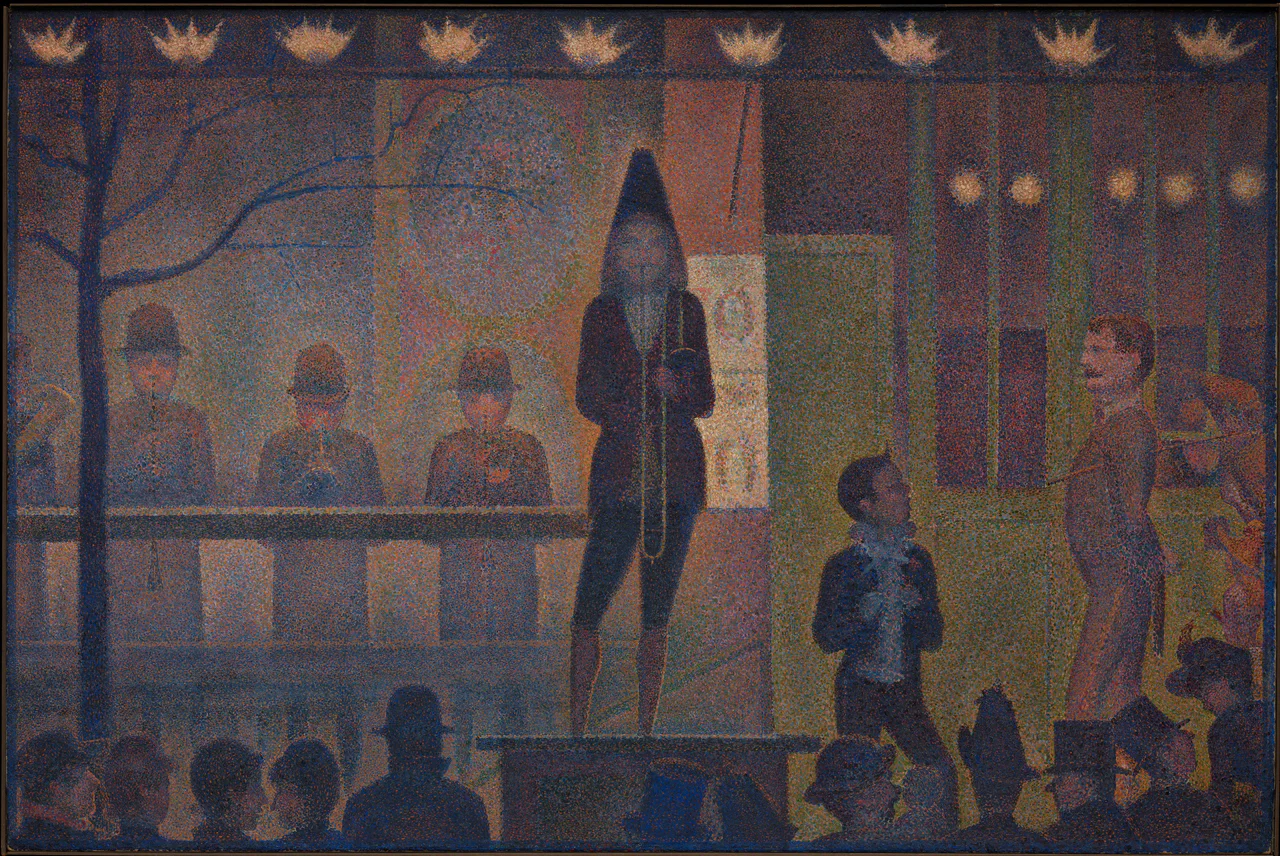
- Night in Paris: musicians play on a platform outside a circus tent to draw in a crowd.
- Georges Seurat painted it in oil on canvas over 1887 and 1888.
- Instead of lines, he used countless small dots of color to build the hazy glow of gaslight.
Reading the picture
5 places to look closer
Tap a number on the painting to jump to its note, or a close-up to see that spot in the whole picture.
Zoom in on the very top edge. A row of spiky flames runs across the picture like a line of little crowns. These are the gas jets lighting the stage. Up close, each flame is nothing but dots of yellow, orange, and white.
Look at the figure standing on the raised platform in the middle. He wears a tall pointed hat and holds a trombone. His face has almost no features. Standing stiff and straight, he looks less like a person than like part of the stage.
Now zoom in on the musicians at the left. Three men in round hats stand in a row behind a rail, blowing their instruments. Their hats, heights, and poses are nearly identical. Can't you almost hear the same tune repeating over and over?
Drop down to the audience seen from behind. A man in a bowler hat rises like a black shadow. Yet even inside that dark shape, orange dots are scattered all over. Seurat refused to paint even darkness with a single color.
Zoom in on the man with the mustache at the right. We see him in profile, turned toward the middle of the stage. His face is built from pink and orange dots, his shadows from purple and blue. The green post behind him makes his outline sharper.
When it was painted
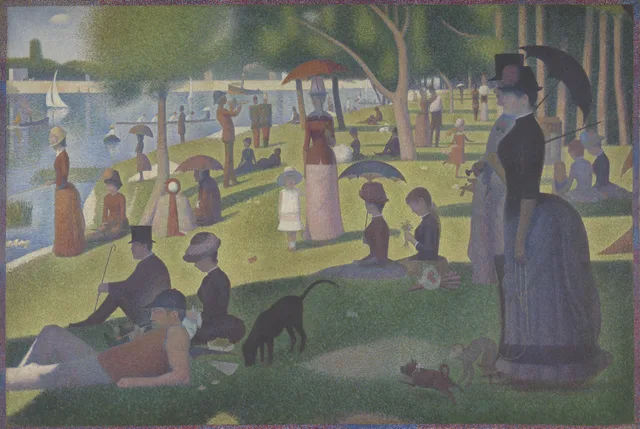
In 1887, Seurat was twenty-seven. A year earlier he had shown A Sunday on La Grande Jatte at the last Impressionist exhibition, and Paris was still arguing about his new way of painting in tiny dots of color.
The setting here is the Gingerbread Fair near the Place de la Nation, on the eastern side of Paris. Every year, just after Easter, it ran for about three weeks, and the Circus Corvi pitched its tent there. A parade, in French, was a free teaser show performed outside. The idea was simple: get people walking by to stop, watch, and buy a ticket to go inside.
Seurat showed this canvas at the Salon des Indépendants in the spring of 1888. He kept returning to nighttime entertainment after that. In March 1891, while his last large painting, The Circus, hung unfinished at the Indépendants, he fell suddenly ill and died. He was thirty-one.
Seurat kept his private life almost completely hidden. He lived with Madeleine Knobloch, and they had a son born in 1890, but his family learned about them only shortly before he died. The little boy died soon afterward.
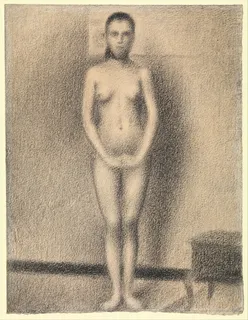
The painting later belonged to the American collector Stephen C. Clark, who left it to the Metropolitan Museum in his will in 1960. In 2017 the museum built a whole exhibition around it, gathering Seurat's drawings for the scene.
Now look again at the backs of the people standing under the gas jets. The real show inside the tent never appears in the picture. Like that crowd, we are left at the entrance with only the teaser.
More by the same painter
Hidden stories in this painting
Questions to think about
- Look for itHow many round, glowing lamps can you count at the upper right?
- Why?Why do you think Seurat made a lively circus show look so quiet?
- What about you?Free samples meant to pull people in are everywhere today, from street shows to short videos and ads, so what do we notice in them, and what do we miss?
Same period
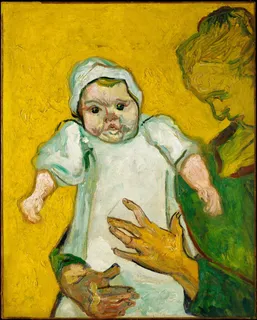
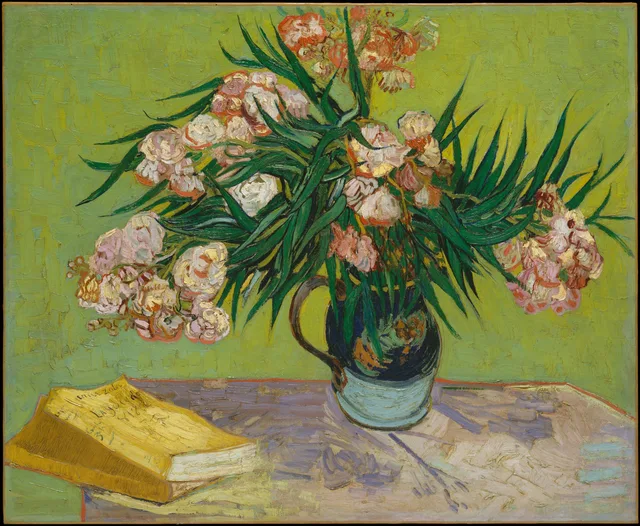
Painted around the same time,
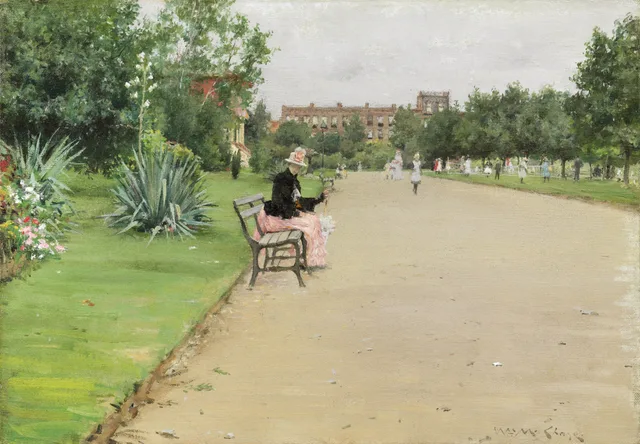
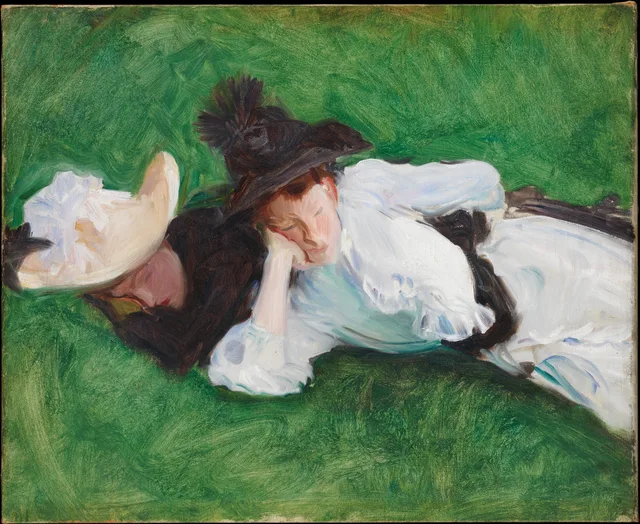
somewhere else
Too good to keep to yourself
This painting,
for someone who comes to mind
They open it at full size
and see every brushstroke.
About this work
- Artist
- Georges Seurat · 1859–1891
- Date
- 1887–88
- Medium
- Oil on canvas
- Size
- 99.7 × 149.9 cm
- Collection
- The Metropolitan Museum of Art
- Image
- Original long edge 3920px · shown at 2560px
- Original
- View on the museum's website ↗