Pyeongye
Painters · 19th century
Georges Seurat
1859–1891
A Paris painter who lived only thirty-one years and tried to mix color not on the palette but in the viewer's eye, setting tiny dots of pure color side by side.
Scenes from a life
The life of Georges Seurat,
scene by scene
- 1878Paris
Born in Paris in 1859 to a comfortable family, Seurat entered the national art school at eighteen. His teacher, Henri Lehmann, had studied with Ingres. Seurat also pored over the chemist Chevreul's theory of how neighboring colors affect each other, and over Charles Blanc's guide to the rules of color and line.
- 1884Paris
That year the official Salon turned down Bathers at Asnières, his big painting of young men resting by the river. Seurat took it instead to the new Salon des Indépendants, an exhibition with no jury and no prizes. There he met Paul Signac, four years younger. The two would push the dot method forward together.
- 1886Paris
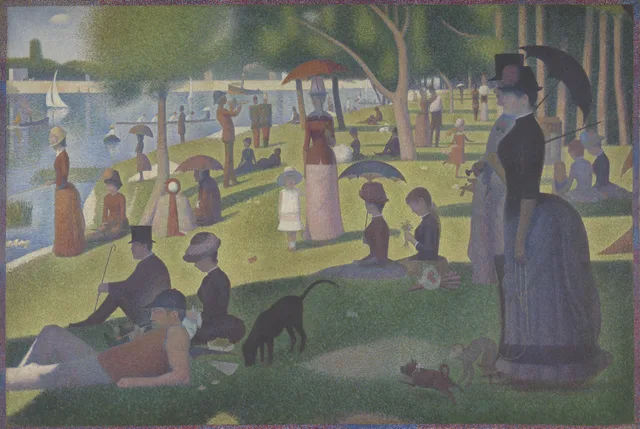
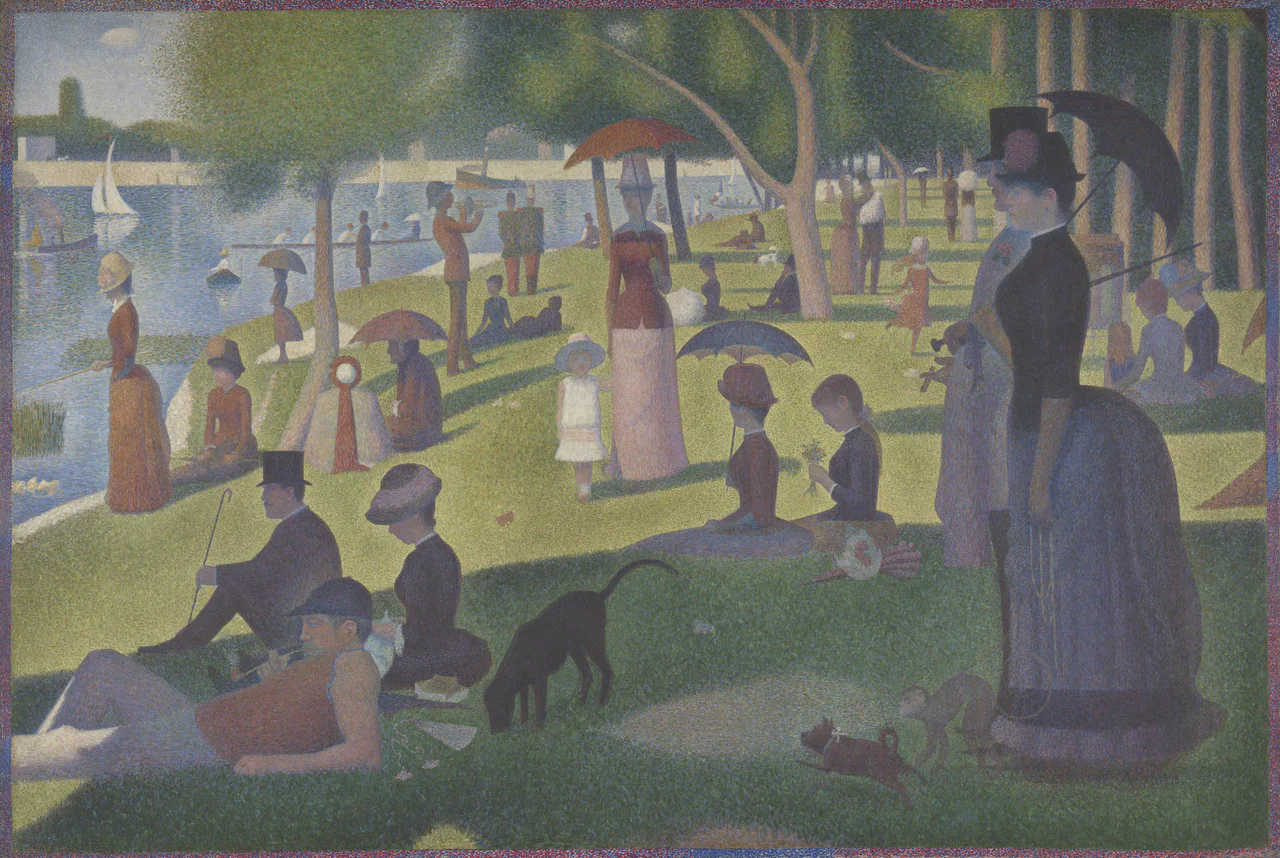
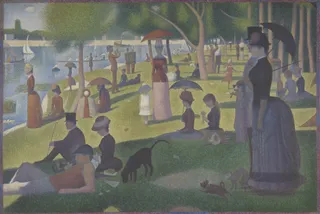
At the eighth and last Impressionist exhibition, a canvas more than ten feet wide went on view: A Sunday on La Grande Jatte — 1884. Seurat had started it in 1884, worked through dozens of studies, and then came back two years later to reshape figures and add new ones. Look at the lower right. In front of the woman with the parasol, a monkey sits on a leash. Step close and the grass and the skirts break apart into small dots and dashes of color. The critic Félix Fénéon gave this new style a name: Neo-Impressionism.
 Painted around this timeA Sunday on La Grande Jatte — 1884
- 1887Paris
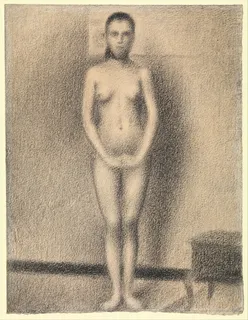
In his studio, Seurat posed models and drew them in conté crayon. In Study for "Poseuses", a woman faces us squarely, hands clasped in front of her. There are almost no outlines. When he rubbed the crayon across the bumpy paper, the black caught only on the raised grain, so light and shadow seem to rise out of the sheet itself. Studies like this led to Poseuses, a large painting of three models in his studio, with La Grande Jatte hanging on the wall behind them.
 Painted around this timeStudy for "Poseuses"
- 1888Paris
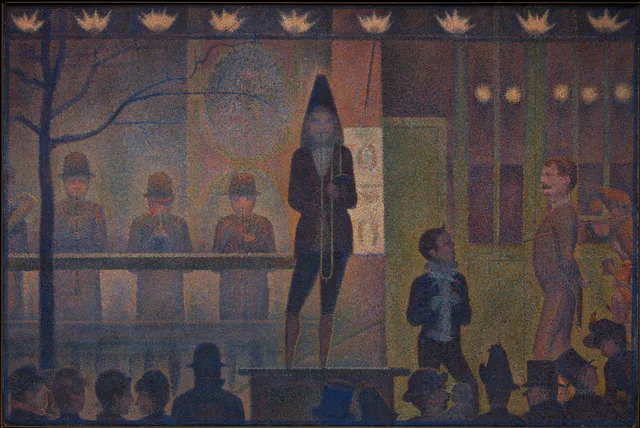
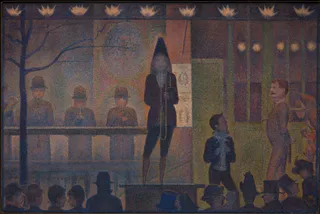
In the spring of 1888, Seurat showed a night scene at the Indépendants. Circus Sideshow shows the free teaser performance put on outside a circus to pull in paying customers. Look at the very top: gas flames burn in a row like a string of crowns. In the middle, a figure in a pointed hat plays the trombone on a platform. Along the bottom edge, the heads of the crowd form a band of dark silhouettes. Everyone is supposed to be moving, yet the picture feels strangely hushed.
Painted around this timeCircus Sideshow (Parade de cirque) - 1889Paris
A few years after finishing La Grande Jatte, Seurat went back to it one more time. Now he added a narrow painted border made of tightly packed red and blue dots. Check the far left edge, beside the woman holding a fishing pole: where the river stops, the band of dots begins. Even the line between picture and frame became something to paint.
Painted around this timeA Sunday on La Grande Jatte — 1884 - 1890Paris
Seurat was quiet and kept his private life to himself. Even close friends knew little about Madeleine Knobloch, his companion. In February 1890 she gave birth to their son. Around this time he painted her seated at a small table, powdering her face in front of a mirror.
- 1891Paris
In March 1891, Seurat fell suddenly ill and died within a few days. He was thirty-one. At that moment his unfinished painting The Circus was hanging at the Indépendants. His son, just over a year old, died a few weeks later. His life was short, but the dot method he worked out was carried on by Signac and a number of younger painters.
People around them
- Paul Signacthe fellow painter Seurat met at the 1884 Indépendants; he carried the dot method forward and later wrote a book explaining it.
- Camille Pissarroan older Impressionist who painted with Seurat's method for a time and helped bring him into the 1886 exhibition.
- Félix Fénéonthe critic who introduced Seurat and his friends to the public as Neo-Impressionists.
- Madeleine KnoblochSeurat's companion and the mother of his son.
- Henri Lehmannhis teacher at the national art school, a former student of Ingres.
Works