Pyeongye

Painters · 17th century
Velázquez
1599–1660
A Seville apprentice who became painter to King Philip IV of Spain, and who gave kings, servants and saints the same steady, searching light.
Scenes from a life
The life of Velázquez,
scene by scene
- 1611Seville
In September 1611, a father signs a contract in Seville. His twelve-year-old son Diego will live and train for six years in the house of the painter Francisco Pacheco. The paperwork counts the apprenticeship from the previous December. From then on, the boy ate, slept and learned under his teacher's roof.
Pacheco was more than a painter. He wrote about art and gathered poets and scholars at his house. Young Diego grew up hearing their talk along with the smell of paint.
- 1618Seville
On April 23, 1618, eighteen-year-old Velázquez gets married. The bride is Juana, his teacher's daughter. A year earlier he had passed the painters' guild examination, which let him work on his own.
Pacheco later told the story in his book on painting. After five years of training the young man, he wrote, he gave him his daughter because of his character and his promise. A daughter, Francisca, arrived the next year, and a second, Ignacia, in 1621.
- 1622Madrid
In the spring of 1622, Velázquez makes his first trip to Madrid. He hopes for a place at court, but no chance to paint the king comes his way.
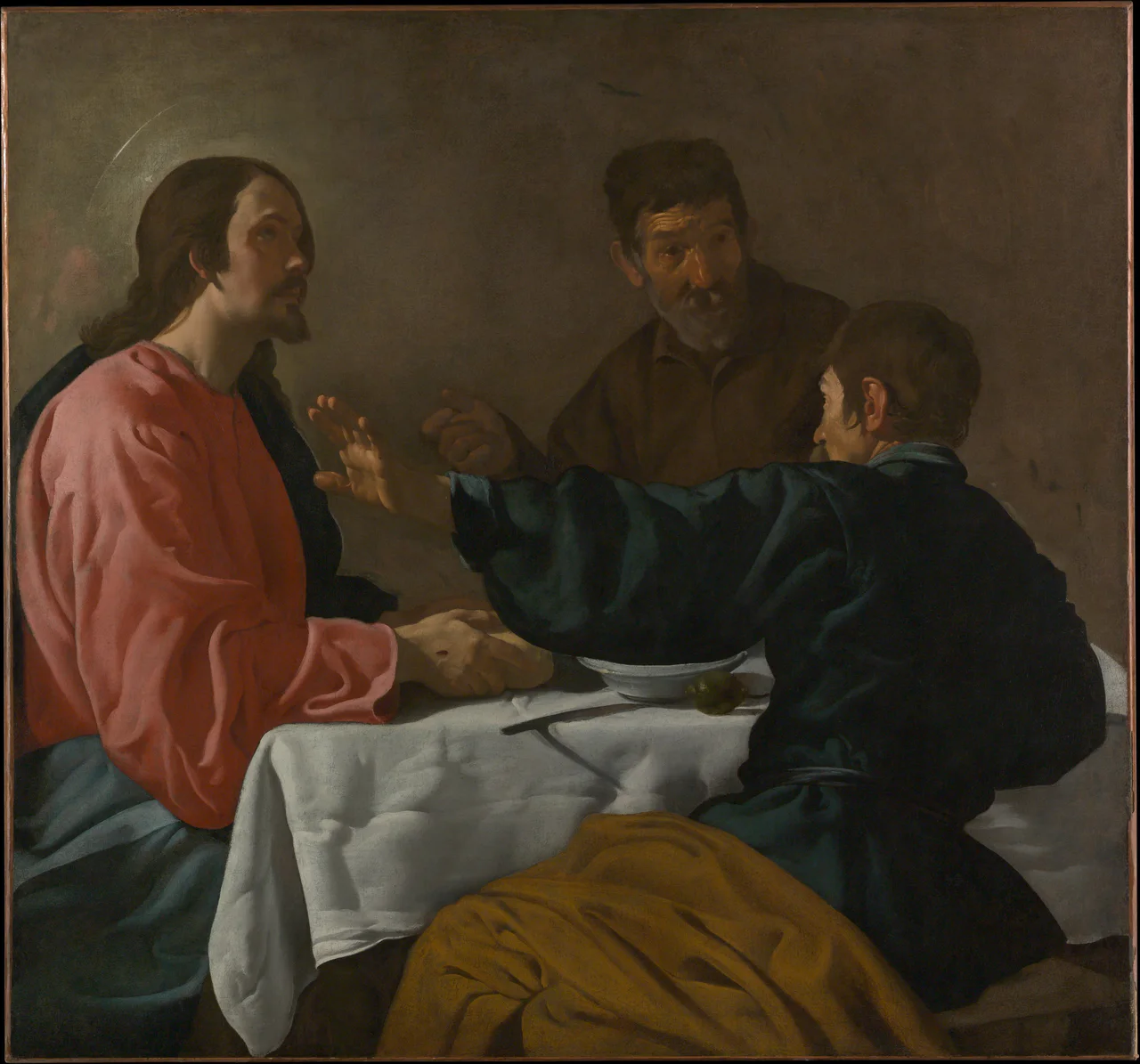
He does not go home empty-handed. At Pacheco's request, he paints the famous poet Luis de Góngora. Back in Seville he keeps painting kitchens, tables and ordinary faces in hard light and deep shadow. The Supper at Emmaus belongs to these years.
 Painted around this timeThe Supper at Emmaus
- 1623Madrid
In the summer of 1623, a second summons arrives. The king's minister, the Count-Duke of Olivares, calls him back, and the royal chaplain Juan de Fonseca puts him up in his own house. Velázquez paints Fonseca first. According to Pacheco, the finished portrait was carried straight to the palace, where the royal household passed it around.
On August 30 he paints the eighteen-year-old Philip IV. On October 6 he is named a painter to the king, at twenty ducats a month. That year he also sketched Charles, Prince of Wales, who was visiting Madrid, but the sketch is lost.
 Painted around this timePhilip IV (1605–1665), King of Spain
- 1627Madrid
In 1627, Philip IV sets his court painters a contest. The subject is his father Philip III's expulsion of the Moriscos from Spain. The rivals are Vicente Carducho, Eugenio Cajés and Angelo Nardi.
The youngest of them wins. As his prize, Velázquez receives a post as an usher of the king's chamber. The painting itself burned in the great 1734 fire at the Alcázar palace in Madrid, so no one can see it today.
- 1628Madrid
In 1628, the Flemish painter Peter Paul Rubens arrives in Madrid on a diplomatic mission. He stays for several months, painting the king and copying pictures in the royal collection.
Pacheco noted that Rubens kept his distance from most local painters. With Velázquez it was different. The two became friends and went together to see the paintings at the Escorial monastery. The next year, with the king's permission, Velázquez left on his first journey to Italy.
- 1650Rome
On March 19, 1650, a portrait goes on show in the portico of the Pantheon in Rome. It is Velázquez's painting of his assistant, Juan de Pareja. Velázquez, now fifty, is on his second Italian trip, buying paintings and sculpture for the king's palaces. That year he joins Rome's Academy of Saint Luke and paints Pope Innocent X.
In November he signs a document in Rome freeing Pareja from slavery. The freedom is set to take effect four years later.
 Painted around this timeJuan de Pareja (ca. 1608–1670)
- 1660Madrid
In November 1659, Velázquez finally becomes a knight of the Order of Santiago. The investigation into his family background dragged on so long that a special dispensation from the pope was needed. In the spring of 1660, as the palace official in charge of royal lodgings, he travels to Pheasant Island on the French border to prepare the rooms and decorations for a royal wedding meeting.
He is back in Madrid by late June and falls ill at the end of July. He dies on August 6, 1660, at sixty-one. His wife Juana dies only days later. The faces he painted, a young king and a trusted assistant among them, still look out at us from museum walls and from this site.
People around them
- Francisco Pachecohis teacher and father-in-law in Seville, who wrote down much of what we know about his early years.
- Juana Pachecohis wife from 1618, who died only days after him.
- Philip IVthe king of Spain who kept Velázquez at his side from 1623 until the painter's death.
- The Count-Duke of Olivaresthe king's minister who brought the young painter to Madrid.
- Peter Paul Rubensthe Flemish painter he befriended in Madrid in 1628.
- Juan de Parejahis workshop assistant, promised freedom in Rome in 1650, who later became a painter himself.
Works
Paintings by
Velázquez on Pyeongye
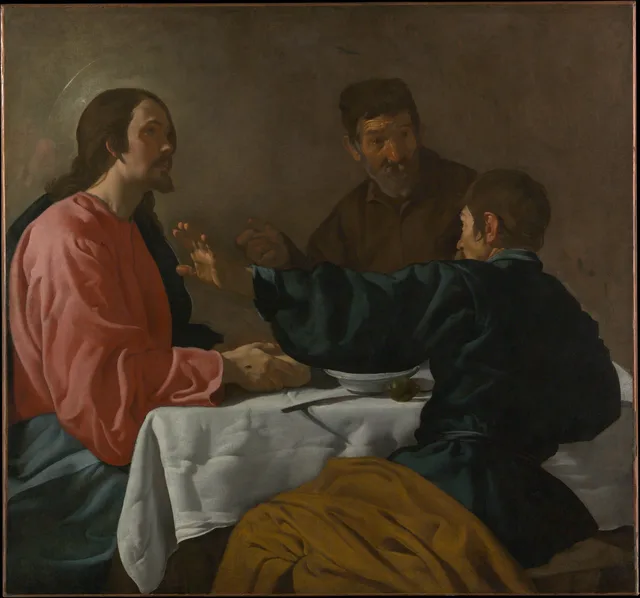 The Supper at Emmaus1622–23Philip IV (1605–1665), King of Spainprobably 1624Juan de Pareja (ca. 1608–1670)1650
Hidden stories in Velázquez's paintings
- The Day a Man Stood Beside His Own PortraitIn Rome in 1650, Velázquez painted Juan de Pareja, the enslaved man who worked in his studio. Pareja later became a painter himself.
- The tiny red mark on the back of a handWhy are these two men so startled at supper? The answer is one small red spot you can easily miss.
Contemporaries