Pyeongye
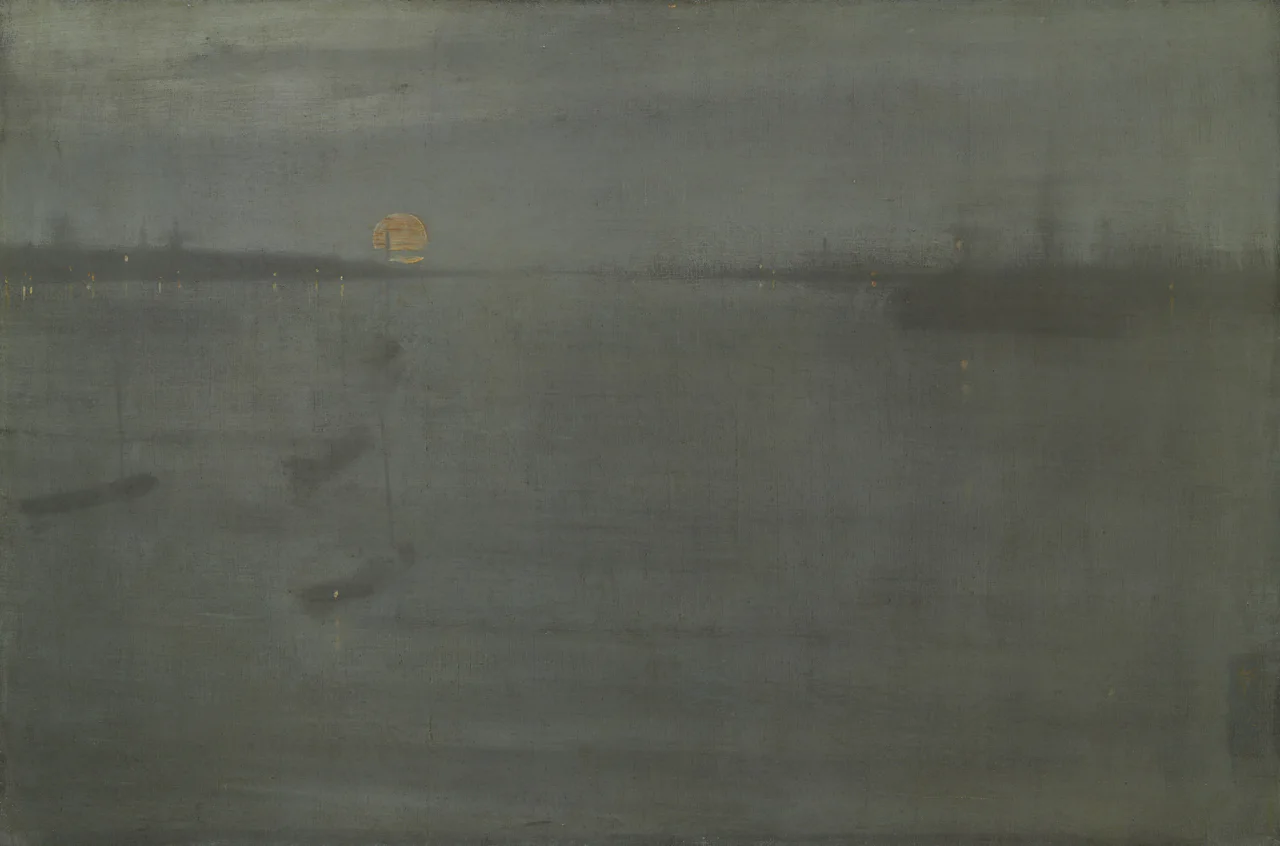
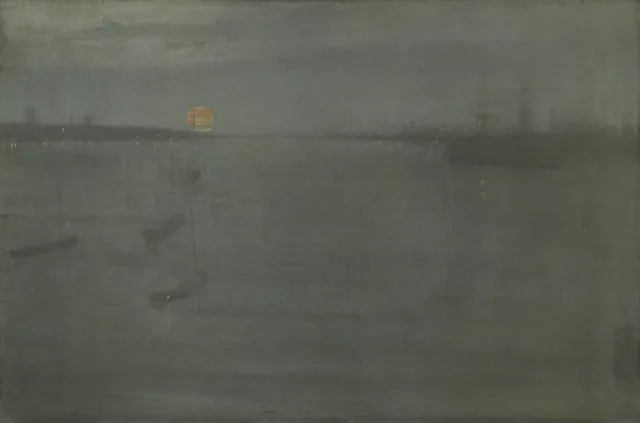
The first time you stand in front of this picture, it can feel a little puzzling. Almost the whole canvas is a hazy gray blue. No ship, no harbor, no person is clearly there. Then an orange circle near the upper left catches your eye. Is this really a painting of the sea?
This is Nocturne: Blue and Gold, Southampton Water, painted by James McNeill Whistler in 1872. It measures about 20 by 30 inches. Southampton Water is an inlet on the south coast of England that opens onto the English Channel. Big ships come and go there, but in this picture almost everything has sunk into the dusk.
Start with that orange circle.
It is the moon, but not a neat, full disk. A dark vertical stroke cuts through its left side, and its lower edge breaks off into a separate sliver. A few red horizontal strokes run across the yellow. It could almost be a lamp flickering in fog.
Now follow the horizon.
Below a dark band, tiny yellow dots are scattered along the shore. From each one a short yellow streak drips downward. These are lights and their reflections on the water. One quick touch of the brush, then one short pull down, and a harbor light and its shimmer are done.
So, about that title. A nocturne is a piece of music, a night song. The name became famous through quiet piano pieces by the Irish composer John Field and by Frédéric Chopin. Whistler borrowed the word for his paintings of the night.
At first he called these pictures his moonlights. The name nocturne was suggested by his patron Frederick Leyland, a Liverpool shipowner who was also a keen amateur pianist. Whistler wrote to thank him for it, and from around this time his night scenes carried the title.
Musical titles were a habit for Whistler. He called a portrait of a woman in white a Symphony in White, and the famous portrait of his mother an Arrangement in Grey and Black. Music does not need to describe anything to move us. It works through harmony. Whistler believed painting could work the same way, through harmonies of color alone. People call this idea art for art's sake.
That is why the color comes before the place in this title. Blue and gold. The blue is the hushed ground of the picture, and the moon and lights sit on it like a few small golden notes.
Finally, look down at the water.
In the middle of a soft dark smudge there is one yellow dot, with a thin yellow line trailing below it. It is too faint to say whether this is a boat or a buoy. The paint is so thin that the weave of the canvas shows straight through.
Not everyone loved these pictures. In 1877 the powerful critic John Ruskin mocked another of Whistler's nocturnes, comparing it to flinging a pot of paint in the public's face. Whistler sued him for libel. In 1878 he won, but the jury awarded him a single farthing, a quarter of a penny. Legal costs helped drive him into bankruptcy the following year.