Pyeongye
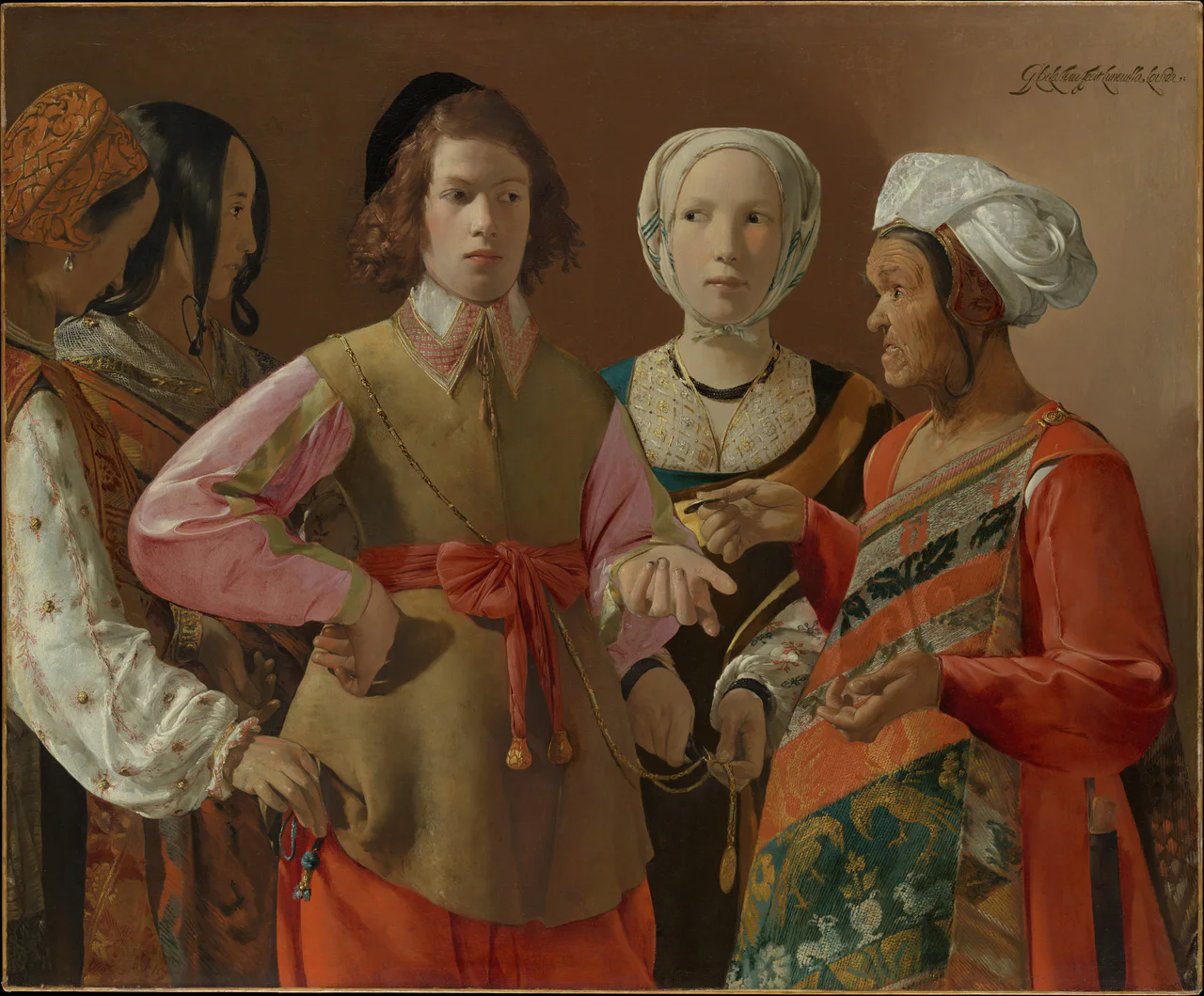
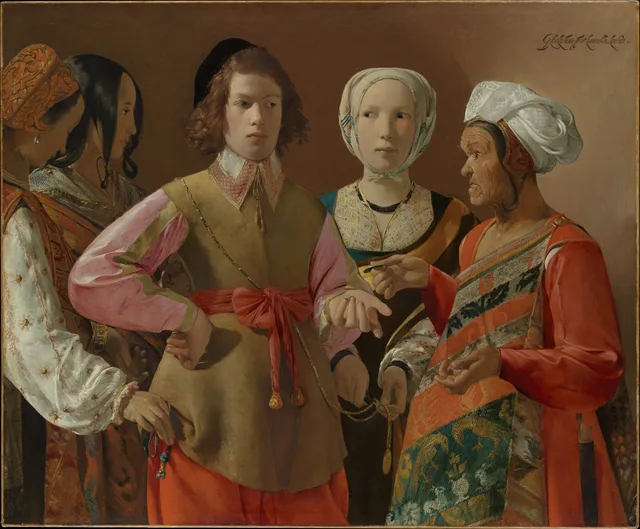
A young man in his finest clothes stands with one hand held out. Pink sleeves, a leather jerkin, a red sash knotted at the waist. On the right, an old woman with a deeply lined face is reading his palm. He looks serious. He wants to know what his future holds.
But the real action in this painting is not on his face. It is in the hands. Follow them one at a time, and you will see a future much closer than anything the fortune-teller is about to promise.
Georges de La Tour probably painted this in the 1630s. Look at the brown wall in the upper right and you will find his signature in flowing script. Next to his name he wrote the town of Lunéville, in Lorraine in eastern France, where he lived and worked.
Start with the pair of hands that seem to be the main event.
The young man holds his palm open and flat. Just above it, the old woman's fingers pinch a single coin. It looks like payment for her reading. La Tour painted even the dark rims at the tips of the young man's fingernails. Right now, all of his attention is on these two hands.
Now cross to the other side of him, on the left of the picture.
A woman's hand, coming out of a white sleeve with red embroidery, has slipped into the young man's side. Her fingers are drawing out a purse with a blue cord and tassel. Just above, a darker hand waits with its fingers spread. It looks ready to take the pouch and pass it along.
For hands this busy, the faces are remarkably calm. The woman in profile gazes steadily at the young man. The woman at the far left bows her head, so half her face is hidden.
Last comes the young woman in the middle, in a white headscarf. She looks at the young man only out of the corner of her eye. Her hands are lower down.
Both of her hands hold the gold chain that hangs across his chest. Between her fingers you can see a small dark blade. An oval gold medal dangles from the end of the chain. When the links give way, the medal will drop right into her palm.
La Tour did not invent this kind of scene. Before him, the Italian painter Caravaggio had painted a naive young man being tricked by a fortune-teller, and the subject spread among painters across Europe. What La Tour adds is the tight choreography of so many hands, each doing its own quiet job.
Many people know La Tour for a very different kind of picture: a single candle glowing in deep darkness. The Penitent Magdalen, also on this site, is one of those. The Fortune-Teller has no candle at all. Instead, an even, bright light lets every pattern in the fabric and every knuckle stand out clearly, which is exactly what you need to catch the thieves at work.