Pyeongye
Painters · 17th century
Georges de La Tour
1593–1652
A baker's son who painted quiet, candlelit night scenes in the small Lorraine town of Lunéville, then was almost forgotten for centuries after his death.
Scenes from a life
The life of Georges de La Tour,
scene by scene
- 1617Vic-sur-Seille
In 1617 there is a wedding in Vic-sur-Seille, a small town in the Duchy of Lorraine. The groom, Georges de La Tour, was a baker's son, baptized in the town in March 1593. The bride, Diane Le Nerf, was the daughter of a financial officer of Duke Henri II of Lorraine, from a family tied to the local nobility.
The baker's boy had married up. Who taught him to paint is still unknown. No record of his training has ever been found.
- 1620Lunéville
In 1620 La Tour moves to his wife's hometown of Lunéville. He petitioned Duke Henri II with a bold argument: painting was a noble art in itself, so he should be exempt from taxes like a nobleman. The duke granted him letters giving him privileges close to those of the nobility.
His son Étienne was born the next year, in 1621. In 1623 and again in 1624, the duke bought a painting from him. Neither of those pictures survives.
- 1638Lunéville
In the 1630s Lorraine was a war zone. Armies of the Thirty Years' War marched through, plague spread, and from 1633 French troops occupied the duchy. In 1638 Lunéville burned.
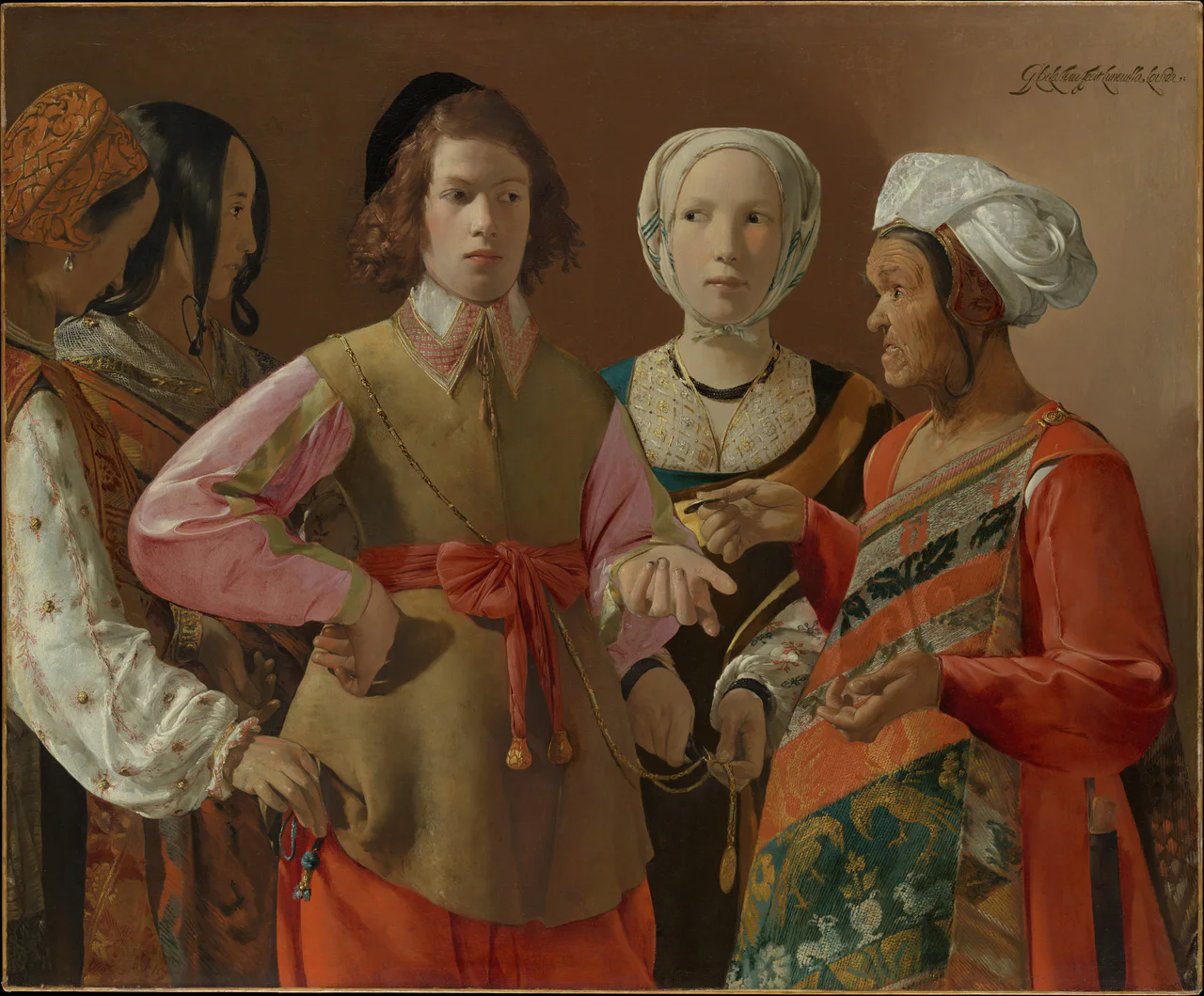
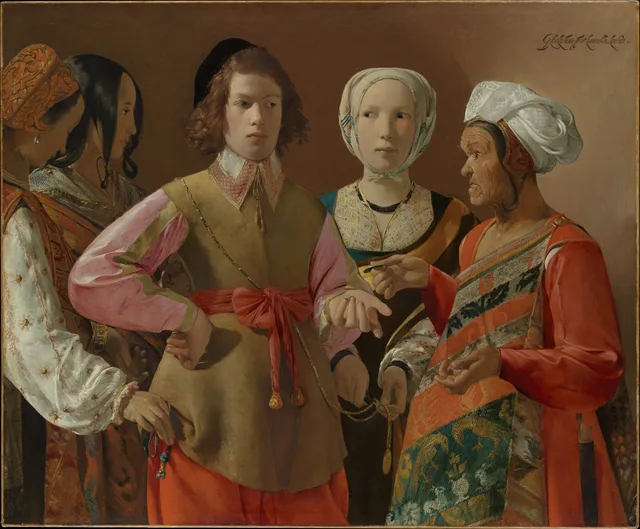
The Fortune-Teller is thought to date from this troubled decade. At right, a wrinkled old woman holds up a coin as she reads a young man's fortune. Meanwhile the hand of the woman at left slides toward his side, and a girl in a white headscarf has her fingers on his gold chain. In the upper right corner, the painter signed his name and the word Lunéville.
 Painted around this timeThe Fortune-Teller
- 1639Paris
In 1639 a record lists La Tour with the title of painter in ordinary to the king. The year after his home town burned, he had become a painter to Louis XIII of France.
It was the king of the very country occupying Lorraine who honored this painter from Lorraine. La Tour then went back to Lunéville and carried on working there.
- 1640sLunéville
His neighbors in Lunéville did not like the painter. Records say he struck an official, beat a peasant, and angered the townspeople by letting his dogs chase hares through their crops.
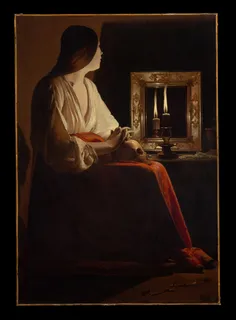
The Penitent Magdalen, from about the same time, is far from all that noise. Mary Magdalene folds her hands on a skull and gazes into a mirror. A second candle flame burns in the glass. A string of pearls lies on the table, and jewelry she has taken off lies on the floor.
Painted around this timeThe Penitent Magdalen - 1650Lunéville
In 1650, 650 francs are paid for a painting called The Denial of Saint Peter. It went to La Ferté, the French governor of Lorraine. The picture is thought to be the one of that subject now in the museum in Nantes, France. In his last years La Tour was painting for the powerful men of the occupying side.
- 1652Lunéville
In January 1652 an epidemic sweeps through Lunéville. His wife Diane died first, and a few weeks later, on January 30, La Tour died too. Around 1654 his son Étienne received the same title his father had held, painter in ordinary to the king.
After that, La Tour's name slipped almost out of memory. In 1915 the German scholar Hermann Voss gathered his paintings together again and brought him back. When the Metropolitan Museum bought The Fortune-Teller in 1960, there was an uproar in France, and the culture minister André Malraux had to answer questions about it in parliament.
People around them
- Diane Le NerfHis wife from 1617, from a family close to the nobility, whose hometown was Lunéville.
- Étienne de La TourHis son, born in 1621, who painted alongside him in the studio.
- Henri II of LorraineThe duke who granted him privileges and bought his paintings.
- Louis XIIIThe French king who gave him the title of painter to the king.
- La FertéThe French governor of Lorraine, who received several of his late paintings.
- Hermann VossThe German scholar who reassembled his work in 1915 and revived his name.
Works
Paintings by
Georges de La Tour on Pyeongye
Hidden stories in Georges de La Tour's paintings
Contemporaries