Pyeongye
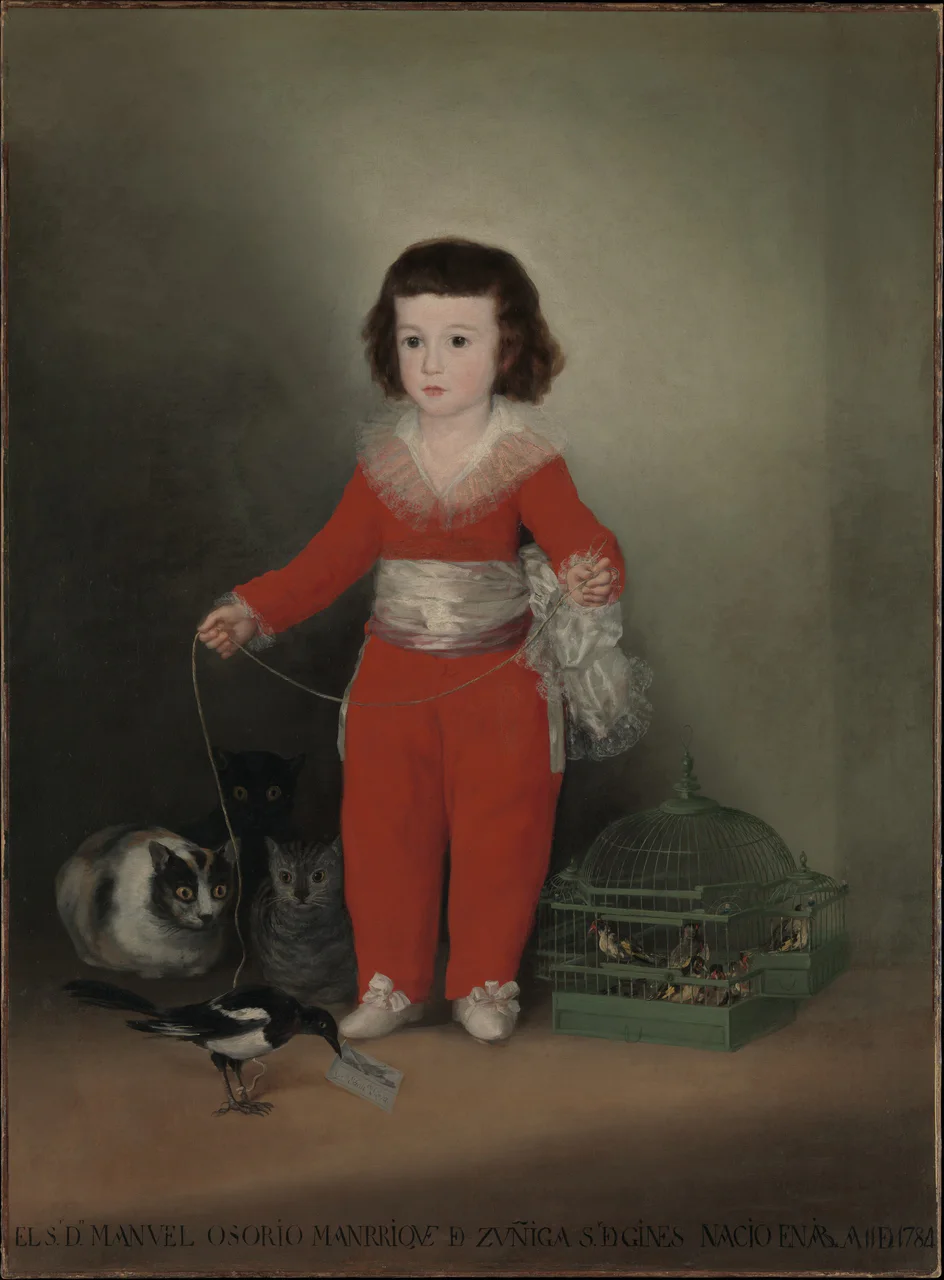
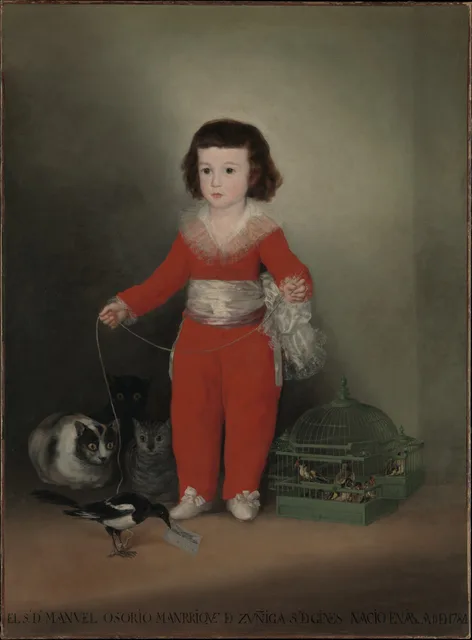
A small boy in a red suit stands and looks straight at us. His lace collar puffs out in white, and a silvery sash wraps his waist. In one hand he holds a string, and at the end of that string is a magpie. So far, this is a charming portrait of a child.
Stay with it a little longer, though, and look into the shadow on the boy's right. Round eyes are shining out of the dark. One pair, two, three. Three cats are staring at the same spot.
The boy's name runs across the bottom of the canvas in large capital letters: Manuel Osorio Manrique de Zúñiga. He was a son of the family of the Count of Altamira, Spanish nobles. The end of the inscription says he was born in 1784. Francisco de Goya painted him around 1787 or 1788, so Manuel was three or four years old.
Start with the magpie's beak.
The bird is holding a small white card. On it, in looping handwriting, is Goya's own name. It is the painter's calling card. Instead of tucking a signature into a corner, Goya let a bird carry his name in its beak, out in the open on the floor.
Now follow the eyes that are following that bird.
On the left, a white cat with black and orange patches lies curled up. On the right sits a gray tabby. Both have their eyes wide open. Behind them, in the darkness, is a black cat whose body you can barely make out. Only its two yellow eyes float in the shadow.
All of those eyes are aimed at the magpie on the floor. A bird tied to a string cannot fly very far. The boy does not seem to notice. He keeps looking out at us. His bright red suit sits right next to the deep dark where the cats are waiting.
There are more birds on the other side.
Inside a green cage, small birds crowd together. Their faces are red, and you can see yellow stripes on their wings. The bars keep the cats from reaching them. The same bars keep the birds from flying away.
In older European paintings, birds often stood for the human soul. Because of that, many people read this picture as a reflection on how fragile childhood is. That is an interpretation by later viewers, not something Goya wrote down. Still, once you have seen the cats, the portrait no longer feels simply sweet.
Around the same time, Goya also painted the boy's mother with his little sister. That picture is on this site too, as Condesa de Altamira and Her Daughter, María Agustina. Both paintings now hang in the same museum, the Metropolitan Museum of Art in New York.
The museum's title for this portrait adds two dates after the boy's name: 1784–1792. Manuel died in 1792, before he turned ten, only a few years after he posed for Goya. The painter could not have known. We, standing in front of the picture today, do.