 Pyeongye
Artwork · 19th century · James McNeill Whistler
LeoTurn on Magnifier at the lower right and move slowly across the painting.
Full screen opens it edge to edge.Tap the painting to fill the screen.
Spread two fingers to look closer.
At a glance
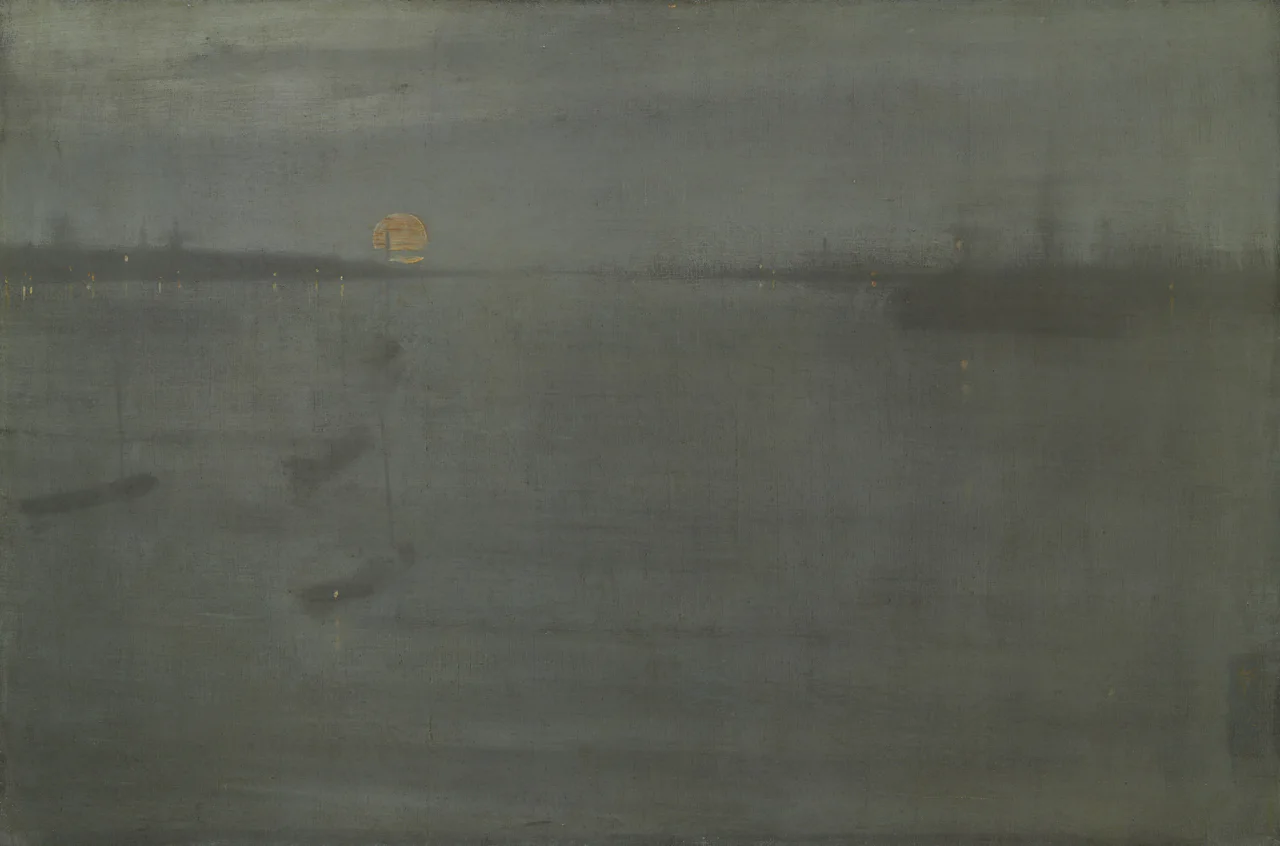
- Southampton Water, an inlet on England's south coast, sinking into the mist of night.
- James McNeill Whistler painted it in 1872, in the years he was making his series of night scenes called Nocturnes.
- Ships and shore have nearly vanished, leaving one moon and a few lights in a blue-gray dark.
Reading the picture
5 places to look closer
Tap a number on the painting to jump to its note, or a close-up to see that spot in the whole picture.
Zoom into the moon on the horizon at the upper left. It is an orange disk built from sideways strokes. But a thin vertical line slices through it, and its lower edge floats off as a separate sliver. It looks as if a ship's mast and drifting mist have broken the moon apart.
Look just below the horizon on the left. Tiny yellow dots sit in a row along a dark band. These are lights on the shore or on boats. Under each dot runs a short yellow stroke, so each light seems to shine back from the water.
Zoom into the horizon on the right. At first it looks empty. Keep looking, and tall masts and the hulls of large ships rise faintly, like ghosts. Whistler left these big vessels as nothing more than a few layers of shadow.
Move down to the water at the lower left. A small boat sits there like a dark smudge, with a single light glinting on it. Below, a yellow glimmer stretches across the water. In all that empty space, this one tiny light holds your eye.
Zoom into the bottom right corner. A faint mark that looks like an insect's wings appears there. Instead of writing his name, Whistler often signed with a butterfly-shaped monogram.
When it was painted
In 1872 Whistler was thirty-eight. Born in America and trained in Paris, he now lived in Chelsea, on the bank of the Thames in London. He had become absorbed in painting rivers and harbors at night.
He did not paint these night scenes on the spot. He would stand in the dark and study the water and the lights for a long time, fixing them in his memory, then paint them later in the studio. He thinned his paint with oil and turpentine into a runny mixture and laid it on in thin washes, so the weave of the canvas still shows through.
It was his patron, the shipping magnate Frederick Leyland, who suggested calling these pictures nocturnes. A nocturne is a piece of piano music about the night. In 1872 Whistler wrote to Leyland to thank him warmly for the name. He wanted people to look at his paintings the way they listened to music, as harmonies of color.
Not everyone was charmed. In 1877 the critic John Ruskin attacked another of the Nocturnes, writing that Whistler had flung a pot of paint in the public's face. Whistler sued Ruskin for libel and won the next year, but the jury awarded him a single farthing. Crushed by legal costs, he went bankrupt in 1879.
This painting entered the Art Institute of Chicago in 1900, while Whistler was still alive. Look again at the broken moon. In a darkness that critics once mocked, that small piece of moon is still quietly glowing.
The painter
James McNeill Whistler
1834–1903
When painting this, the artist was about 38 years old
All paintings by James McNeill Whistler →More by the same painter
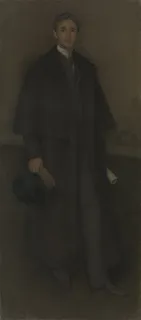
Hidden stories in this painting
Questions to think about
- Look for itHow many yellow lights can you find in the painting?
- Why?Why do you think Whistler named his paintings after a kind of piano music?
- What about you?Ruskin treated one of these pictures as a careless smear. When we look at a work today and think it was made with no effort, how far should we trust that judgment?
Same period
Painted around the same time,
somewhere else
Too good to keep to yourself
This painting,
for someone who comes to mind
They open it at full size
and see every brushstroke.
About this work
- Artist
- James McNeill Whistler · 1834–1903
- Date
- 1872
- Medium
- Oil on canvas
- Size
- 51 × 76.7 cm
- Culture
- London
- Collection
- The Art Institute of Chicago
- Image
- Original long edge 6442px · shown at 2560px
- Original
- View on the museum's website ↗