Pyeongye
Painters · 18th century
Canaletto
1697–1768
A Venetian who learned to paint fake palaces for the opera stage, then spent his life painting the real canals and squares of Venice for travelers to take home to England.
Scenes from a life
The life of Canaletto,
scene by scene
- 1720Rome
It is carnival season in 1720, and the curtain rises at the Teatro Capranica in Rome. Two new operas by Alessandro Scarlatti take the stage that season. The painted scenery behind the singers comes from a Venetian stage painter, Bernardo Canal, and his son Giovanni Antonio, then in his early twenties.
Back in Venice, the young man turned from painted streets to real ones. People called him Canaletto, little Canal, to tell him apart from his father.
- 1725Venice
On July 14, 1725, the Venetian painter Alessandro Marchesini writes to Stefano Conti, a cloth merchant in Lucca. Conti wants views of Venice and has asked for pictures by the older view painter Luca Carlevarijs. Marchesini pushes back and steers him toward the young Canaletto instead.
Canaletto went on to paint four Venetian views for Conti. The merchant kept careful records of what he bought, with prices and the artist's own descriptions. Those letters tell us a great deal about Canaletto in the 1720s, including that he liked to prepare his pictures on the spot, outdoors.
- 1727Venice
An Irishman in Venice, Owen McSwiny, writes to the Duke of Richmond in England. He is keeping an eye on the paintings the duke has ordered from Canaletto. The painter, he complains, is whimsical and has far more work than he can manage.
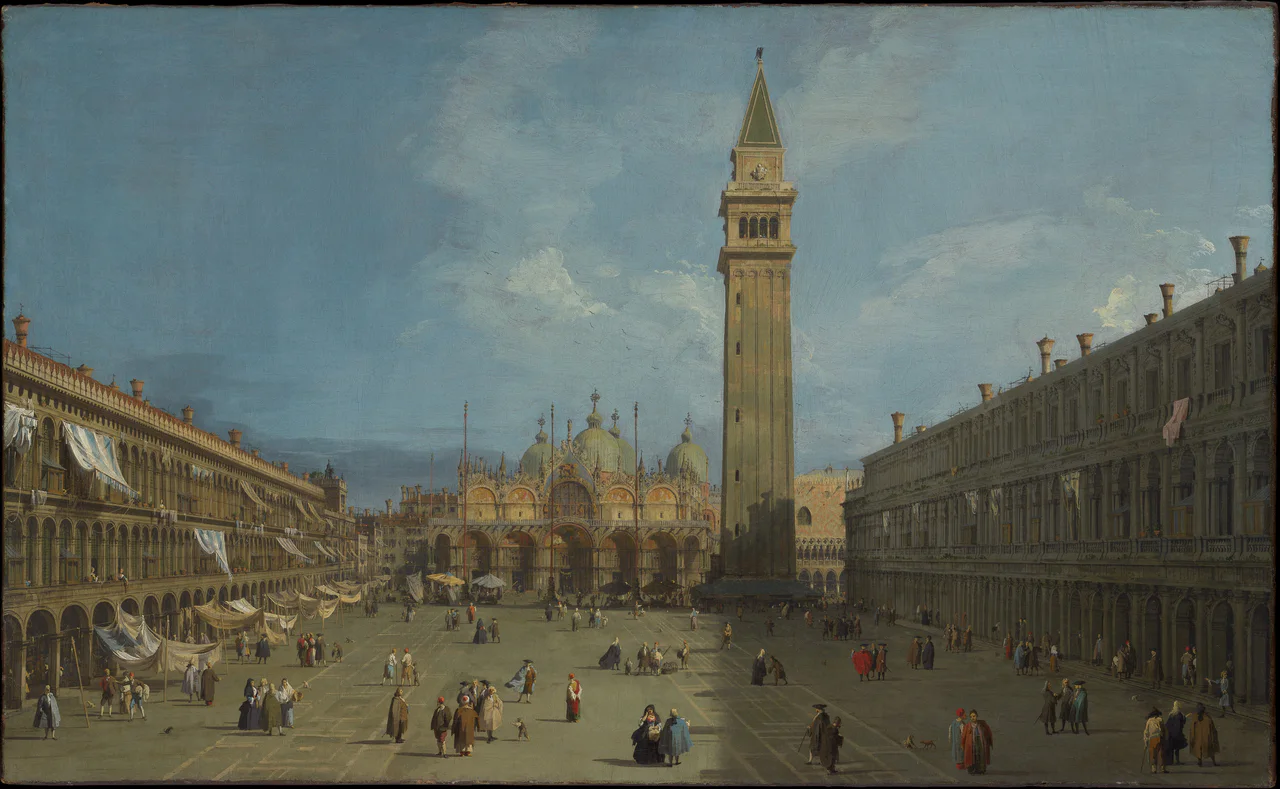
Piazza San Marco belongs to these busy years. Market awnings line the great square in front of the basilica, and men in black tricorn hats stroll among shoppers. The museum points out that the paving in the picture shows a stage of the repaving work done between 1725 and 1727.
 Painted around this timePiazza San Marco
- 1735Venice
In the house of Joseph Smith, an English merchant living in Venice, Canaletto's paintings keep piling up. In 1735 fourteen of Smith's Grand Canal views come out as engravings, bound together as a book. The plates were cut by the architect and engraver Antonio Visentini.
Now people who had never been to Venice could leaf through Canaletto's canals. Smith became the go-between for English visitors who wanted a view to take home. In 1762 he sold his Canaletto collection to King George III.
- 1741Venice
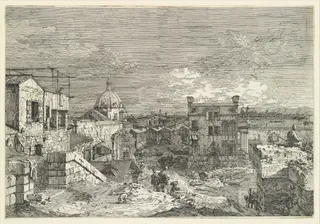
In 1740 the War of the Austrian Succession breaks out. Fewer English travelers cross the Alps, and orders slow down. Canaletto picks up a copper plate and an etching needle.
He titled his set of etchings Views, some taken from real places and some imagined, and dedicated it to Joseph Smith. Imaginary View of Venice on this site is one sheet from that set. On the wall of the house at left you can read MDCCXLI, the year 1741 in Roman numerals. At right, a man sits on a crumbling wall and looks down at the boats below.
Painted around this timeImaginary View of Venice, houses at left with figures on terraces, a domed church at center in the background, boats and boat-sheds below, and a seated man observing from a wall at right in the foreground, from "Views" (Vedute altre prese da i luoghi altre ideate da Antonio Canal) - 1746London
In May 1746, Canaletto arrives in London. His name is already known there. Soon he is painting the Thames and Whitehall from the windows of the Duke of Richmond's London house.
A few years later an odd rumor spread: his English pictures were not as good, so perhaps he was not the real Canaletto. On July 25, 1749, he answered with a newspaper advertisement. Any gentleman, it said, could come to his lodgings at Mr. Wiggan's, a cabinet maker in Silver Street, Golden Square, and see his new view of St. James's Park.
- 1752Warwick
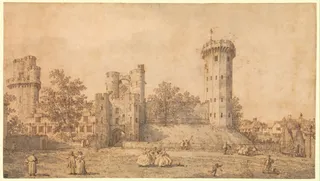
One client who kept coming back was Lord Brooke, owner of Warwick Castle. He was having the grounds reshaped by the landscape designer Lancelot Brown. Canaletto painted and drew the castle from several sides.
Warwick Castle: The East Front is a drawing from 1752. Visitors stand before walls drawn stone by stone, and at the very bottom a child runs past with a long pole over one shoulder. Around 1755 Canaletto went home to Venice.
Painted around this timeWarwick Castle: The East Front - 1763Venice
In January 1763 the Venetian Academy votes on new members, and the sixty-five-year-old Canaletto is turned down. On September 11 that year he is voted in. He was late with his required reception piece and handed it in only in 1765. It was an imagined scene of grand architecture, not a real view.
Canaletto died in Venice on the night of April 19, 1768. He was buried in San Lio, the church where he had been baptized. His Venice now lives on in collections far from home, including the three pictures on this site.
People around them
- Bernardo Canalhis father and first teacher, with whom he painted opera scenery in Rome.
- Joseph Smithan English merchant and later consul in Venice, and Canaletto's most important client.
- Owen McSwinyan Irishman in Venice who handled the Duke of Richmond's orders and wrote about the painter's moods.
- Duke of Richmondan English patron who ordered his work from Venice and later had him paint the view from his London house.
- Antonio Visentinithe engraver who turned Smith's Canalettos into a printed book.
- Bernardo Bellottohis sister's son, who trained in his studio and became a view painter himself.
Works
Paintings by
Canaletto on Pyeongye
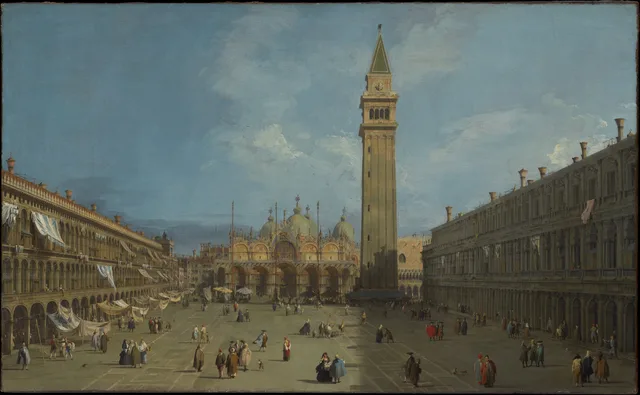 Piazza San Marcolate 1720s
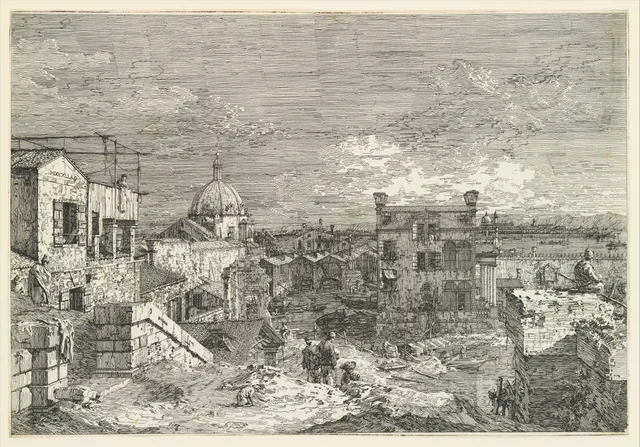 Imaginary View of Venice, houses at left with figures on terraces, a domed church at center in the background, boats and boat-sheds below, and a seated man observing from a wall at right in the foreground, from "Views" (Vedute altre prese da i luoghi altre ideate da Antonio Canal)1741
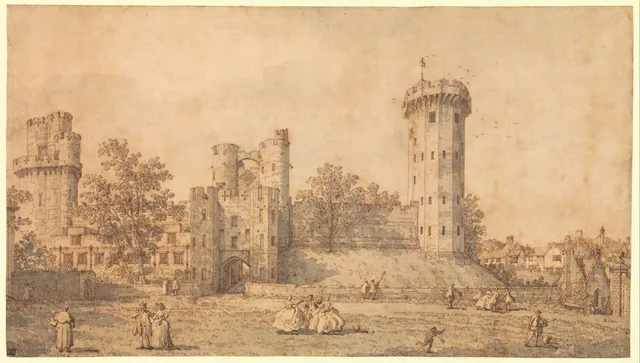 Warwick Castle: The East Front1752