Pyeongye

Painters · 20th century
Henri Rousseau
1844–1910
A Paris tax clerk who taught himself to paint, Rousseau built jungles he had never seen out of hothouse plants, zoo animals and pictures in books.
Scenes from a life
The life of Henri Rousseau,
scene by scene
- 1863Angers
Henri Rousseau is not yet twenty when he is accused of taking a little money and some stamps from the lawyer's office in Angers where he works. After that, he joins the army. He was born in Laval in 1844, the son of a tinsmith.
In the barracks he met soldiers back from the French expedition to Mexico and listened to their stories. Years later he liked to hint that he had been to Mexico too. Scholars agree he never left France. His jungles were not memories. They were made up from the start.
- 1871Paris
His father died in 1868, and Rousseau left the army and moved to Paris. Around then he married Clémence Boitard. In 1871 he took a job with the Paris octroi, the office that checked goods such as wine coming through the city gates and charged a tax on them.
Friends later called him le Douanier, the customs man, though he never worked in customs. The nickname stuck for good. The couple had several children, but only their daughter Julia lived to grow up. Clémence died in 1888.
- 1884Paris
A forty-year-old tax clerk receives a permit to copy paintings in the Louvre. Rousseau had never gone to art school. He learned by standing in front of pictures in the museums.
Two years later he sent four works to the second Salon des Indépendants, a show with no jury where anyone could hang a picture. One was A Carnival Evening: two small figures in white costumes stand under the moon before a bare winter wood. From then on he showed there almost every year.
- 1891Paris
A tiger appears on the walls of the Indépendants. It crouches in grass bent flat by wind and rain. Rousseau called it Surprised!, and it was his first jungle picture.
Many critics sneered that it looked like a child's drawing. But the Swiss painter Félix Vallotton wrote a newspaper review that praised the tiger warmly and told readers not to miss it. Two years later, in 1893, Rousseau left the tax office and lived on a small pension so he could paint full time.
- 1905Paris
At the autumn Salon that year, a huge jungle by Rousseau goes on the wall: a hungry lion leaping on an antelope. In the same show Matisse and a group of young painters hung canvases in loud, raw color. The critic Louis Vauxcelles called them wild beasts, and the name Fauves came out of that exhibition.
So a self-taught painter of sixty-one found himself in the same show as the newest young artists. For his jungles, Rousseau visited the hothouses and the zoo at the Jardin des Plantes in Paris and collected animal pictures from books and magazines.
- 1907Paris
In December the police arrest Rousseau and lock him up. An old acquaintance, Louis Sauvaget, had drawn him into a fraud against the Bank of France. At the trial in January 1909, his lawyer showed the jury one of his jungle paintings full of monkeys. The point was plain: could a man this innocent plan a swindle? Rousseau was found guilty, but his sentence was suspended.
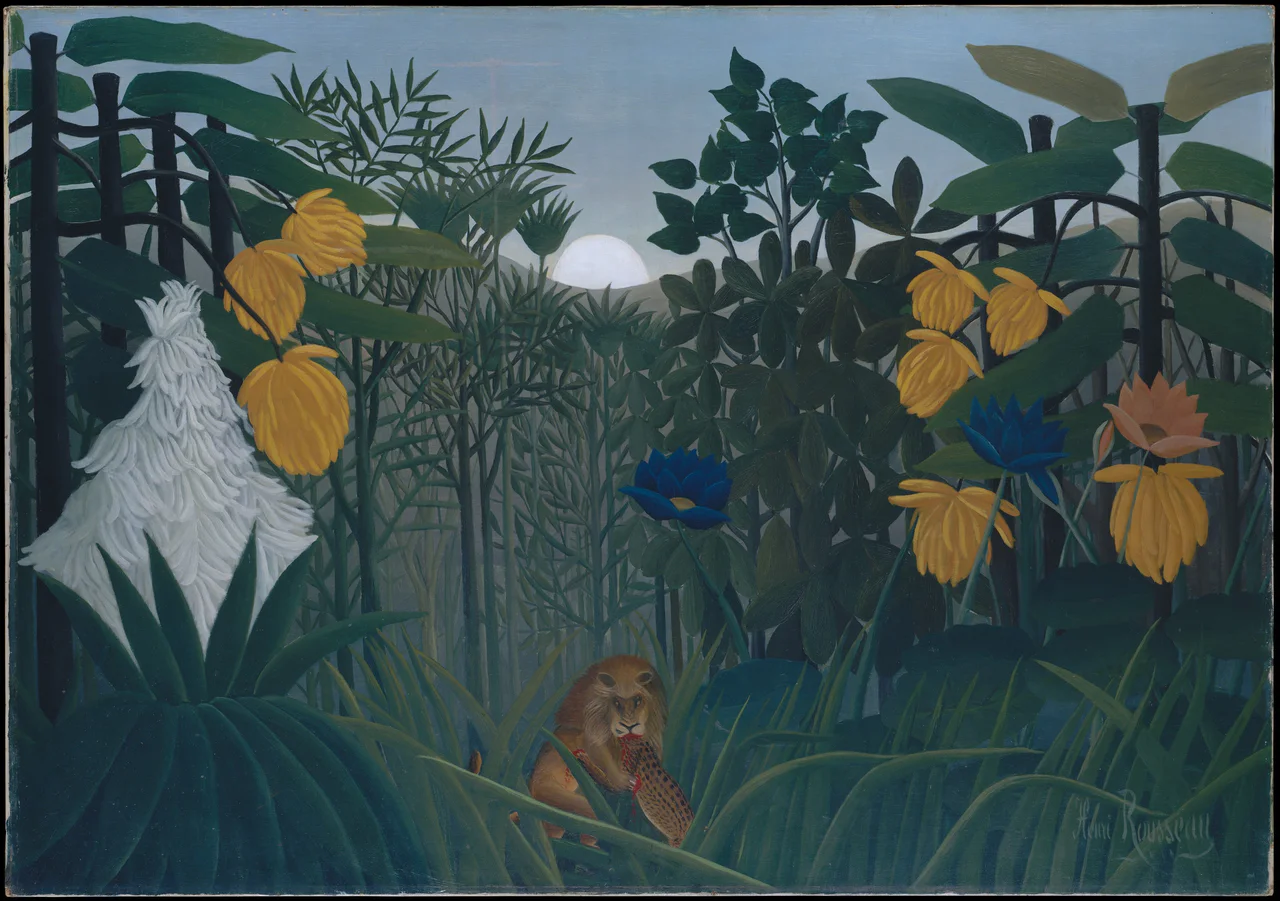
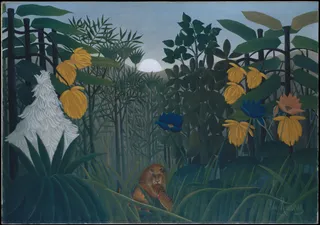
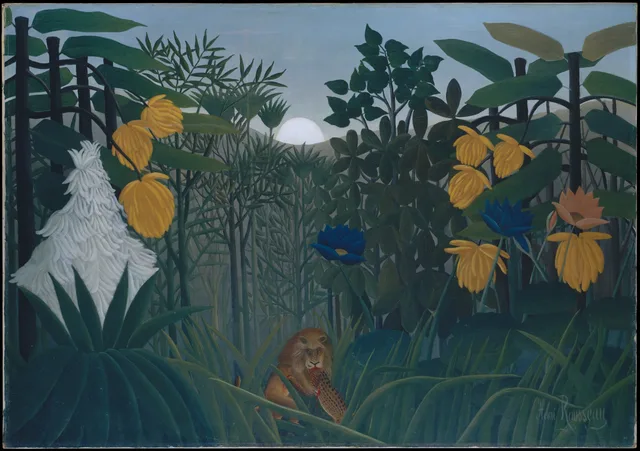
Look at The Repast of the Lion from these years. Low in the middle, a lion grips a spotted animal in the grass. Yet the lion is looking at us, not at its meal. Above hang yellow bunches of bananas and blue flowers, and a round white sun sits in the sky.
 Painted around this timeThe Repast of the Lion
- 1908Paris
One November night, a party fills the shabby studio building in Montmartre known as the Bateau-Lavoir. The young Picasso was throwing a dinner for Rousseau, then sixty-four. Not long before, Picasso had picked up a Rousseau portrait of a woman for very little. The poet Apollinaire, the painter Marie Laurencin, Gertrude Stein and Alice Toklas were among the guests.
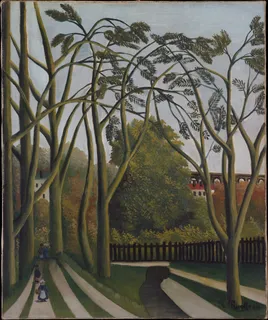
Apollinaire recited verses in Rousseau's honor, and Rousseau took out his violin and played. The party was half a joke and half sincere. In The Banks of the Bièvre near Bicêtre, from about this time, thin trees curve up into the sky. On the path at lower left a woman in a white bonnet and white apron carries a basket, and behind the trees on the right runs a long row of arches.
 Painted around this timeThe Banks of the Bièvre near Bicêtre
- 1910Paris
In March, Rousseau sends The Dream to what would be his last Indépendants: a woman lying on a sofa in the middle of a jungle. Apollinaire wrote in praise of it.
That summer a wound in his leg turned gangrenous. Rousseau died at the Necker hospital in Paris on 2 September. In 1913 the sculptor Brancusi and the painter Ortiz de Zárate carved a poem by Apollinaire on his gravestone. His lion and his riverbank now hang in the Metropolitan Museum of Art in New York.
People around them
- Clémence Boitardhis first wife, with him until her death in 1888.
- Félix Vallottonthe Swiss painter who praised Surprised! in print in 1891.
- Alfred Jarrya writer from Rousseau's hometown of Laval and a close friend.
- Pablo Picassowho threw a banquet for him in his studio in 1908.
- Guillaume Apollinairethe poet who wrote verses in his honor and the lines carved on his grave.
Works
Paintings by
Henri Rousseau on Pyeongye
Hidden stories in Henri Rousseau's paintings
Contemporaries