 Pyeongye
Artwork · 15th century · Maestro delle Storie del Pane
LeoTurn on Magnifier at the lower right and move slowly across the painting.
Full screen opens it edge to edge.Tap the painting to fill the screen.
Spread two fingers to look closer.
Portrait of a Man, possibly Matteo di Sebastiano di Bernardino Gozzadini
Maestro delle Storie del Pane1494(?)Tempera on wood52.7 × 37.1 cm
At a glance
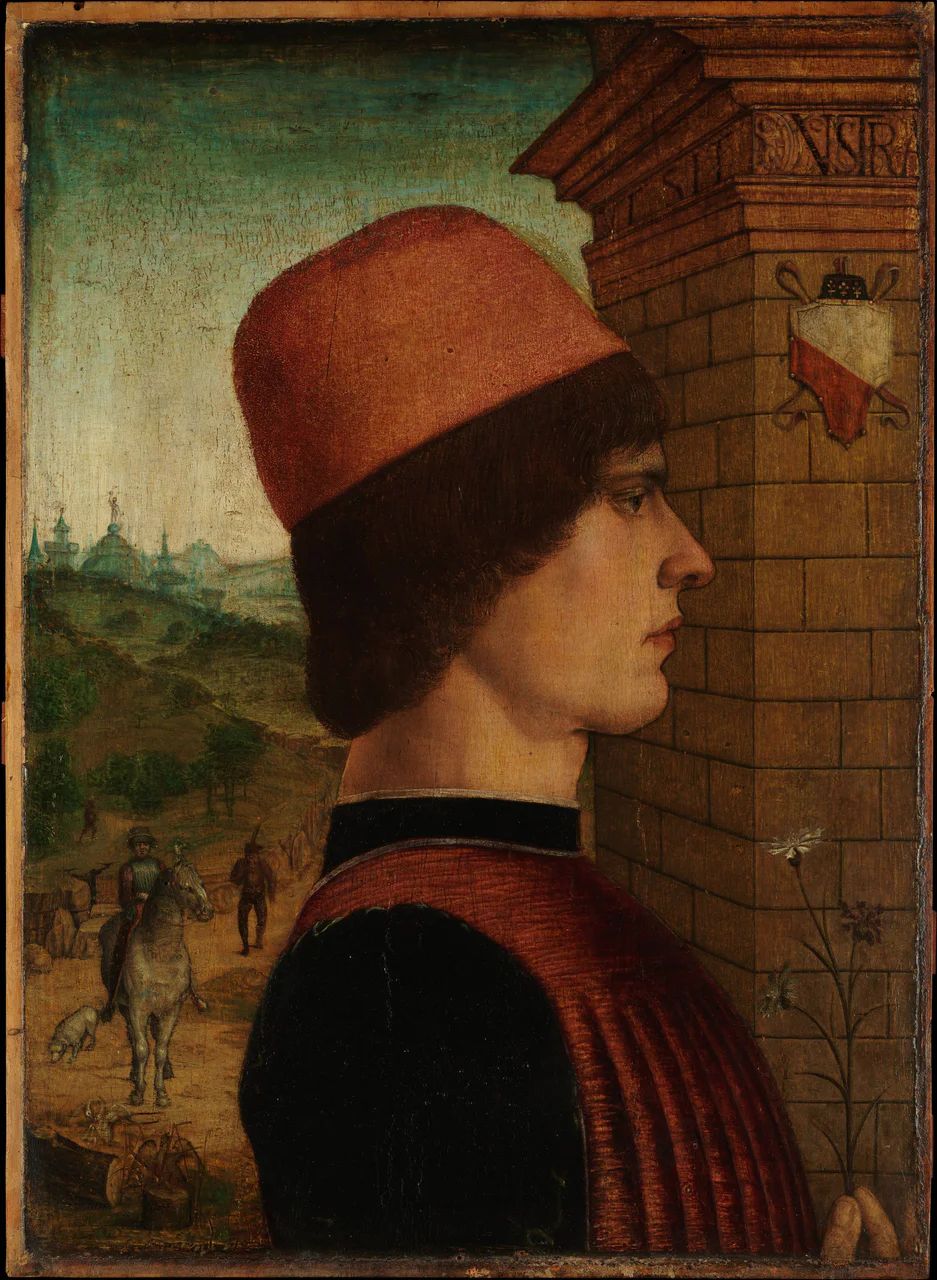
- A young man in a red cap is shown in profile, facing right, with a brick building beside him and a winding country road behind.
- An unnamed painter known as the Master of the Story of the Bread made it in tempera on wood, probably in 1494. The sitter may be Matteo Gozzadini of Bologna.
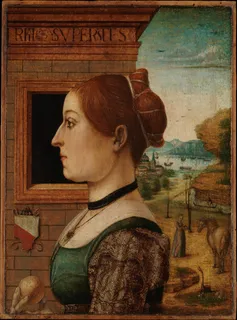
- It has a partner, a portrait of a woman by the same hand, and the two make more sense together than apart.
Reading the picture
4 places to look closer
Tap a number on the painting to jump to its note, or a close-up to see that spot in the whole picture.
Start at the top right corner of the building. Large letters are carved into the band under the cornice, but the edge of the panel cuts them off. Below hangs a coat of arms: a white shield crossed by a slanting red band. It tells the viewer which family this young man belongs to.
Now drop to the bottom right corner. Two fingers rise from the lower edge of the panel, pinching a slender stem. At the top it opens into a white flower and a purple one, with thin leaves and jagged petal tips. These are carnations. In portraits of this period, the carnation often hinted at an engagement or a marriage.
Look along the road at the lower left. A man in a hat sits on a gray horse, and behind him another figure walks with a pole over his shoulder. At the horse's feet a small animal has its nose to the ground. Behind the sitter, ordinary life goes on.
Zoom in on the town on the far hill. Its domes and pointed towers fade into a blue-green haze. On top of the biggest dome stands a statue with one arm raised high. By blurring what is far away, the painter makes the scene feel deep.
When it was painted
Picture Bologna around 1494. The man who really ran this northern Italian city was Giovanni II Bentivoglio. The Gozzadini were one of Bologna's old noble families, and this young man seems to belong to them.
We don't know the painter's name. His nickname comes from a set of wall paintings in a castle in the countryside near Bologna, where Bentivoglio went to relax. In one room, the walls follow bread from start to finish, from sowing the grain to serving it at a banquet. Scholars see the same hand in this portrait, so they call the artist the Master of the Story of the Bread.
The long name in the title is a family tree in miniature. Matteo di Sebastiano di Bernardino means Matteo, son of Sebastiano, who was the son of Bernardino. The museum is careful, though. It says the sitter is only possibly Matteo.
This panel was made to hang beside a partner, Portrait of a Woman, possibly Ginevra d'Antonio Lupari Gozzadini. The pair was probably painted to mark an engagement or a wedding. Read the carved letters on both cornices in a row and you get one Latin sentence: VT SIT NOSTRA FORMA SVPERSTES. It means, roughly, so that our likeness may survive.
Centuries later, both panels belonged to the Lehman family, the New York bankers. In 1975 they entered the Metropolitan Museum of Art with the Robert Lehman Collection. Even their museum numbers sit side by side, 1975.1.95 and 1975.1.96.
Now look back at the cornice at the top right. The letters cut off by the edge, SIT among them, are the start of that sentence. The rest waits on his wife's panel.
More by the same painter
Questions to think about
- Look for itWhere do the fingers holding the flower stem come from?
- Why?Why might the painter have shown the man in strict profile, like a head on a coin, instead of from the front?
- What about you?This young man introduces himself with a family coat of arms and a single flower. When we choose one profile picture today, what do we put in it to say who we are?
Same period
Painted around the same time,
somewhere else
Too good to keep to yourself
This painting,
for someone who comes to mind
They open it at full size
and see every brushstroke.
About this work
- Artist
- Maestro delle Storie del Pane · 1470–1500
- Date
- 1494(?)
- Medium
- Tempera on wood
- Size
- 52.7 × 37.1 cm
- Collection
- The Metropolitan Museum of Art
- Image
- Original long edge 3871px · shown at 2560px
- Original
- View on the museum's website ↗