 Pyeongye
Artwork · 15th century · Maestro delle Storie del Pane
LeoTurn on Magnifier at the lower right and move slowly across the painting.
Full screen opens it edge to edge.Tap the painting to fill the screen.
Spread two fingers to look closer.
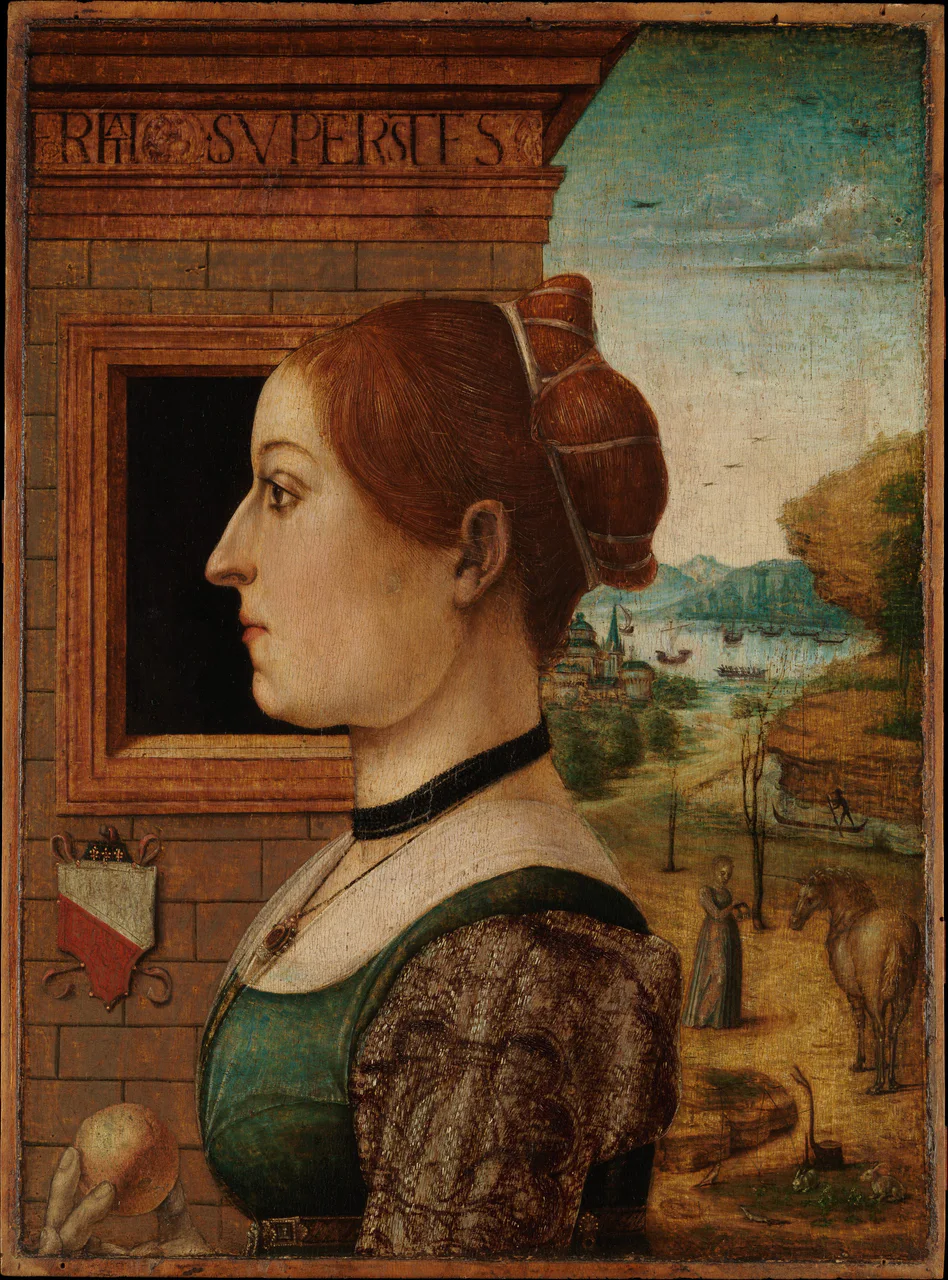
Portrait of a Woman, possibly Ginevra d'Antonio Lupari Gozzadini
Maestro delle Storie del Pane1494?Tempera on wood50.2 × 37.1 cm
At a glance
- A young woman with red hair bound up in white ribbons is shown in profile, facing left, against a lake, mountains and woods.
- The painter known as the Master of the Story of the Bread made it in tempera on wood, probably in 1494. The sitter may be Ginevra Gozzadini of Bologna.
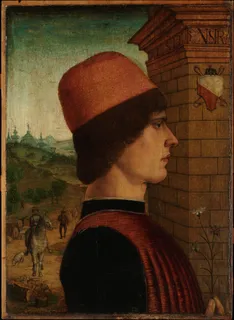
- She is paired with a portrait of a man who may be her husband, and a maiden with a unicorn hides in the landscape behind her.
Reading the picture
4 places to look closer
Tap a number on the painting to jump to its note, or a close-up to see that spot in the whole picture.
Zoom in on the back of her head. Her red hair is gathered, rolled into a rounded bun and wrapped several times with white ribbon. Each strand is drawn with a fine line of the brush, catching the light. You can follow the combed lines all the way down to her ear.
Move down to her neck. A black velvet band circles her throat, and below it a red jeweled pendant hangs from a thin cord. It sits against the white edge of her chemise and the green of her dress.
Look at the bottom left corner. A hand rises from the lower edge of the panel, holding up a round fruit. It is golden with a blush of red, and you can even see the mark where the stem was. In the partner portrait, a hand in the same spot holds a flower. Side by side, the two hands seem to be offering each other gifts.
Now look deep into the landscape on the right. A woman in a long gown stands holding something out, and a horse-like animal with a long horn on its forehead walks up to her. It is a unicorn. Old stories said a unicorn would grow gentle only before a pure young woman. That is why it often appeared in art as a sign of a woman's chastity.
When it was painted
Start at the top, on the carved cornice. One Latin word stands out: SUPERSTES, meaning one who survives. It is actually the last word of a longer sentence. The sentence begins on this portrait's partner, Portrait of a Man, possibly Matteo di Sebastiano di Bernardino Gozzadini.
Put the two cornices together and they read VT SIT NOSTRA FORMA SVPERSTES, roughly so that our likeness may survive. Both panels also show the same coat of arms, a white shield crossed by a slanting red band. The pair was probably made to celebrate an engagement or a marriage.
Her name in the title tells a small story too. Ginevra d'Antonio Lupari means Ginevra, daughter of Antonio Lupari. Gozzadini is the name of an old noble family of Bologna. Still, the museum only says the sitter is possibly Ginevra, because no one can be sure.
Around 1494 the real power in Bologna was Giovanni II Bentivoglio. In his country castle outside the city, where he went to relax, one room is painted with the story of bread, from sowing the grain to serving loaves at a banquet. The painter of these portraits left no name, but scholars see the same hand in them. So they call him the Master of the Story of the Bread.
Centuries later, the two panels belonged to the Lehman family, the New York bankers. In 1975 they came to the Metropolitan Museum of Art with the Robert Lehman Collection. The couple still live together in one museum.
Now follow her gaze. She looks to the left, toward the place where her husband's profile would hang. That single word above her, SUPERSTES, still ties the two faces into one sentence.
More by the same painter
Questions to think about
- Look for itCan you find the two little rabbits in the grass at the bottom right?
- Why?Why do you think the painter put a fruit in her picture and a flower in his?
- What about you?This couple marked their marriage with a pair of paintings. When we make an important promise today, what do we use to remember it, and what meaning do we put into it?
Same period
Painted around the same time,
somewhere else
Too good to keep to yourself
This painting,
for someone who comes to mind
They open it at full size
and see every brushstroke.
About this work
- Artist
- Maestro delle Storie del Pane · 1470–1500
- Date
- 1494?
- Medium
- Tempera on wood
- Size
- 50.2 × 37.1 cm
- Collection
- The Metropolitan Museum of Art
- Image
- Original long edge 3869px · shown at 2560px
- Original
- View on the museum's website ↗