 Pyeongye
Artwork · 15th century · Francesco di Giorgio Martini
LeoTurn on Magnifier at the lower right and move slowly across the painting.
Full screen opens it edge to edge.Tap the painting to fill the screen.
Spread two fingers to look closer.
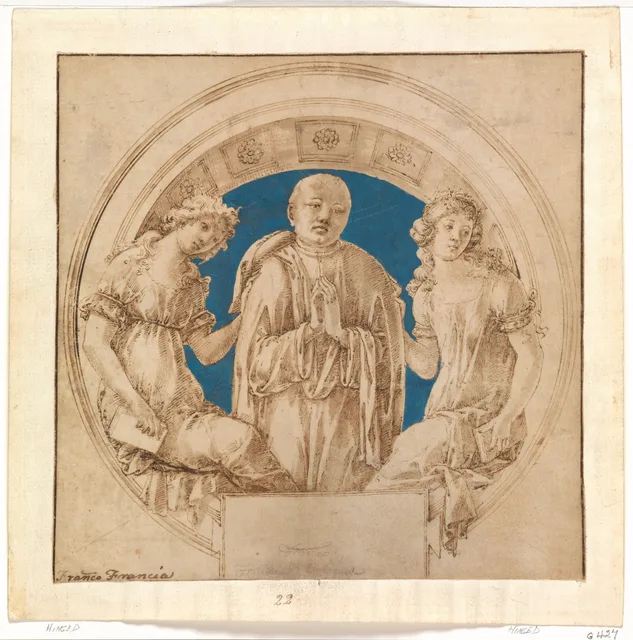
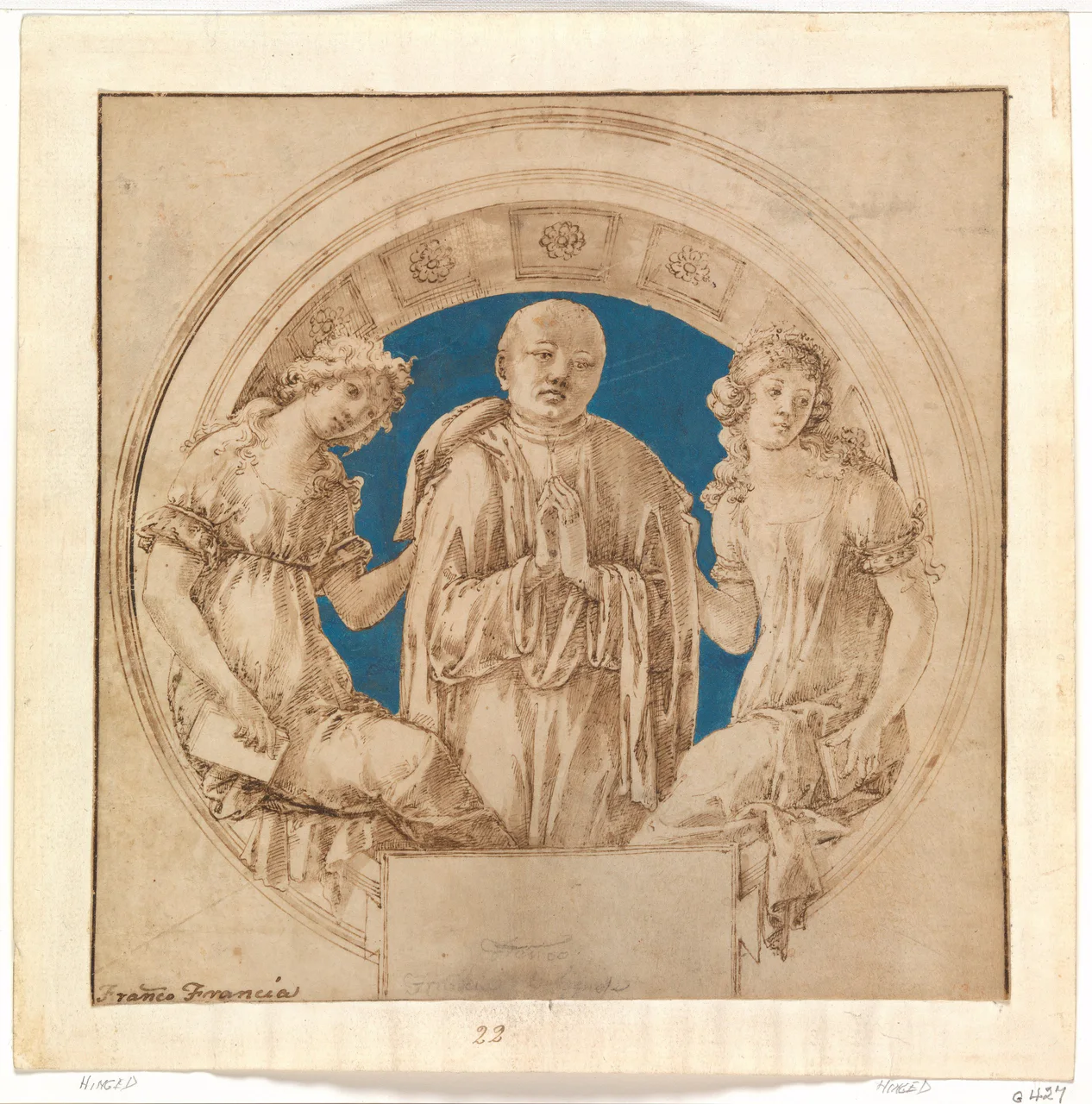
Design for a Wall Monument
Francesco di Giorgio Martinica. 1490Pen and brown ink, brush and brown wash, blue gouache, on vellum18.4 × 18.4 cm
At a glance
- Inside a round arch, a man holds his hands pressed together, framed by two seated figures. It is a design for a monument set against a wall.
- Francesco di Giorgio Martini, a painter and architect from Siena, drew it around 1490.
- On a piece of vellum just over seven inches square, he worked in brown pen and painted only the background blue, to preview how the carved monument would look.
Reading the picture
5 places to look closer
Tap a number on the painting to jump to its note, or a close-up to see that spot in the whole picture.
Zoom in on the face of the man in the middle. His hair is cropped short, his cheeks are full, and his mouth is firmly closed. It does not look like an idealized face. It looks like a portrait of a real person. Yet nowhere on the sheet is his name written.
Look at the underside of the arch. A row of square panels runs along it, and each holds a round, many-petaled flower. Panels like these, called coffers, go back to the buildings of ancient Rome. Double lines around each square show that it is sunk into the stone.
Zoom in on the hand of the seated figure at the left. It holds a squarish book upright on its lap. The folds of the robe are packed with slanting hatching. Over the pen lines, a thin brown wash deepens the shadows.
Now look behind the shoulder of the figure at the right. A pointed shape, like the tip of a wing, rises there. The figure has thick curly hair and tilts its head to look toward the man in the middle.
Look at the empty rectangle at the very bottom. Nothing is written on it. On a monument, this is usually where a name or an inscription would go. The faint pencil writing near its lower edge, the number 22 underneath, and the words Franco Francia in the lower left corner all seem to have been added later by someone else.
When it was painted
Around 1490, Francesco di Giorgio was in his early fifties. He had started out as a painter in his hometown of Siena, and for a time he shared a workshop there with the painter Neroccio de' Landi. Then he moved to Urbino, where he built fortresses for its ruler, Federico da Montefeltro, and made his name.
He was a sculptor and an architect as well as a painter. He also wrote treatises on architecture and engineering, full of drawings of city walls, fortresses, and machines for lifting loads and raising water. In 1490 he was called to Milan to give advice on the great central tower of its cathedral.
That June he also went to Pavia to advise the builders of its new cathedral, and Leonardo da Vinci traveled with him. Leonardo owned a manuscript copy of Francesco's treatise and wrote his own notes in its margins. That book is now in the Laurentian Library in Florence.
Nobody knows for sure what this small sheet of vellum was for. The Met suggests it may record an idea for a tomb sculpture, or perhaps for a painting. Another proposal is that it was made as the opening page of his treatise on machines. If so, the man in the middle could be a self-portrait.
Francesco died in 1501. Centuries later the drawing entered the collection of the New York banker Robert Lehman, and in 1975 it came to the Met with the Robert Lehman Collection.
Look again at the man in the center. That cropped hair and firmly closed mouth may belong to the builder of fortresses himself.
Questions to think about
- Look for itHow many square panels with flowers can you count in the arch?
- Why?Why do you think the artist left everything brown and painted only the background blue?
- What about you?The man honored here survives as a face without a name. When we build monuments and memorials today, whose names go on them, and whose are left off?
Same period
Painted around the same time,
somewhere else
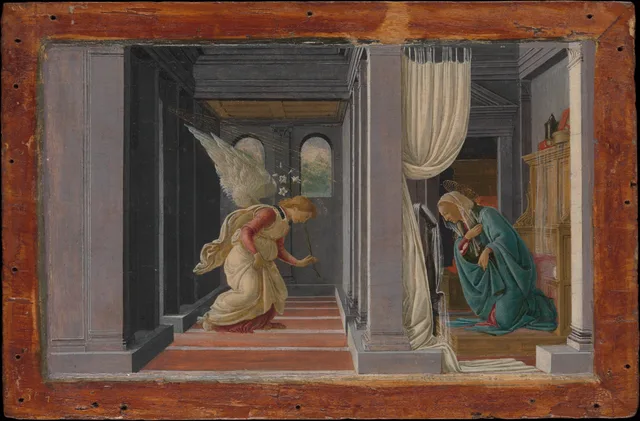 The AnnunciationBotticellica. 1490
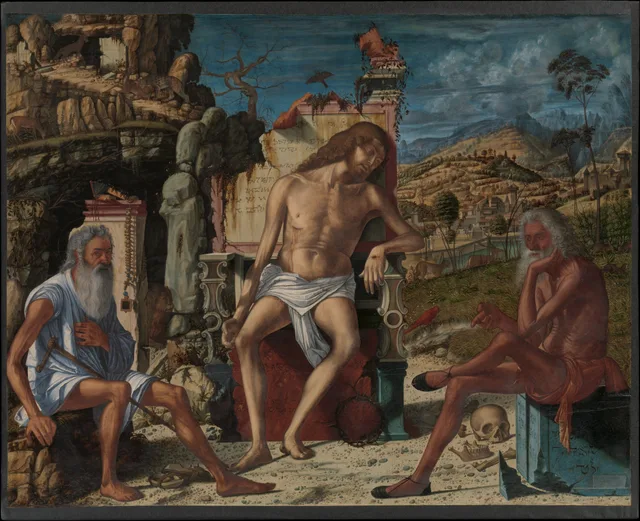 The Meditation on the PassionVittore Carpaccioca. 1490
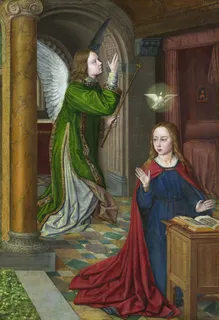 The AnnunciationJean Hey1490–95
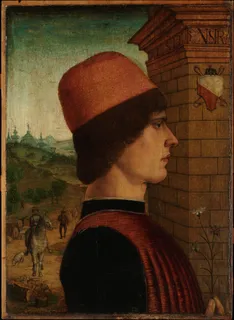 Portrait of a Man, possibly Matteo di Sebastiano di Bernardino GozzadiniMaestro delle Storie del Pane1494(?)
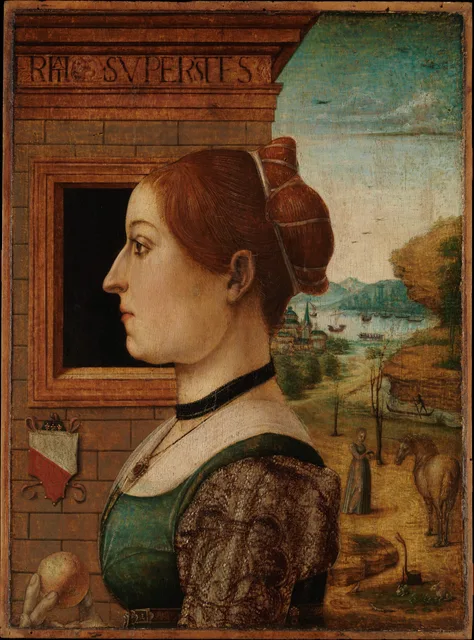 Portrait of a Woman, possibly Ginevra d'Antonio Lupari GozzadiniMaestro delle Storie del Pane1494?
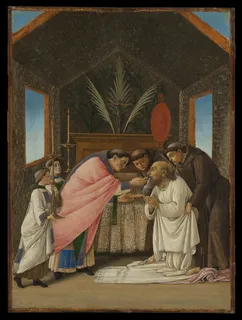 The Last Communion of Saint JeromeBotticelliearly 1490s
Too good to keep to yourself
This painting,
for someone who comes to mind
They open it at full size
and see every brushstroke.
About this work
- Artist
- Francesco di Giorgio Martini · 1439–1501
- Date
- ca. 1490
- Medium
- Pen and brown ink, brush and brown wash, blue gouache, on vellum
- Size
- 18.4 × 18.4 cm
- Collection
- The Metropolitan Museum of Art
- Image
- Original long edge 2958px · shown at 2560px
- Original
- View on the museum's website ↗