 Pyeongye
Artwork · 17th century · Philippe de Champaigne
LeoTurn on Magnifier at the lower right and move slowly across the painting.
Full screen opens it edge to edge.Tap the painting to fill the screen.
Spread two fingers to look closer.
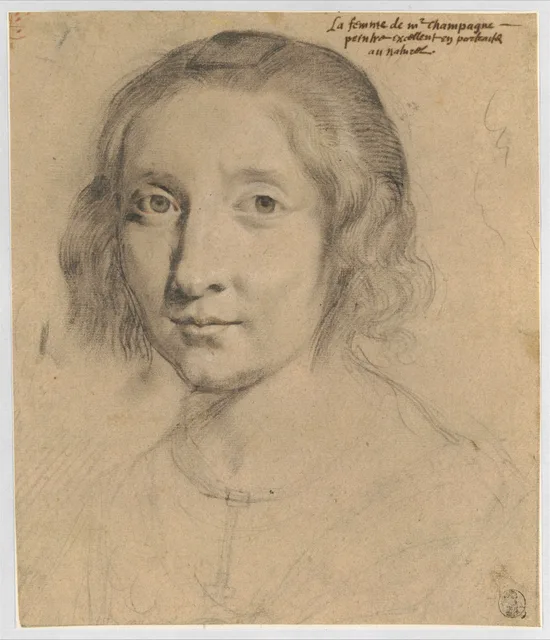
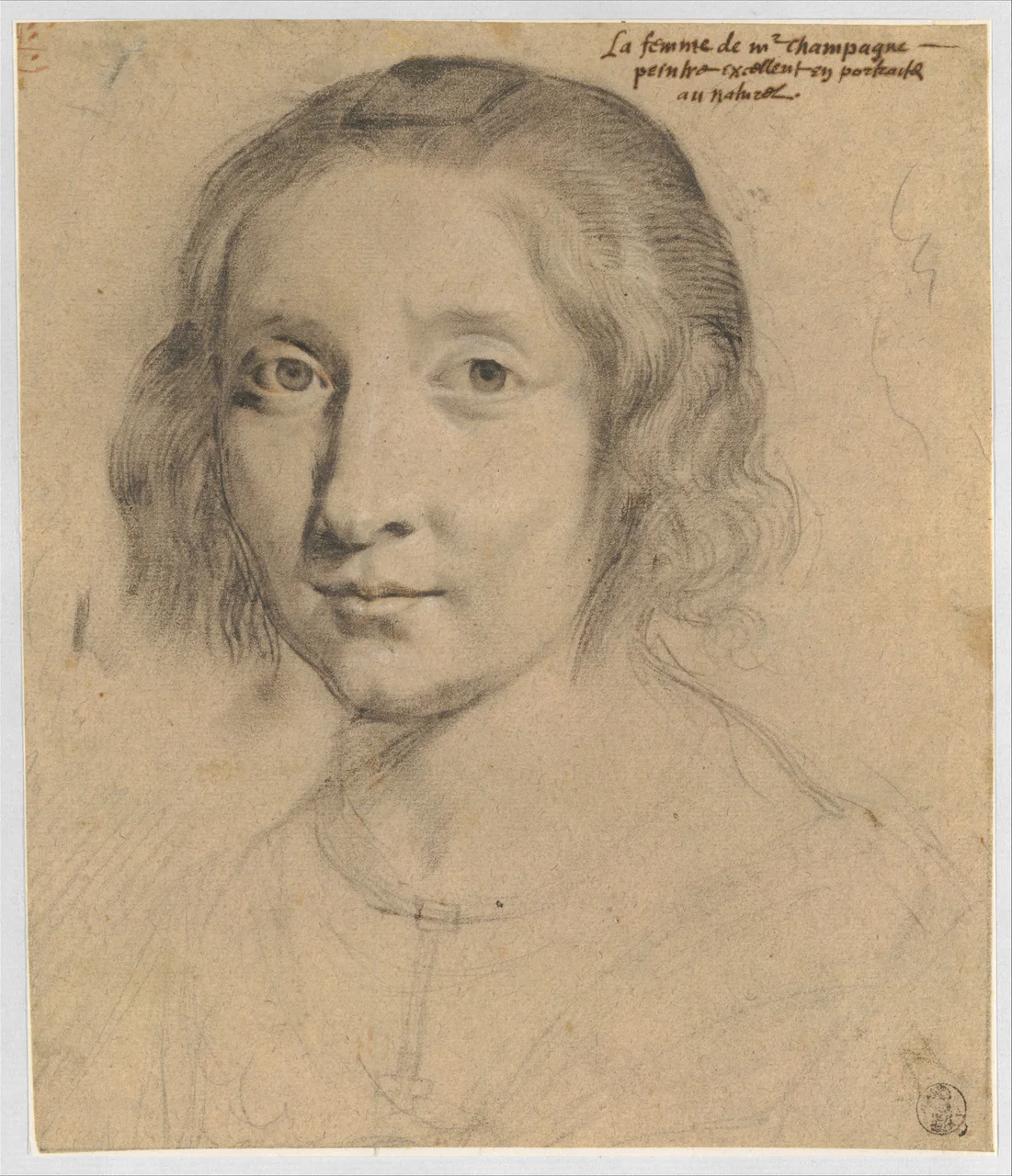
Portrait of Charlotte Duchesne
Philippe de Champaigneca. 1628Black chalk, heightened with white, with touches of red chalk22 × 19.6 cm
At a glance
- A young woman with shoulder-length hair looks straight out at us in this drawing of a face.
- Philippe de Champaigne, a painter born in Brussels who worked in Paris, drew his wife, Charlotte Duchesne, from life around 1628.
- On a sheet about the size of two hands, he used black chalk with touches of white and red. The face is carefully finished, while the body is only a few lines.
Reading the picture
5 places to look closer
Tap a number on the painting to jump to its note, or a close-up to see that spot in the whole picture.
Start with the brown handwriting at the upper right. In French it reads: the wife of Monsieur Champagne, excellent painter of portraits from life. The words are written in pen with a quick, slanting hand. Thanks to these few lines, we know who the woman is.
Zoom in on her eyes. Her pupils look straight ahead, so wherever you stand, she meets your gaze. Under the lids and around the sockets, the chalk is softened into gentle shadow, as if rubbed with a fingertip. Thin touches of white chalk catch the light on the brow.
Look at her mouth. A faint brownish red chalk mixes in among the black lines of the lips. The corners turn neither up nor down. It is a quiet mouth, as if she is about to say something.
Zoom in on the hair at the right. Champaigne layered countless fine strokes to build the waves. The tan paper shows between the lines, which gives the hair its sheen.
Look down at the collar. Unlike the face, the round collar and a small clasp are sketched in a few light lines. The artist spent his time on her face and only marked in her clothes.
When it was painted
Around 1628, Champaigne was about twenty-six. Born in Brussels, he had come to Paris at nineteen. There he joined the team decorating the Luxembourg Palace for Marie de' Medici, the king's mother, working under her court painter, Nicolas Duchesne. The young Nicolas Poussin was working there in the same years.
After Duchesne died, Champaigne married his daughter Charlotte. He also stepped into his father-in-law's post as painter to the queen mother. This drawing comes from just that moment: a newly established painter sitting his young wife down and studying her face.
The drawing also solved a mystery. The Bowes Museum in England owns a bust-length oil portrait of a woman by Champaigne. For a long time she was thought to be Henrietta Maria, the French princess who became queen of England. When this drawing surfaced in 1992, it showed that the oil was actually a portrait of Charlotte, based on this study.
Charlotte died young, in 1638. Years later their daughter Catherine became a nun at the convent of Port-Royal, and Champaigne painted a picture giving thanks for her recovery from illness.
The Met bought the drawing in 1994. Look again at her eyes. The woman who sat for her husband nearly four hundred years ago is still looking straight back at us.
Questions to think about
- Look for itCan you spot the small round stamp in the lower right corner of the sheet?
- Why?Why do you think Champaigne finished the face so carefully but left the clothes and body as a few lines?
- What about you?For decades, the painted version of this woman was taken for someone else. Photos online are often misidentified too. How can we check who someone in an image really is?
Same period
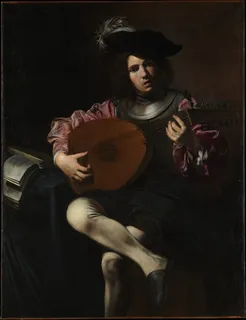
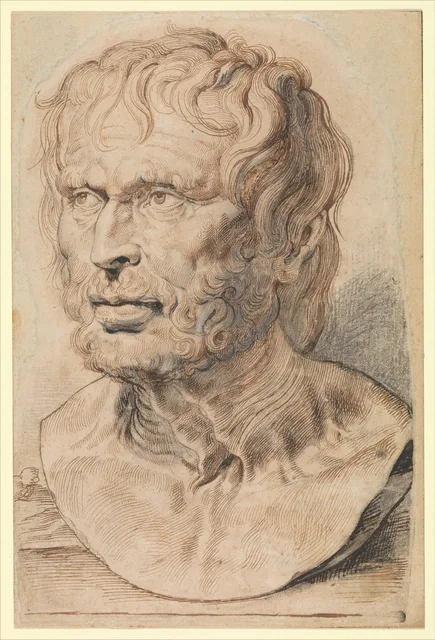
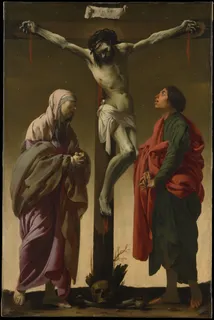
Painted around the same time,
somewhere else
Too good to keep to yourself
This painting,
for someone who comes to mind
They open it at full size
and see every brushstroke.
About this work
- Artist
- Philippe de Champaigne · 1602–1674
- Date
- ca. 1628
- Medium
- Black chalk, heightened with white, with touches of red chalk
- Size
- 22 × 19.6 cm
- Collection
- The Metropolitan Museum of Art
- Image
- Original long edge 3703px · shown at 2560px
- Original
- View on the museum's website ↗