 Pyeongye
Artwork · 17th century · Francisco de Zurbarán
LeoTurn on Magnifier at the lower right and move slowly across the painting.
Full screen opens it edge to edge.Tap the painting to fill the screen.
Spread two fingers to look closer.
At a glance
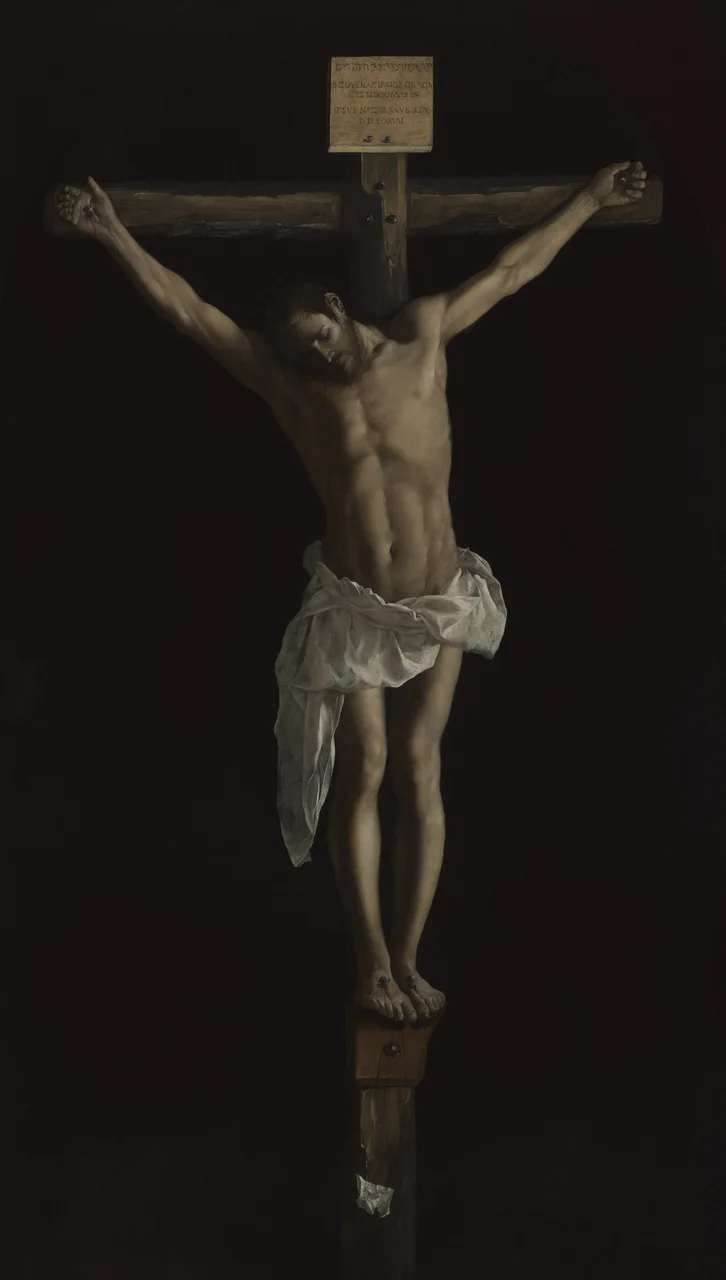
- Against total darkness hangs one figure: Christ on the cross, already dead.
- Francisco de Zurbarán painted it in 1627, before he turned thirty.
- The canvas is almost three meters tall, and with the background wiped away the body looks more like a carved statue than a painting.
Reading the picture
5 places to look closer
Tap a number on the painting to jump to its note, or a close-up to see that spot in the whole picture.
Start at the top with the wooden sign. It carries three lines in three different scripts: Hebrew, then Greek, then Latin. All three say the same thing, Jesus of Nazareth, King of the Jews. Look closely and you can see the two nails holding the board in place.
Now the face. The head has dropped onto one shoulder, the eyes are closed, and the hair falls down past the cheek. There is no blood on the face and no twisted expression. The forehead, the tip of the nose, and the edge of the beard catch a faint light.
Look at the white cloth around the hips. Every fold and pleat shifts from pale gray to dark gray in tiny steps. One end hangs down long beside the leg. It looks crisp enough to rustle if you touched it.
Move down to the feet. They are not crossed over each other. Each foot has its own nail, with thin lines of blood running down, and both rest on a small wooden block. Every toe has its own light and shadow, so they feel close enough to touch.
At the very bottom, a crumpled scrap of white paper seems stuck to the post of the cross. Zoom in and you can see handwriting on it. This little painted note is known as the place where Zurbarán signed his name.
When it was painted
In 1626 Zurbarán was twenty-seven and living far from the big city. His home was Llerena, a small town in Extremadura, the region of western Spain where he was born. Then a major job arrived from Seville. The Dominican monastery of San Pablo el Real signed him up to paint twenty-one pictures in just eight months.
This Crucifixion was one of that group, finished in 1627. It was hung in a chapel of the monastery where very little light came in, and visitors saw it through an iron grille. About a century later, the painter and writer Antonio Palomino reported that people who saw it took it for a sculpture.
Seville wanted to keep this young painter close. In 1629 the city council invited Zurbarán to move to Seville and settle there. He did, and over the next years he became the painter that monasteries across the city turned to for their big series.
The painting itself had a rough road. In 1810, when Napoleon's army held Seville, it was listed among the pictures removed by the occupying government. After that it dropped out of sight for a very long time. It turned up in a private collection in Basel, Switzerland, in the early 1950s, and the Art Institute of Chicago bought it in 1954. The next spring a Chicago newspaper ran the story on its front page as a painting lost to the world for a century.
Now look again at the crumpled scrap of paper at the foot of the cross. Through the dark chapel, a war, and strangers' houses, the little note the young painter from Llerena painted there has stayed right where he put it.
The painter
Francisco de Zurbarán
1598–1664
When painting this, the artist was about 29 years old
All paintings by Francisco de Zurbarán →More by the same painter
Questions to think about
- Look for itHow many nails can you find in the whole painting?
- Why?Why do you think Zurbarán left out the crowd, the sky, and the hill, and kept only darkness?
- What about you?People once saw this suffering through an iron grille in a dark room. When we see someone's pain through a phone screen today, what helps us actually feel it?
Same period
Painted around the same time,
somewhere else
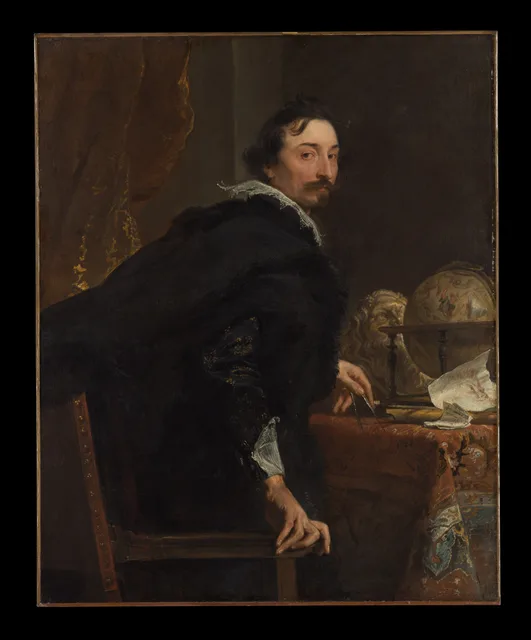 Lucas van Uffel (died 1637)Anthony van Dyckca. 1622
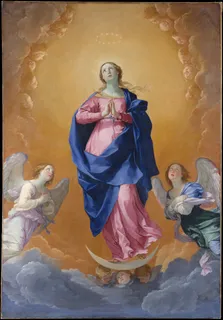 The Immaculate ConceptionGuido Reni1627
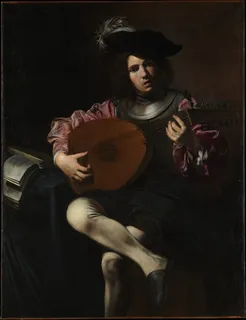 Lute PlayerValentin de Boulogneca. 1625–26
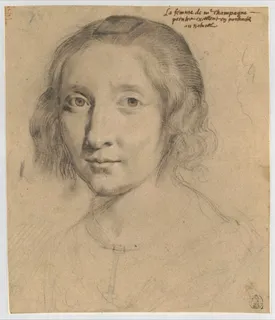 Portrait of Charlotte DuchesnePhilippe de Champaigneca. 1628
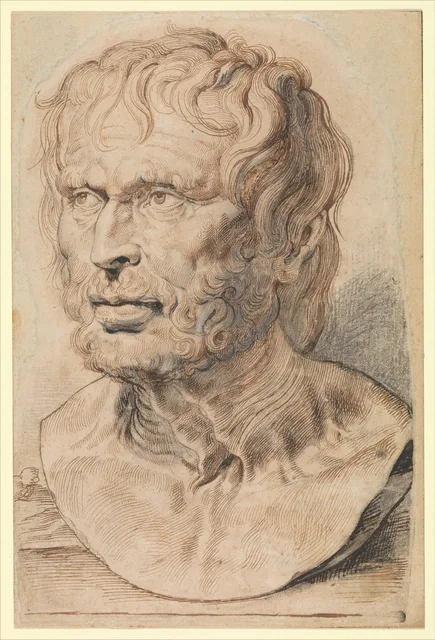 Bust of Pseudo-SenecaPeter Paul Rubens1600–1626
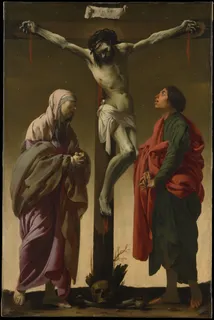 The Crucifixion with the Virgin and Saint JohnHendrick ter Brugghenca. 1624–25
Too good to keep to yourself
This painting,
for someone who comes to mind
They open it at full size
and see every brushstroke.
About this work
- Artist
- Francisco de Zurbarán · 1598–1664
- Date
- 1627
- Medium
- Oil on canvas
- Size
- 290.3 × 165.5 cm
- Culture
- Spain
- Collection
- The Art Institute of Chicago
- Image
- Original long edge 16906px · shown at 2560px
- Original
- View on the museum's website ↗