 Pyeongye
Artwork · 17th century · Guido Reni
LeoTurn on Magnifier at the lower right and move slowly across the painting.
Full screen opens it edge to edge.Tap the painting to fill the screen.
Spread two fingers to look closer.
At a glance
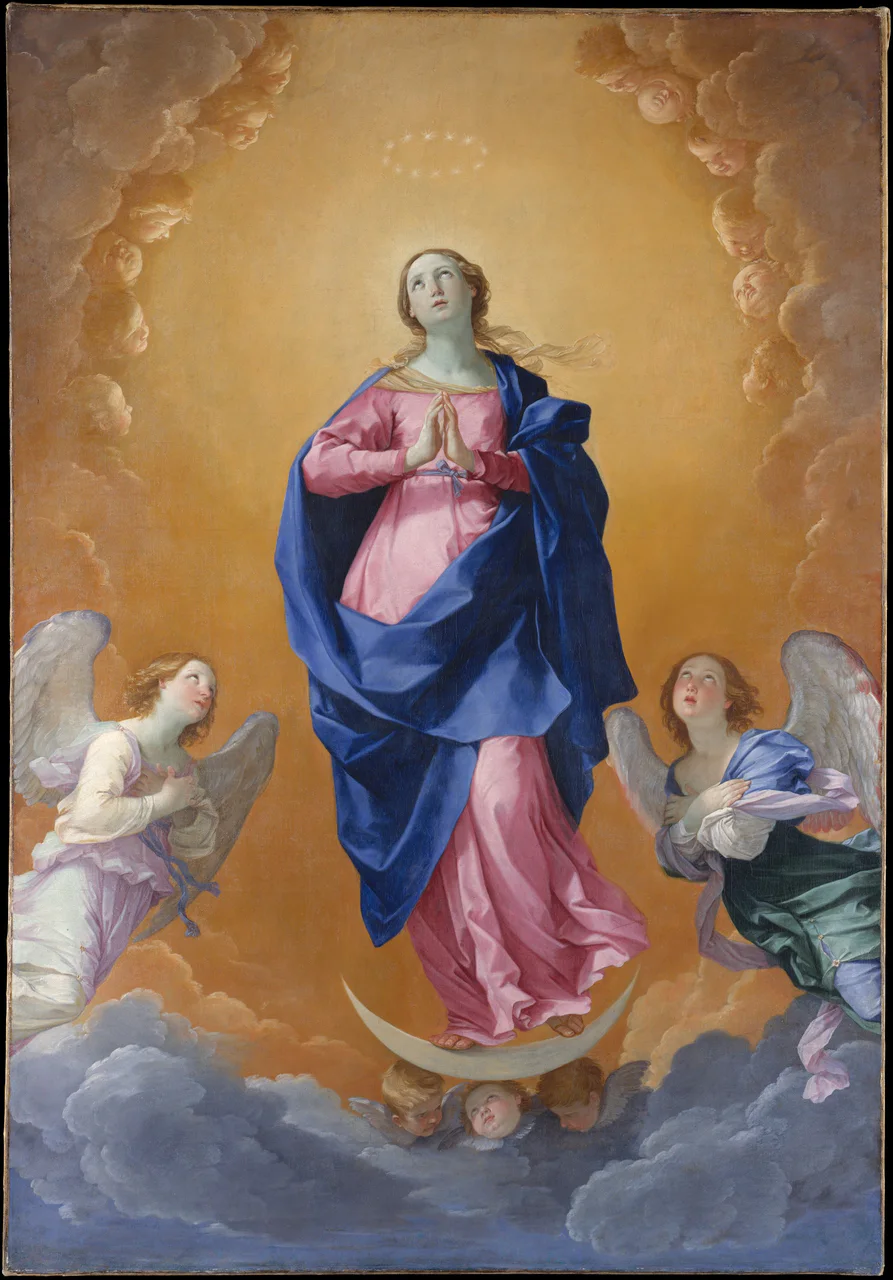
- A young Virgin Mary in a pink dress and a deep blue cloak rises into a golden sky, standing on a crescent moon and gazing upward.
- Guido Reni, a painter from Bologna in Italy, made it in 1627.
- The canvas is almost nine feet tall, and soft gold, pink, and blue fill most of it.
Reading the picture
5 places to look closer
Tap a number on the painting to jump to its note, or a close-up to see that spot in the whole picture.
Zoom in above Mary's head. Tiny stars form a ring around it like a crown. Count them and you will find twelve. They come from the Book of Revelation, which describes a woman crowned with twelve stars.
Look just below her folded hands. A pale blue ribbon ties her pink dress at the waist. Around it the dark blue cloak swirls and falls in big folds. Light slides along every fold, so you can feel how heavy the cloth is.
Zoom in on the clouds at the upper right. The faces of baby angels seem half melted into the clouds. One has its eyes closed, another looks down. At first you see only clouds, then the faces appear one by one.
Look at the angel at the lower left. It spreads its gray wings, presses a hand to its chest, and looks up at Mary. Its lilac robe and white sleeves glow against the golden background.
Zoom in at Mary's feet. Her sandaled feet rest on a thin crescent moon. Below, three winged baby angels push their heads out between gray clouds. The one in the middle has round cheeks and wide eyes.
When it was painted
In 1627 Guido Reni was in his early fifties, a celebrated painter who ran a large workshop in Bologna. Born near the city, he had trained at the academy founded by the Carracci family of painters. As a young man he went to Rome, studied Raphael and ancient sculpture, and made his name there. His ceiling painting Aurora, in a Roman palace, is still counted among his best-known works.
This canvas began in Rome. According to the Metropolitan Museum, the Spanish ambassador there commissioned it from Reni for the Infanta of Spain, a princess of the royal family. The Immaculate Conception, the belief that Mary was free from sin from the first moment of her existence, was a subject Spaniards held especially dear in those years.
Reni's own life was not always as calm as his pictures. He earned large sums, yet he also lost a great deal of money gambling. His Bolognese biographer, Carlo Cesare Malvasia, wrote about his life in detail and recorded this weakness too.
The painting traveled to Spain. The Met explains that it later hung in Seville Cathedral, where it made a deep impression on Spanish painters, especially Bartolomé Esteban Murillo of Seville. Murillo went on to paint the Immaculate Conception again and again.
The canvas came to the Metropolitan Museum in 1959. Look again at the thin crescent moon under Mary's feet and the ring of stars above her head. Set it beside one of Murillo's versions, and you can see how far this golden vision flew.
The painter
Guido Reni
1575–1642
When painting this, the artist was about 52 years old
All paintings by Guido Reni →More by the same painter
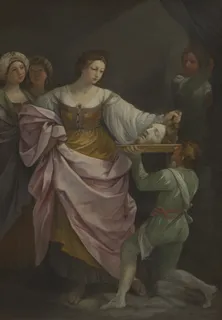
Questions to think about
- Look for itOn the right side of the picture, can you find Mary's hair and a thin veil blowing out behind her shoulder?
- Why?Why do you think Reni left out the ground, buildings, and people, and filled the background with nothing but sky and clouds?
- What about you?Reni used stars and a moon to show something no one can see. If you had to show an idea you care about in a single picture, which objects would you put in it?
Same period
Painted around the same time,
somewhere else
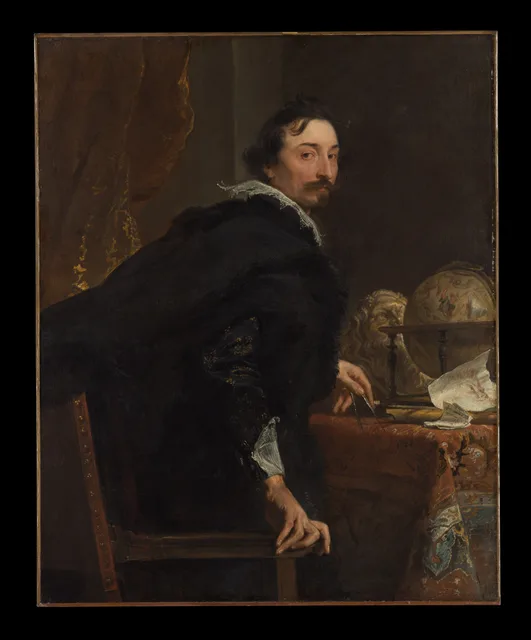 Lucas van Uffel (died 1637)Anthony van Dyckca. 1622
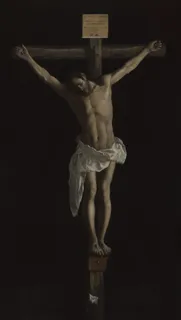 The CrucifixionFrancisco de Zurbarán1627
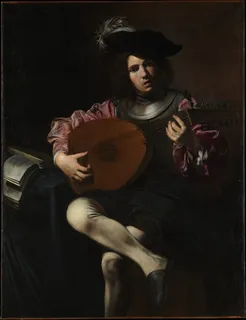 Lute PlayerValentin de Boulogneca. 1625–26
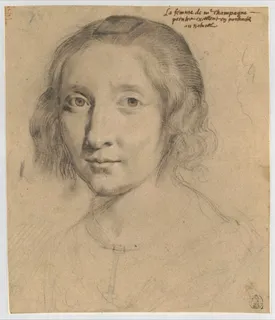 Portrait of Charlotte DuchesnePhilippe de Champaigneca. 1628
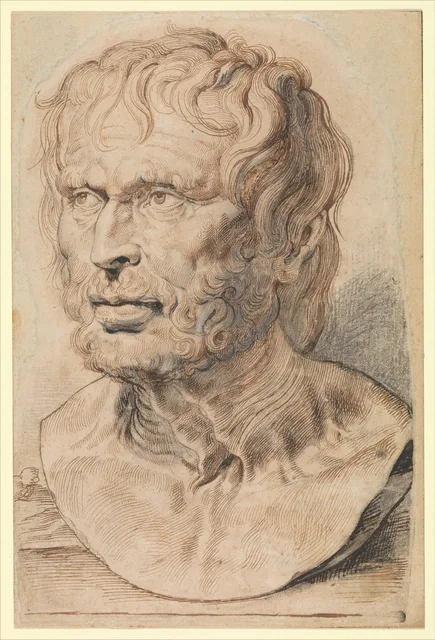 Bust of Pseudo-SenecaPeter Paul Rubens1600–1626
 The Crucifixion with the Virgin and Saint JohnHendrick ter Brugghenca. 1624–25
Too good to keep to yourself
This painting,
for someone who comes to mind
They open it at full size
and see every brushstroke.
About this work
- Artist
- Guido Reni · 1575–1642
- Date
- 1627
- Medium
- Oil on canvas
- Size
- 268 × 185.4 cm
- Collection
- The Metropolitan Museum of Art
- Image
- Original long edge 3722px · shown at 2560px
- Original
- View on the museum's website ↗