 Pyeongye
Artwork · 17th century · Valentin de Boulogne
LeoTurn on Magnifier at the lower right and move slowly across the painting.
Full screen opens it edge to edge.Tap the painting to fill the screen.
Spread two fingers to look closer.
At a glance
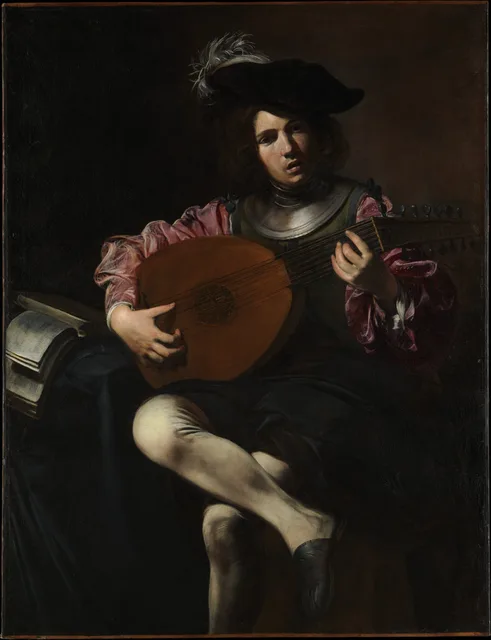
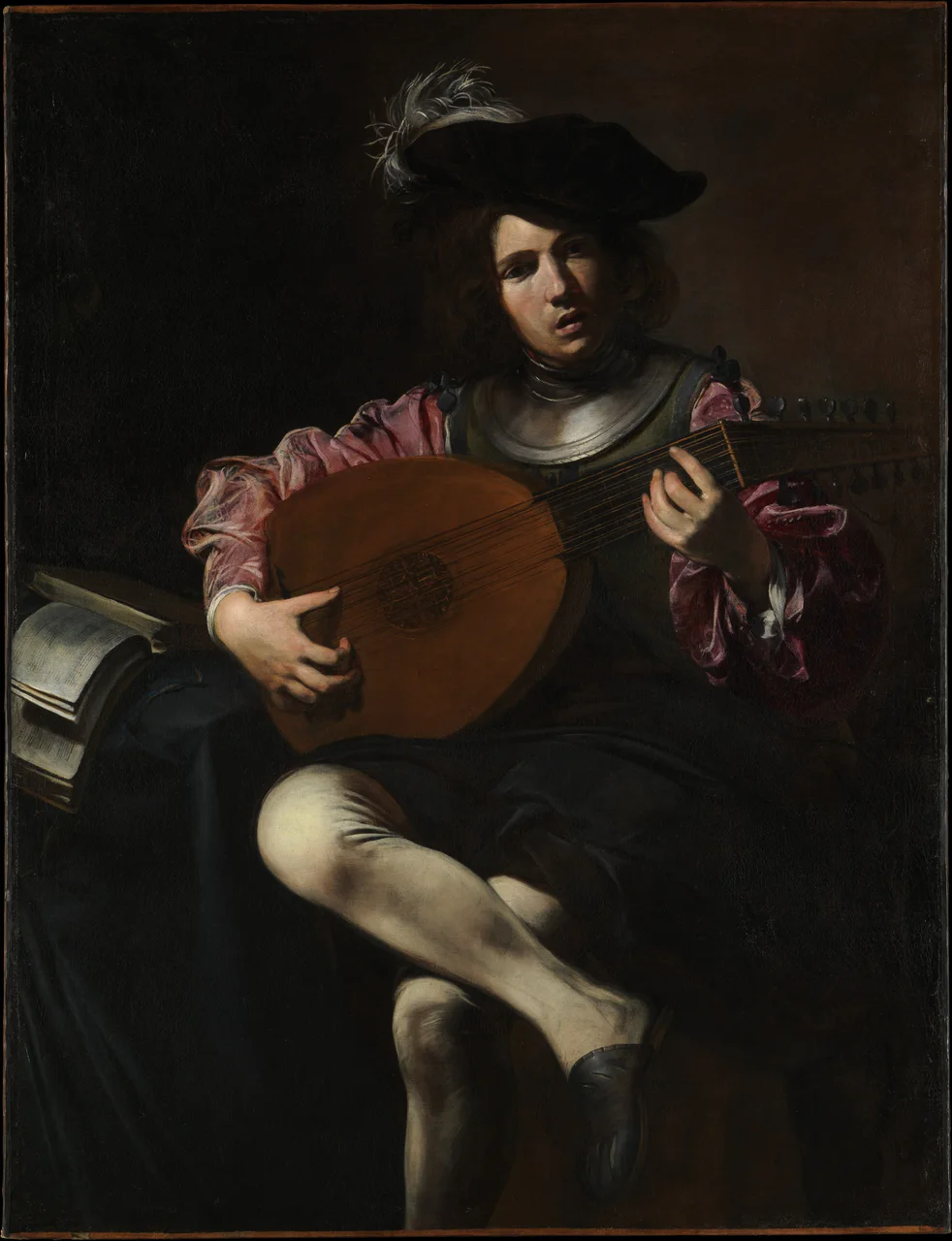
- A young man in a plumed hat and a steel collar sits with his legs crossed, playing the lute and singing.
- Valentin de Boulogne, a French painter who worked in Rome, painted it around 1625–26.
- Against a near-black background, a single beam of light picks him out, freezing one moment of song as if on a stage.
Reading the picture
5 places to look closer
Tap a number on the painting to jump to its note, or a close-up to see that spot in the whole picture.
Zoom into the face. The lips are parted, because he is in the middle of a song. His eyes turn toward us. Half of his face catches the light, and the other half sinks into shadow.
Look at the gleaming metal below his chin. It is a gorget, a piece of armor that wraps the neck in curved, overlapping plates. Only the edges hit by the light flash white. A musician's hands and a soldier's steel belong to the same young man.
Zoom into the round sound hole of the lute. Inside the opening, a fine pattern is carved into the wood. Thin strings run across it, and the fingers of his right hand are plucking them. Even his fingernails catch a glint of light.
Go to the far right, where the lute's neck ends. A row of dark tuning pegs sticks out of the pegbox. Below them, the pink sleeve is painted with fast, loose strokes that make the silk crumple and shine. His left fingers press down on the strings to shape the notes.
Move to the left edge. A stack of open papers rests on a table. Fine lines are drawn across the pages, so they look like sheets of music. In the darkness, only their curled edges glow white.
When it was painted
Around 1625, Valentin was about thirty-four. Born in Coulommiers, east of Paris, he had come to Rome as a young man. Caravaggio had died in 1610, but Rome was full of young painters still under the spell of his pictures. Valentin was one of them.
These painters liked dark backgrounds, strong side light, and people from the street: musicians, soldiers, card players. Valentin also kept company with the Bentvueghels, a band of Dutch and Flemish artists in Rome known for their drinking and their mock rituals.
His reputation kept rising. In the later 1620s, Cardinal Francesco Barberini, nephew of Pope Urban VIII, gave him commissions, and he painted an altarpiece for Saint Peter's Basilica. This picture comes from a few years earlier, when his name was just beginning to grow.
Then, in the summer of 1632, Valentin died suddenly at forty-one. Giovanni Baglione, a Roman biographer of the time, wrote that after a long night of drinking, overheated, he plunged into a cold fountain and fell ill.
The painting outlived him. In the 1650s it belonged to Cardinal Mazarin, the powerful chief minister of the young Louis XIV. The Met bought it in 2008, and in 2016 the museum staged an exhibition devoted to Valentin's work.
Look at him once more. Above the steel gorget, his mouth is open mid-note. A painter who did not live long caught one bar of a song, and it has hung in this darkness for four hundred years.
Questions to think about
- Look for itCan you find the three brightest spots in the whole painting?
- Why?Why do you think Valentin dressed a musician in a soldier's armor?
- What about you?This young man carries both a tool of war and a tool of music. Have you ever discovered a gentler side in someone who first seemed tough?
Same period
Painted around the same time,
somewhere else
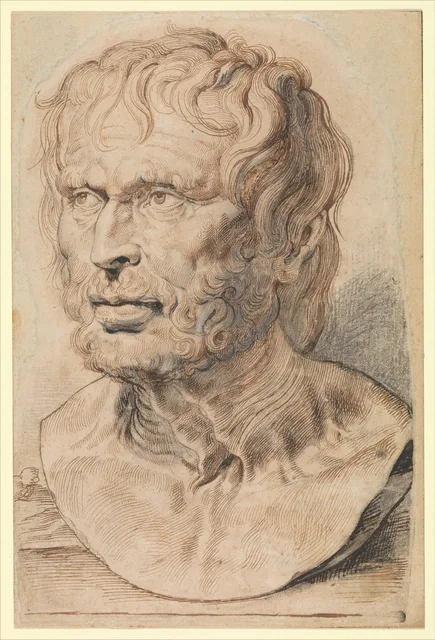 Bust of Pseudo-SenecaPeter Paul Rubens1600–1626
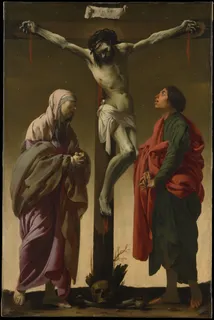 The Crucifixion with the Virgin and Saint JohnHendrick ter Brugghenca. 1624–25
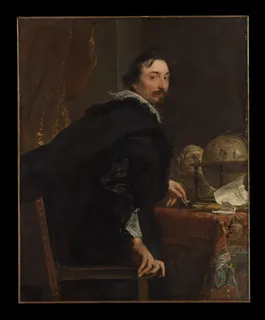 Lucas van Uffel (died 1637)Anthony van Dyckca. 1622
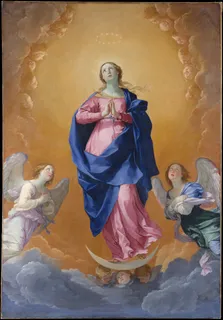 The Immaculate ConceptionGuido Reni1627
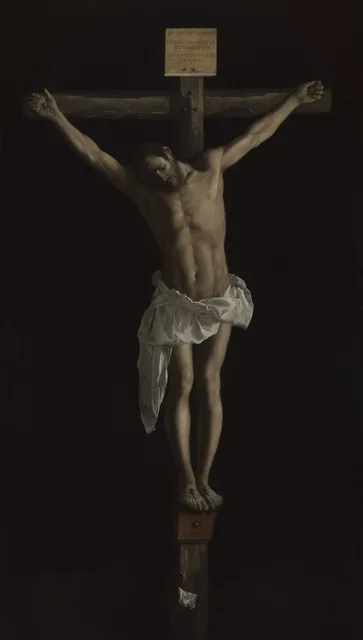 The CrucifixionFrancisco de Zurbarán1627
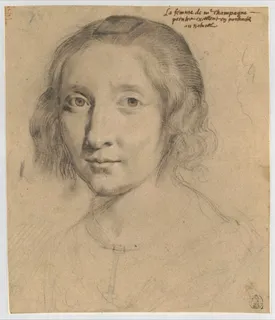 Portrait of Charlotte DuchesnePhilippe de Champaigneca. 1628
Too good to keep to yourself
This painting,
for someone who comes to mind
They open it at full size
and see every brushstroke.
About this work
- Artist
- Valentin de Boulogne · 1591–1632
- Date
- ca. 1625–26
- Medium
- Oil on canvas
- Size
- 128.3 × 99.1 cm
- Collection
- The Metropolitan Museum of Art
- Image
- Original long edge 3864px · shown at 2560px
- Original
- View on the museum's website ↗