 Pyeongye
Artwork · 17th century · Hendrick ter Brugghen
LeoTurn on Magnifier at the lower right and move slowly across the painting.
Full screen opens it edge to edge.Tap the painting to fill the screen.
Spread two fingers to look closer.
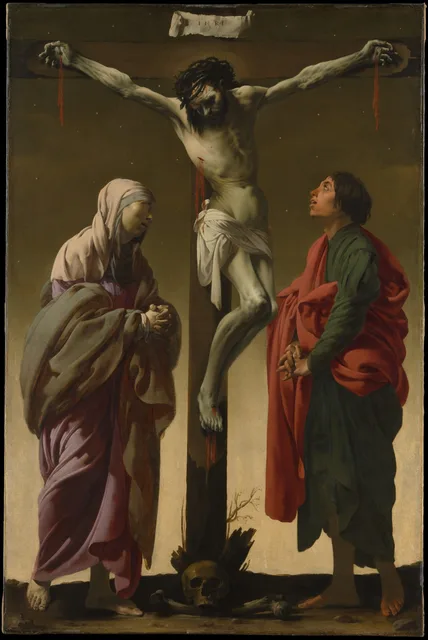
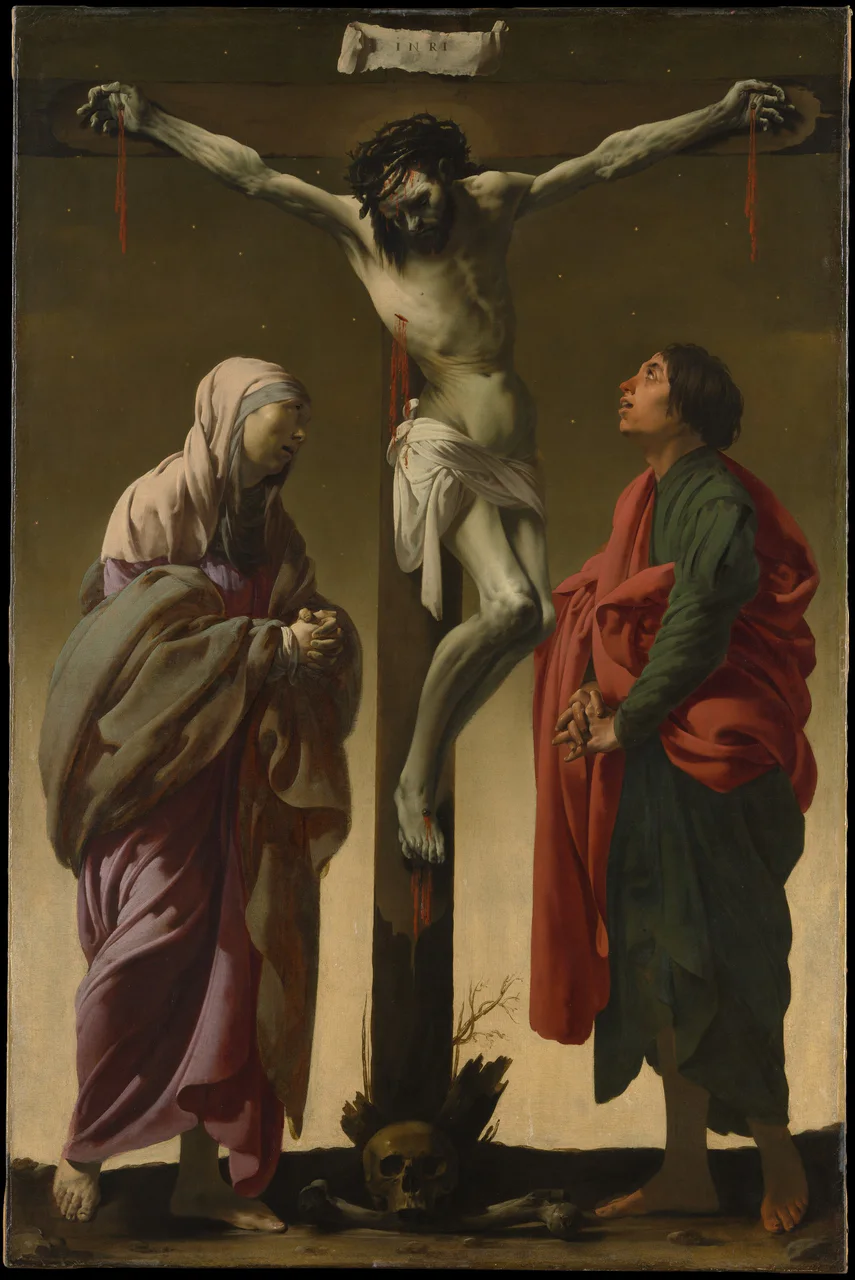
The Crucifixion with the Virgin and Saint John
Hendrick ter Brugghenca. 1624–25Oil on canvas154.9 × 102.2 cm
At a glance
- Under a dark sky pricked with stars, Christ hangs on the cross, with the Virgin Mary on one side and Saint John the Apostle on the other.
- Hendrick ter Brugghen, a painter from Utrecht in the Dutch Republic, painted it in oil on canvas around 1624–25.
- On a canvas about five feet tall, he set just three large figures and gathered all the grief into their faces and hands.
Reading the picture
5 places to look closer
Tap a number on the painting to jump to its note, or a close-up to see that spot in the whole picture.
Zoom in on the very top of the cross. A ragged-edged sheet of paper bears four letters: INRI. They stand for the Latin words meaning Jesus of Nazareth, King of the Jews. The Gospels say Pilate had this charge written and fixed to the cross.
Look at Christ's face. The crown of thorns presses into his brow, and drops of blood run down his face. His head has dropped forward, and most of his face sinks into shadow. Right beside it his shoulder catches bright light, which makes the shadow feel even deeper.
Zoom in on Mary at the left. Under her head cloth, an aging face turns toward her son, mouth open. Then look to the right of her face, into the dark sky, and find the tiny stars scattered there like dust.
On the right, John tips his head back to look up at the cross. His mouth hangs half open, and the skin under his eye glistens as if wet. His reddened nose and messy fringe make him look less like a saint and more like a young man undone by grief.
Drop down to the foot of the cross. A skull rests on a pile of bones, and behind it split wooden wedges brace the cross. Golgotha, the place where Jesus was crucified, means the place of the skull. An old legend also says the first man, Adam, was buried there, so painters often put a skull at the foot of the cross.
When it was painted
Around 1624, Hendrick ter Brugghen was about thirty-six. He had trained in Utrecht with Abraham Bloemaert, then spent nearly ten years in Italy as a young man before coming home in 1614. In Rome he had seen Caravaggio's strong light and dark and his vivid, ordinary-looking figures.
Around 1620, two other Utrecht painters, Gerrit van Honthorst and Dirck van Baburen, also came back from Italy. The three are now called the Utrecht Caravaggisti. Then, in 1624, Baburen died young. This picture was painted at just about that time.
Utrecht was a Protestant city then. Catholics gathered for Mass in chapels hidden inside private houses, out of sight from the street. The Met believes this painting was probably made for the altar of one of those hidden churches.
There is something puzzling about it, too. Ter Brugghen followed Caravaggio, yet this picture looks like a religious painting from a century earlier. Think of the starry sky, the thin, angular body of Christ, and the shallow, stage-like ground. Many scholars think he borrowed the look of older art on purpose, to help a viewer at prayer.
Ter Brugghen died in Utrecht in 1629, at forty-one. For a long time afterward his name was largely forgotten, and only in the twentieth century did he draw wide attention again. The Met bought this painting in 1956 with funds from a number of donors.
Look again at the empty sky behind the three figures. For people who met in secret to pray, the painter set out no crowd and no landscape, only these three.
Questions to think about
- Look for itHow far down does the blood run from each of Christ's hands and from his feet?
- Why?Why do you think the painter left out landscape and crowds and kept only a dark sky behind the figures?
- What about you?This picture may have been made for people who had to hide their faith. What do you think about people today who must hide because their beliefs or ideas are different?
Same period
Painted around the same time,
somewhere else
Too good to keep to yourself
This painting,
for someone who comes to mind
They open it at full size
and see every brushstroke.
About this work
- Artist
- Hendrick ter Brugghen · 1588–1629
- Date
- ca. 1624–25
- Medium
- Oil on canvas
- Size
- 154.9 × 102.2 cm
- Collection
- The Metropolitan Museum of Art
- Image
- Original long edge 3722px · shown at 2560px
- Original
- View on the museum's website ↗