 Pyeongye
Artwork · 17th century · Anthony van Dyck
LeoTurn on Magnifier at the lower right and move slowly across the painting.
Full screen opens it edge to edge.Tap the painting to fill the screen.
Spread two fingers to look closer.
At a glance
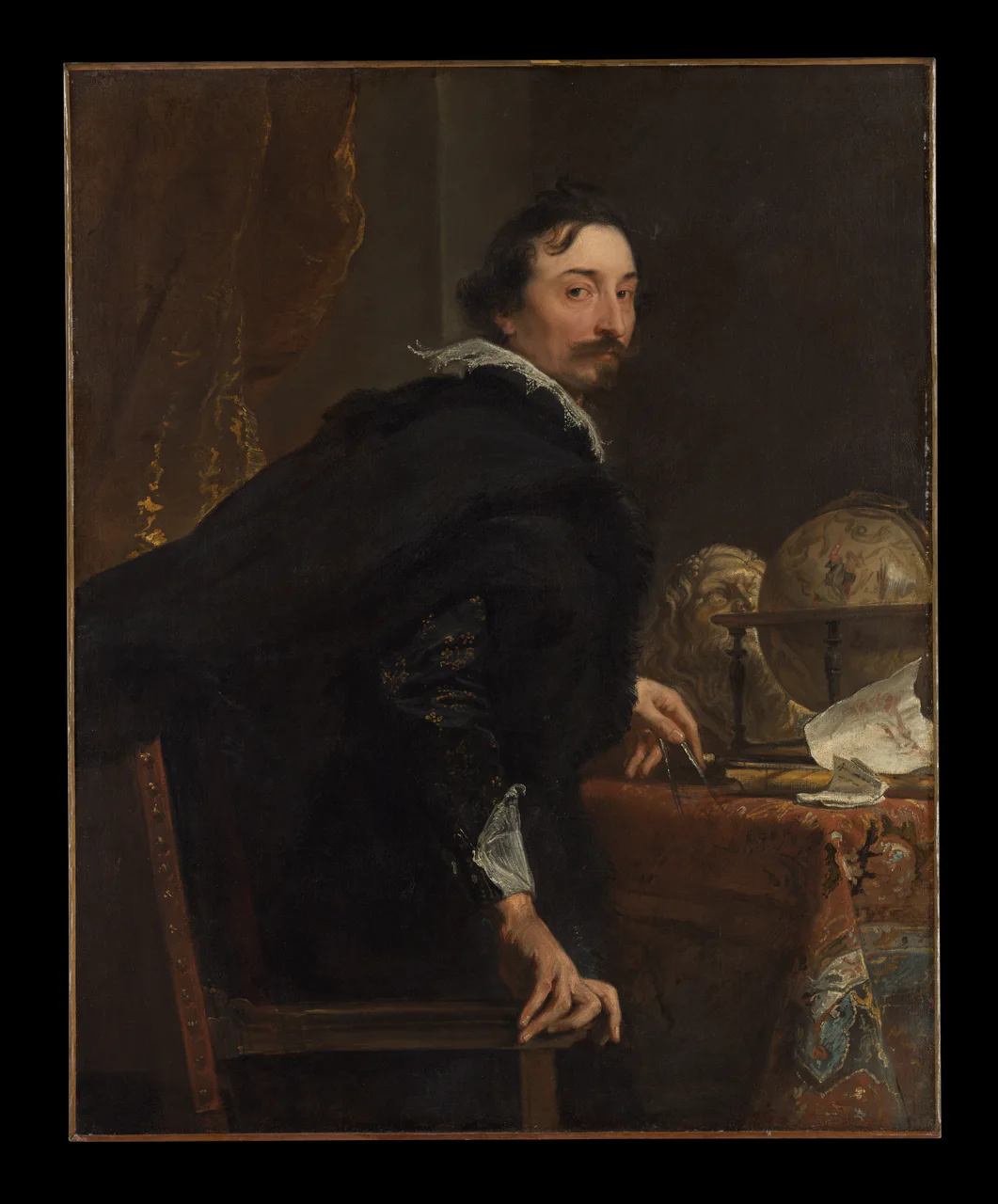
- A man in a fur-trimmed black cloak twists around in his chair and looks back over his shoulder, as if someone has just called his name.
- Anthony van Dyck painted this portrait of Lucas van Uffel in oil on canvas around 1622, during his years in Italy.
- A pair of compasses, a large globe and a carved stone head tell us what kind of things this man cared about.
Reading the picture
5 places to look closer
Tap a number on the painting to jump to its note, or a close-up to see that spot in the whole picture.
Zoom in on the face first. His brow is slightly creased and his eyebrows lifted, and only his head has turned toward us. He has a mustache and a short beard on his chin. A white lace collar falls at an angle over the black cloak.
Look at the hand resting on the table. Between his thumb and fingers he holds a pair of metal compasses. Both points touch the red cloth on the table. It looks like the moment he glanced up from measuring something.
Move to the back of the table on the right. A big globe sits on a stand, and on its surface you can make out a figure in red. To its left, a carved head of a bearded old man peers out of the shadows. In portraits of this time, globes and compasses often signaled learning and an interest in the wider world.
Zoom into the end of the sleeve on the arm reaching down toward the chair. A white cuff sticks out from the black clothing. Van Dyck made it with a few quick, scratchy strokes of white paint. Up close they are just brushmarks, but step back and they turn into stiff, crisp linen.
At the end of that arm, look at the hand on the chair. His long fingers press lightly on its edge. It looks as if he is about to push himself up. Van Dyck became known for painting hands like these, long and elegant.
When it was painted
In the autumn of 1621, a twenty-two-year-old Van Dyck left Antwerp for Italy. He had become a master in the Antwerp painters' guild before he turned nineteen, and he had worked in Rubens's studio. Just the winter before, he had spent a few months in London working for King James I.
He stayed in Italy until 1627. His base was the port city of Genoa, where the Flemish painter brothers Lucas and Cornelis de Wael took him in. He traveled to Rome, Venice and as far as Sicily, copying old masters into a small sketchbook. That sketchbook is now in the British Museum in London.
He painted this portrait around 1622, in Venice. There he studied the paintings of Titian closely. The sitter, Lucas van Uffel, was a wealthy Flemish merchant who had settled in Venice, and he collected paintings. The Met describes the portrait as showing him as a learned gentleman with many interests.
Van Uffel died in 1637, and in 1639 his collection was sold at auction in Amsterdam. Among the pictures was Raphael's portrait of Baldassare Castiglione. Rembrandt came to the sale, made a quick sketch of the Raphael, and noted down the price it fetched. Many scholars see the pose of that portrait in the self-portrait Rembrandt painted the following year.
Van Dyck's portrait turns up again around 1730 in the collection of the landgraves of Hesse-Kassel in Germany. It came to the Metropolitan Museum in 1913 through the bequest of Benjamin Altman, a New York department store owner. Now look at the picture again. A man who once owned a Raphael twists around between his globe and his compasses to look back at us. That glance has a story behind it.
More by the same painter
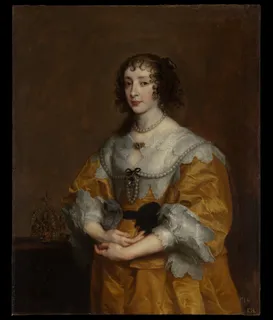
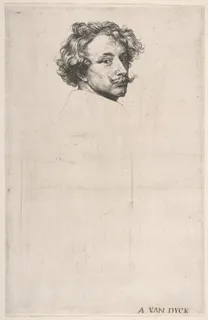
Questions to think about
- Look for itIn this dark painting, how many spots of bright white can you find?
- Why?Why do you think Van Dyck showed this man twisting around to look back, instead of sitting straight and facing us?
- What about you?If someone painted your portrait today, which three objects would you want beside you to show who you are?
Same period
Painted around the same time,
somewhere else
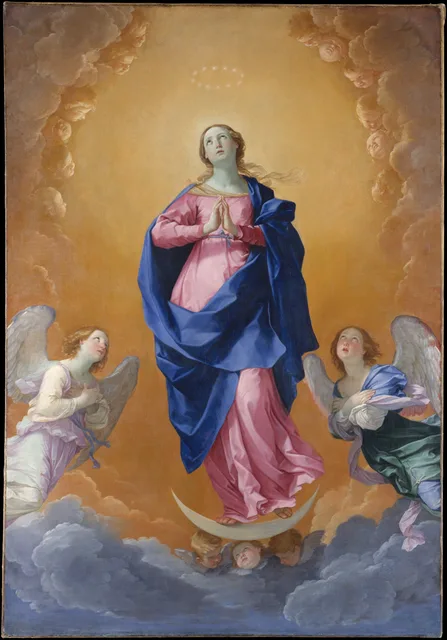 The Immaculate ConceptionGuido Reni1627
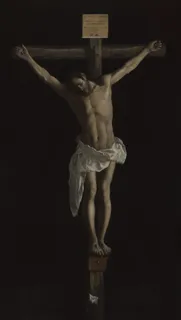 The CrucifixionFrancisco de Zurbarán1627
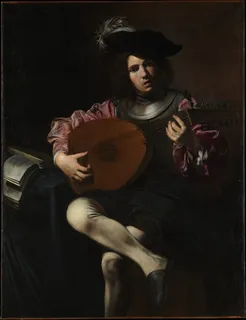 Lute PlayerValentin de Boulogneca. 1625–26
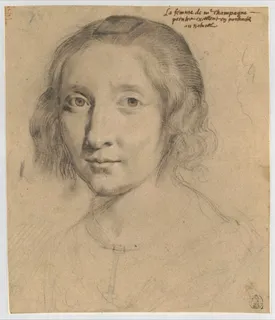 Portrait of Charlotte DuchesnePhilippe de Champaigneca. 1628
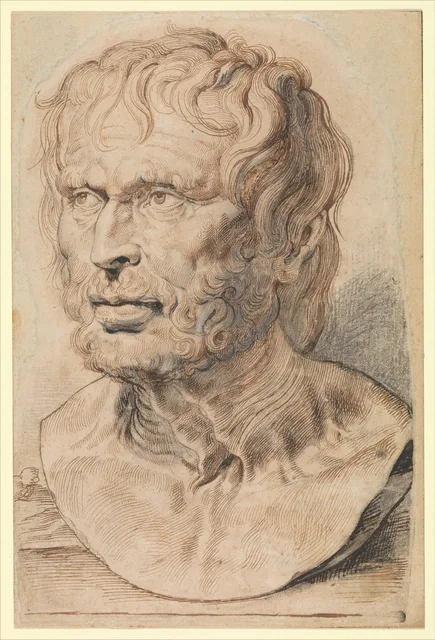 Bust of Pseudo-SenecaPeter Paul Rubens1600–1626
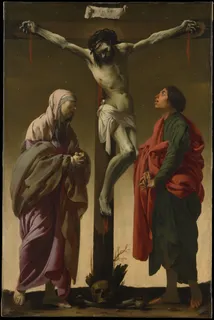 The Crucifixion with the Virgin and Saint JohnHendrick ter Brugghenca. 1624–25
Too good to keep to yourself
This painting,
for someone who comes to mind
They open it at full size
and see every brushstroke.
About this work
- Artist
- Anthony van Dyck · 1599–1641
- Date
- ca. 1622
- Medium
- Oil on canvas
- Size
- 124.5 × 100.6 cm
- Collection
- The Metropolitan Museum of Art
- Image
- Original long edge 4000px · shown at 2560px
- Original
- View on the museum's website ↗