 Pyeongye
At a glance
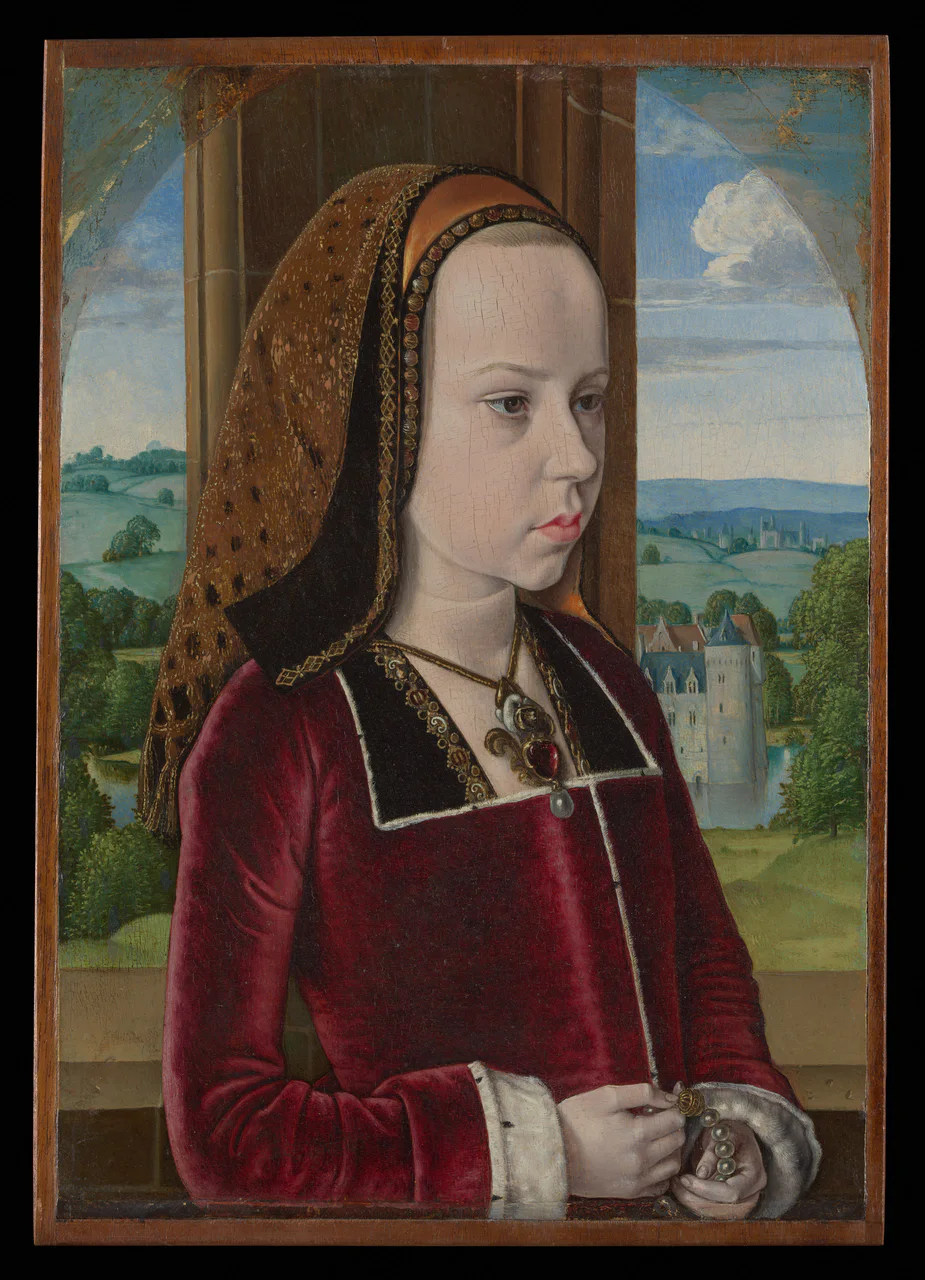
- A girl of about ten, dressed in red velvet, stands at a window ledge. She is Margaret of Austria.
- Jean Hey, known as the Master of Moulins, painted her in oil on oak around 1490.
- The panel is small, about the size of a sheet of paper, and shows a child being raised to become queen of France.
Reading the picture
4 places to look closer
Tap a number on the painting to jump to its note, or a close-up to see that spot in the whole picture.
Zoom in on the edge of her headdress. A black band is stitched with a gold diamond pattern. Beside it runs a line of round beads, some glinting red and some gold. Behind them, the brown cloth is sprinkled with tiny flecks of gold.
Look at the jewel at the end of her necklace. Below a curling gold setting hangs a deep red stone. A single dot of white paint makes it sparkle. On the skin just above, fine cracks spread like a web, the kind that form as old paint ages.
Drop down to her hands. Her fingers hold a string of clear beads, with a round bead of woven gold at one end. It looks like a set of prayer beads. Her hands rest on the ledge, so she seems to stand right at the edge of the frame.
Look out the window on the right. A castle with a round tower and blue roofs stands at the water's edge, and its walls are mirrored in the moat. Far beyond the hills, the towers of another town fade into the haze.
When it was painted
Around 1490, Margaret was ten years old and had already lived in France for most of her life. She was born in 1480 to Maximilian of Habsburg and Mary of Burgundy. After her mother died in a fall from a horse in 1482, the toddler was promised to Charles, heir to the French throne. At about three she was sent to the French court as part of a peace treaty.
The woman who raised her there was Charles's older sister, Anne of France. Anne helped run the kingdom while her brother was young, and with her husband, Pierre II, Duke of Bourbon, she kept a court at Moulins. Jean Hey worked for this couple. The Met dates the portrait to 1490 or 1491, around the time Margaret visited the Bourbon court at Moulins.
The engagement is hidden in the picture. Along her collar, white and red letters alternate between the gold ornaments. The museum reads them as C and M, for Charles and Margaret.
The promise did not last. At the end of 1491, Charles VIII married Anne of Brittany instead. Margaret never became queen of France, and in 1493 she was finally sent home to her father. She married twice after that, and both husbands died within a few years.
In 1507 she became governor of the Netherlands and set up her court at Mechelen. She filled it with books and paintings. Jan van Eyck's Arnolfini Portrait was one of the pictures she owned. This small portrait of her as a girl later belonged to Robert Lehman, and it came to the Met with his collection in 1975.
Look again at her hands and her face. A ten-year-old holds her prayer beads and gazes past us without a smile. The country she was raised to rule as queen never became hers.
More by the same painter
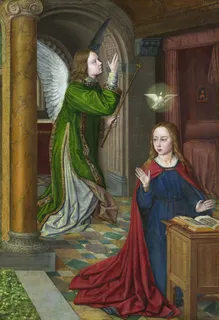
Questions to think about
- Look for itThrough the window on the left, behind her head, can you find the stream winding between the trees?
- Why?Why do you think the painter showed this young girl unsmiling and calm, wrapped in velvet and jewels?
- What about you?Margaret left her home as a small child because of an engagement other people arranged. Where do we still see children carrying out plans that adults made for them?
Same period
Painted around the same time,
somewhere else
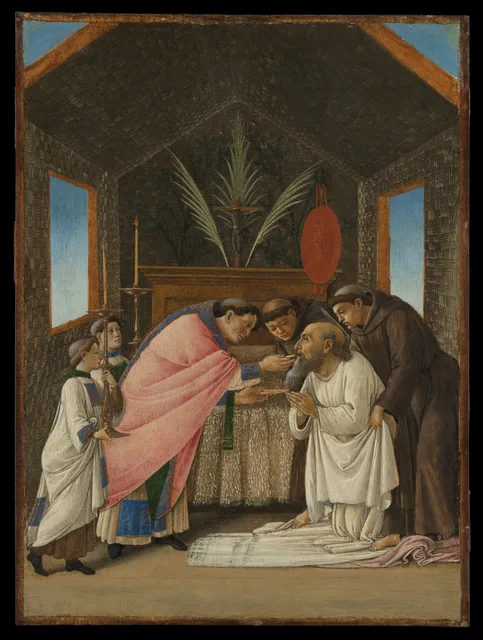 The Last Communion of Saint JeromeBotticelliearly 1490s
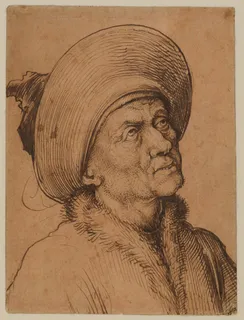 Bust of a Man in a Hat Gazing UpwardMartin Schongauerca. 1480–90
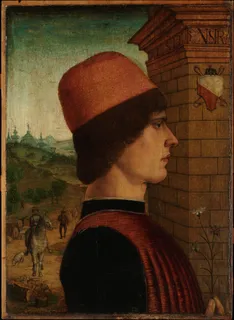 Portrait of a Man, possibly Matteo di Sebastiano di Bernardino GozzadiniMaestro delle Storie del Pane1494(?)
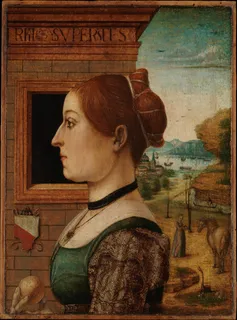 Portrait of a Woman, possibly Ginevra d'Antonio Lupari GozzadiniMaestro delle Storie del Pane1494?
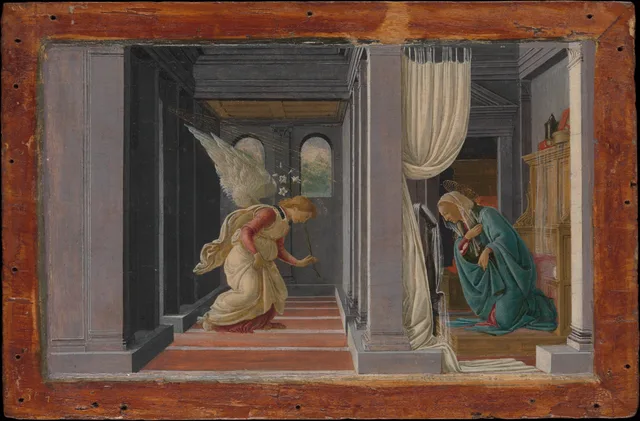 The AnnunciationBotticellica. 1490
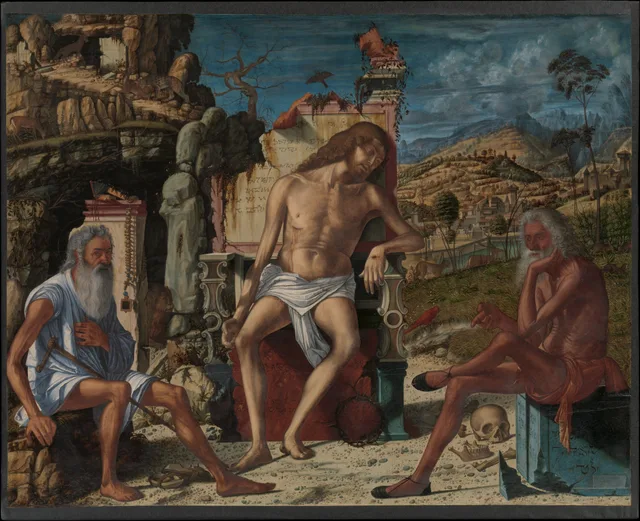 The Meditation on the PassionVittore Carpaccioca. 1490
Too good to keep to yourself
This painting,
for someone who comes to mind
They open it at full size
and see every brushstroke.
About this work
- Artist
- Jean Hey · 1475–1499
- Date
- ca. 1490
- Medium
- Oil on oak panel
- Size
- 32.7 × 23 cm
- Collection
- The Metropolitan Museum of Art
- Image
- Original long edge 4000px · shown at 2560px
- Original
- View on the museum's website ↗