 Pyeongye
Artwork · 18th century · Sir Joshua Reynolds
LeoTurn on Magnifier at the lower right and move slowly across the painting.
Full screen opens it edge to edge.Tap the painting to fill the screen.
Spread two fingers to look closer.
At a glance
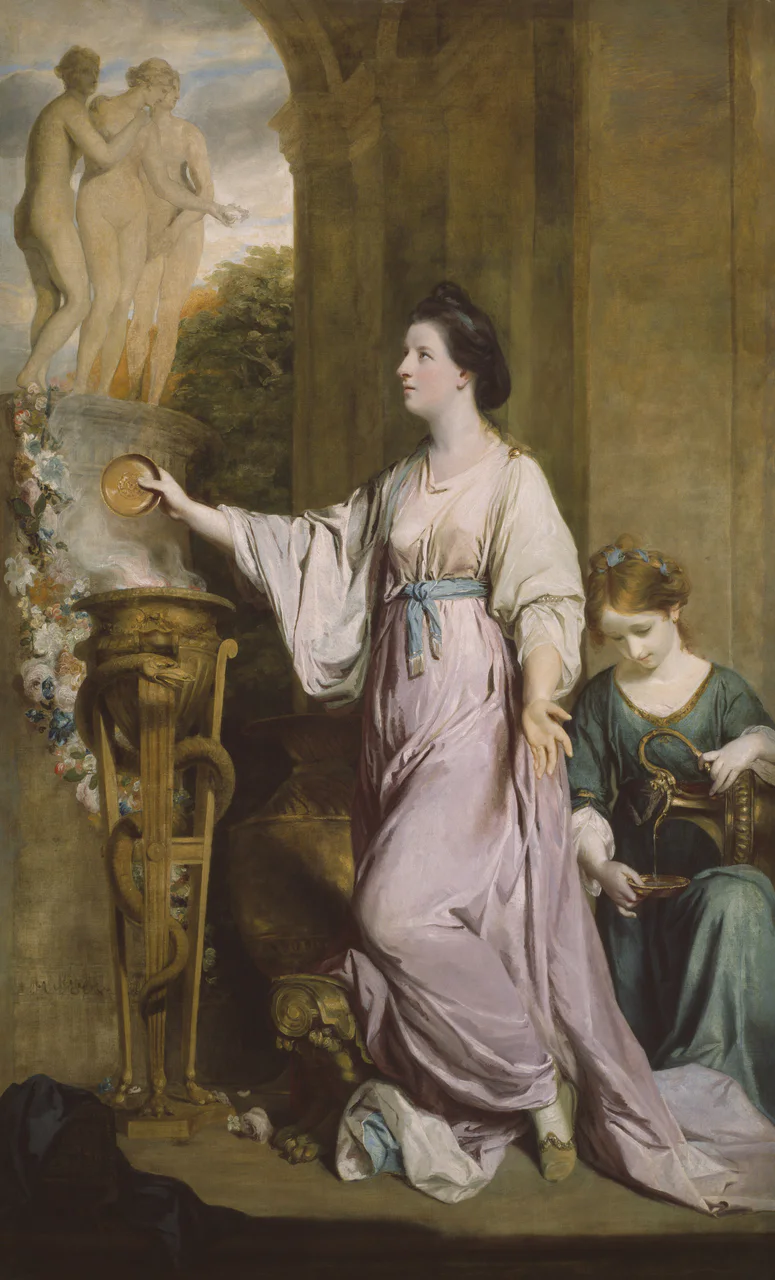
- A young aristocrat in classical robes holds a golden dish over a smoking altar, pouring an offering of oil to a statue of the Three Graces, in a portrait taller than a person.
- Joshua Reynolds painted it in London between 1763 and 1765, when he was about forty.
- A real young wife is cast as the heroine of an ancient ritual, which shows how grand Reynolds wanted a portrait to feel.
Reading the picture
4 places to look closer
Tap a number on the painting to jump to its note, or a close-up to see that spot in the whole picture.
Zoom in on her face. She tilts her head up toward the statue, lips slightly parted as if about to speak. Her dark hair is swept up and tied with a pale blue ribbon. This is Sarah Lennox, known after her marriage as Lady Sarah Bunbury.
Follow her arm out over the altar. Her thumb holds a round golden dish with a flower pattern pressed into its center. Below, white smoke curls up from the altar. The Art Institute of Chicago explains that she is pouring a libation of oil to the Graces.
Zoom in on the girl in green at lower right. She tips a golden jug with a handle that curves like a snake, and a thin thread of oil runs into a small dish. Reynolds even painted the drops landing. She plays the helper in the ceremony.
Look up at the statue on its tall base at upper left. Three goddesses lean together, arms around one another, and one holds a few flowers. These are the Three Graces. The museum notes that they stood for fertility and served Venus, goddess of love, which made them fitting for a marriage portrait.
When it was painted
In the early 1760s Reynolds, about forty, was already a much sought-after portrait painter in London. In 1760 he set up a large house and studio in Leicester Fields. In 1764 he and Samuel Johnson founded the dining society known as The Club.
The man who ordered this picture was Charles Bunbury. In 1762 he married Sarah Lennox, a daughter of the Duke of Richmond, and the Art Institute describes this as a marriage portrait. Sarah had once caught the eye of the young King George III. But in 1761 the king married the German princess Charlotte, and Sarah was one of the bridesmaids at that wedding.
The image soon spread as a print. In 1766 the engraver Edward Fisher reproduced it as a mezzotint. In 1787 the caricaturist James Gillray mocked fashionable ladies posing at altars in a print that pointed back to this very painting.
The marriage did not last. In 1769 Sarah left home with another man, and in 1776 the marriage was dissolved by an Act of Parliament. She later married the soldier George Napier and raised several sons. Reynolds became the first president of the Royal Academy in 1768. The painting later came to the Art Institute of Chicago in 1922 as part of the Mr. and Mrs. W. W. Kimball Collection.
Look again at Sarah's upturned eyes. The young wife, around twenty, gazes calmly at the Graces, with no idea where her life is about to go.
More by the same painter
Questions to think about
- Look for itHow many things connected with the offering can you find, such as smoke, oil or flowers?
- Why?Why do you think Reynolds placed this young wife in an ancient temple setting instead of an ordinary room?
- What about you?Wedding photos and profile pictures are often dressed up too. In a picture meant to show who I am, what would I polish and what would I leave as it is?
Same period
Painted around the same time,
somewhere else
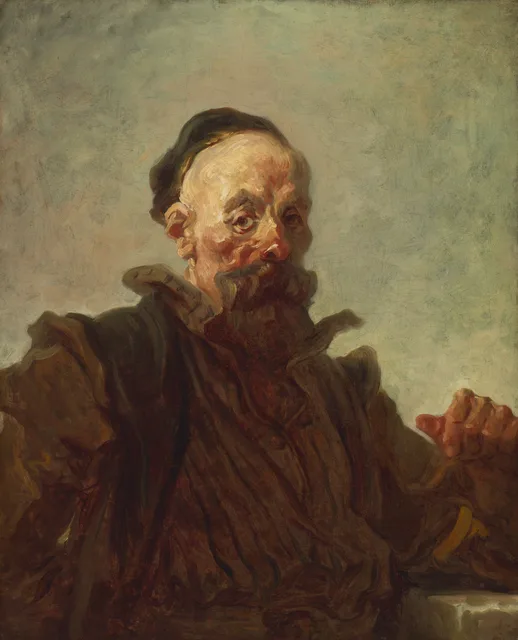 Portrait of a Man in CostumeJean Honoré Fragonardc. 1767–68
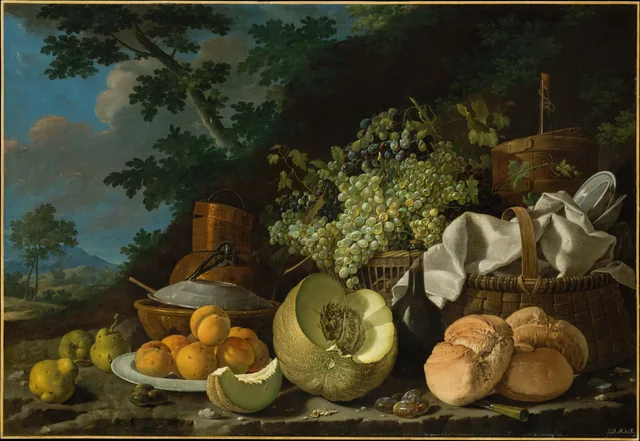 The Afternoon Meal (La Merienda)Luis Meléndezca. 1772
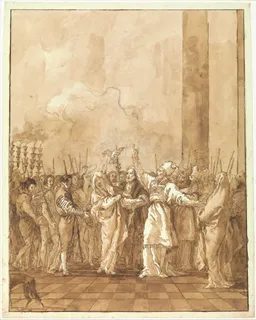 The Betrothal of the VirginGiovanni Domenico Tiepoloca. 1770
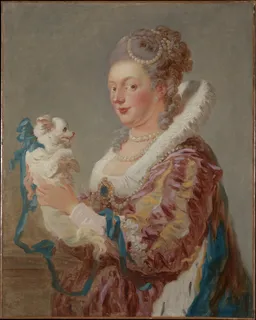 Marie Emilie Coignet de Courson (1716–1806) with a DogJean Honoré Fragonardca. 1769
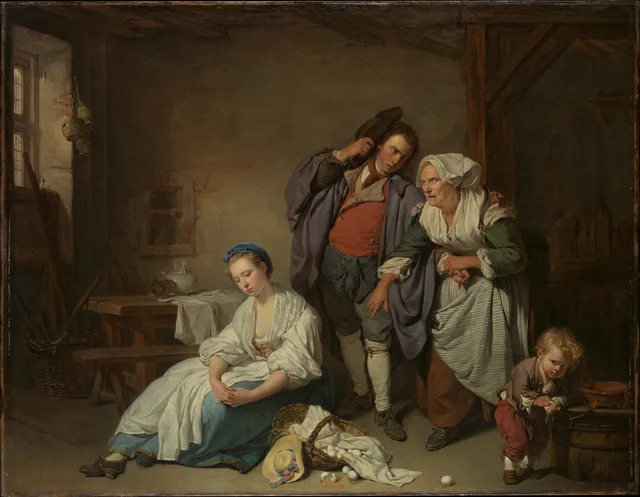 Broken EggsJean-Baptiste Greuze1756
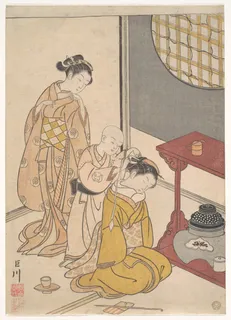 Night Rain at the Double-Shelf Stand, from the series Eight Parlor Views (Zashiki hakkei)Suzuki Harunobuca. 1766
Too good to keep to yourself
This painting,
for someone who comes to mind
They open it at full size
and see every brushstroke.
About this work
- Artist
- Sir Joshua Reynolds · 1723–1792
- Date
- 1763–65
- Medium
- Oil on canvas
- Size
- 242.6 × 151.5 cm
- Culture
- England
- Collection
- The Art Institute of Chicago
- Image
- Original long edge 8921px · shown at 2560px
- Original
- View on the museum's website ↗