 Pyeongye
Artwork · 19th century · Martin Johnson Heade
LeoTurn on Magnifier at the lower right and move slowly across the painting.
Full screen opens it edge to edge.Tap the painting to fill the screen.
Spread two fingers to look closer.
At a glance
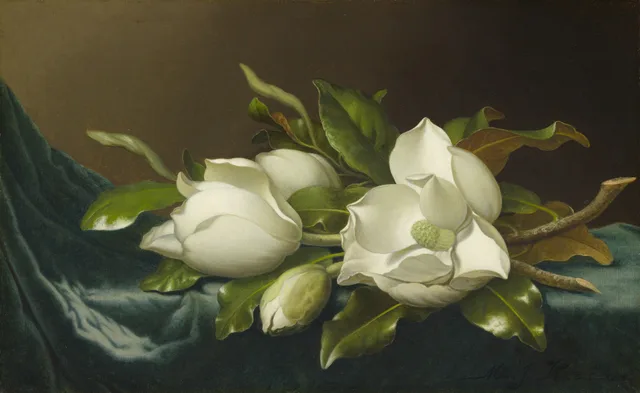
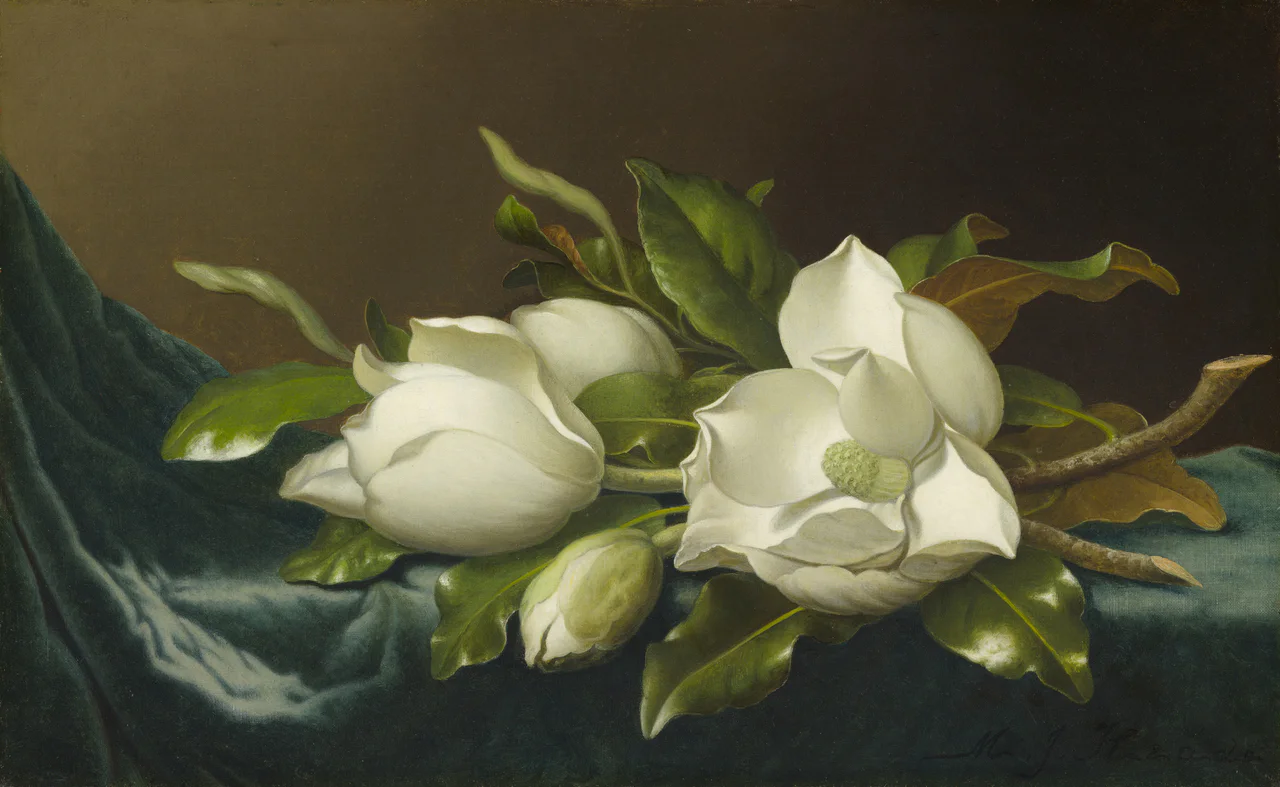
- A fully open magnolia, a half-open blossom, and a bud lie stretched across a blue velvet cloth with glossy leaves and a cut branch.
- The American painter Martin Johnson Heade made it around 1885 to 1895, after he had settled in Florida.
- Against a dark background, a sharp light picks out every white petal, so the flowers seem close enough to touch.
Reading the picture
4 places to look closer
Tap a number on the painting to jump to its note, or a close-up to see that spot in the whole picture.
Zoom in on the center of the open flower on the right. A pale green cluster rises like a little pinecone, bumpy all over. Heade gave each tiny knob a dot of light so it stands up from the surface. The petals around it curve using only the softest shifts between cream and gray.
Look at the velvet cloth in the lower left. Over the deep blue-green fabric, white light runs down in ripples. Velvet shines only along the ridges of its folds because of its nap, and Heade painted exactly that. The smooth white of the flowers sits beside the soft glow of the cloth.
Zoom in on the small bud near the bottom. Its petals are still shut tight, with only a white tip peeking out. Pale green and yellowish brown spread over the outer petals wrapped around it. With an open flower and a bud in the same picture, you can feel the time it takes a blossom to unfold.
Follow the cut branch reaching out to the right. Its gray-brown bark is flecked with tiny white spots. The leaves beneath it are not glossy green but the rusty brown of their undersides. Turn over a real magnolia leaf and you will find that same color.
When it was painted
In 1883, at sixty-four, Heade gave up a lifetime of wandering. That year he married and settled in Saint Augustine, the old city on Florida's Atlantic coast. Before that he had traveled all over the United States, to England and Europe, and three times to Brazil, where he painted hummingbirds and orchids.
In Saint Augustine he found a patron in Henry Flagler, the railroad and hotel tycoon. Flagler built a grand hotel in the city and set up a row of artists' studios behind it. Heade took one of those studios, and Flagler bought his paintings and commissioned a large one from him.
In Florida, Heade turned to the flowers growing around him: the Cherokee rose, orange blossoms, and magnolias. The Art Institute of Chicago notes that this is one of several pictures he made of the white magnolia. He also sent letters to a magazine about nature and hunting, signing them with the pen name Didymus.
Heade died in Saint Augustine in 1904. His name then faded for decades and only drew new attention in the middle of the twentieth century. This painting came to the Art Institute of Chicago in 1983.
Look at the center of the open flower again. In the southern town where the wanderer finally stayed put, he took the time to look this closely into the heart of a single bloom.
Questions to think about
- Look for itHow many flowers and buds can you count in the picture?
- Why?Why do you think Heade laid the magnolias out on a cloth instead of putting them in a vase?
- What about you?Heade was past sixty before he stayed in one place and began painting the flowers around him. When a busy, restless person finally stays put, what might they start to notice?
Same period
Painted around the same time,
somewhere else
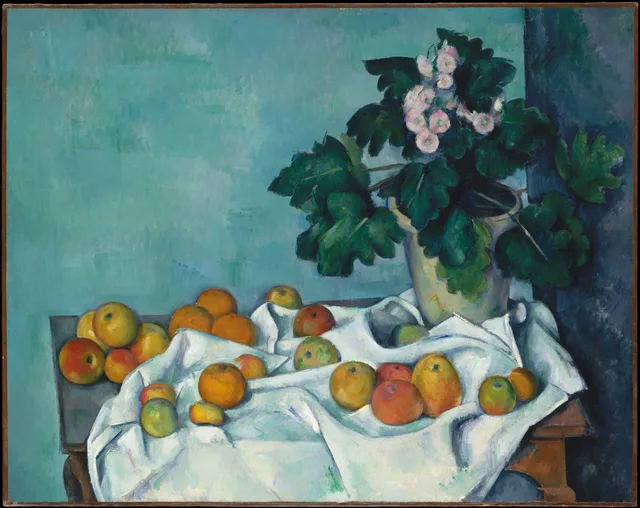 Still Life with Apples and a Pot of PrimrosesPaul Cézanneca. 1890
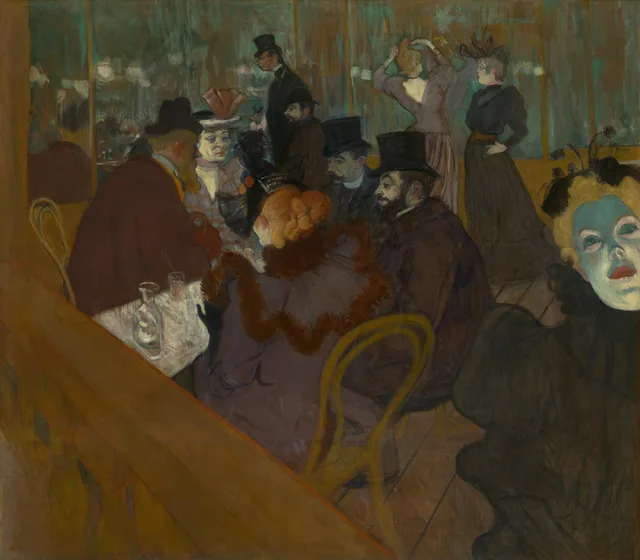 At the Moulin RougeHenri de Toulouse-Lautrec1892–95
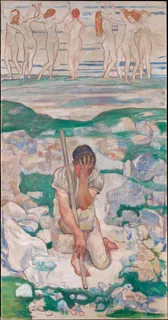 The Dream of the Shepherd (Der Traum des Hirten)Ferdinand Hodler1896
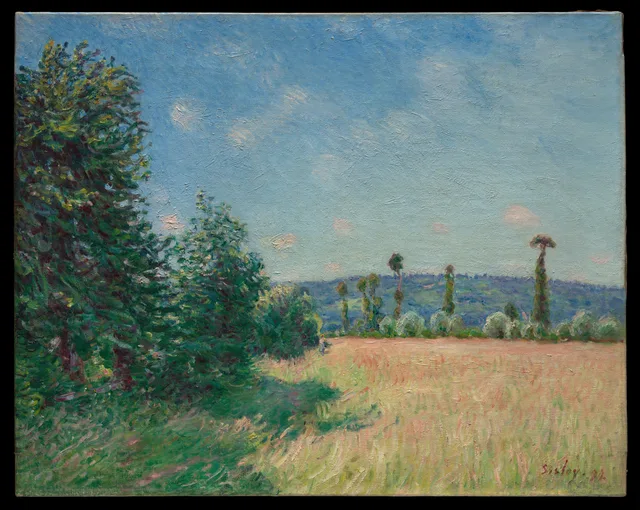 Sahurs Meadows in Morning SunAlfred Sisley1894
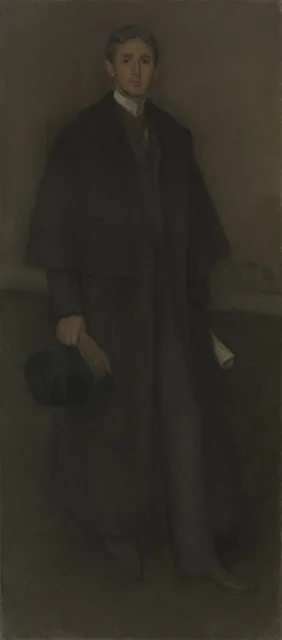 Arrangement in Flesh Color and Brown: Portrait of Arthur Jerome EddyJames McNeill Whistler1894
 Chrysanthemums in the Garden at Petit-GennevilliersGustave Caillebotte1893
Too good to keep to yourself
This painting,
for someone who comes to mind
They open it at full size
and see every brushstroke.
About this work
- Artist
- Martin Johnson Heade · 1819–1904
- Date
- 1885–95
- Medium
- Oil on canvas
- Size
- 38.6 × 61.8 cm
- Culture
- Florida
- Collection
- The Art Institute of Chicago
- Image
- Original long edge 10004px · shown at 2560px
- Original
- View on the museum's website ↗