 Pyeongye
Artwork · 19th century · Ferdinand Hodler
LeoTurn on Magnifier at the lower right and move slowly across the painting.
Full screen opens it edge to edge.Tap the painting to fill the screen.
Spread two fingers to look closer.
At a glance
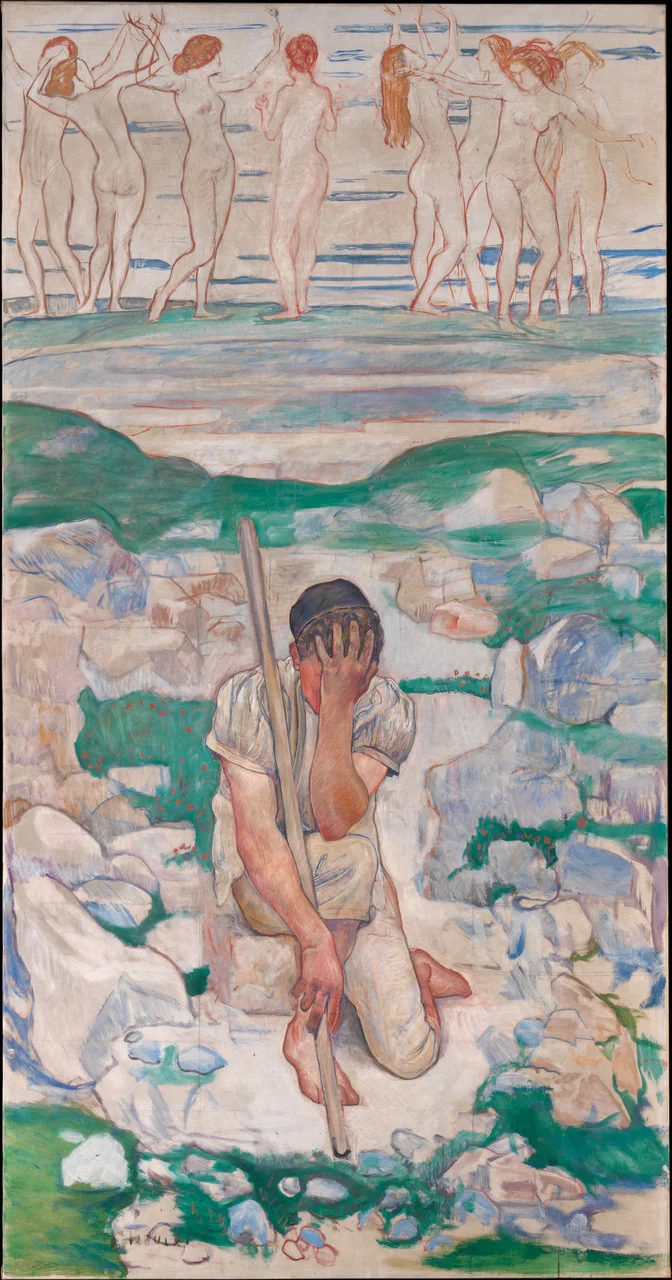
- A shepherd kneels on a rocky slope with one hand over his face, while high above him a row of women raise their arms as if dancing.
- The Swiss painter Ferdinand Hodler painted it in oil on canvas in 1896.
- The canvas is over eight feet tall, and Hodler splits it in two: the hard ground below and the dream above.
Reading the picture
5 places to look closer
Tap a number on the painting to jump to its note, or a close-up to see that spot in the whole picture.
Zoom in on the shepherd's face. You cannot see it. His fingers are spread wide over his forehead and eyes, and only a reddened ear and cheek show. Is he crying, or is he shutting his eyes to picture something? Hodler hides the answer behind a hand.
Follow the long staff down to its tip. It is planted in the ground just in front of his bare foot. The top of the foot and the toes are outlined in red. The dreamer, it seems, is still tied firmly to the earth.
Look at the green patch on the left, halfway down. Hodler brushed on a wide area of blue-green and then dabbed red dots over it. He never paints a petal, yet they read as small flowers in the grass. White rock, green grass, and red flowers are all it takes to make the slope.
Move up to the line where the dream meets the land. The women's bare feet stand on a pale blue-green strip. Below it, bands of pink and blue run sideways. Water or cloud, it is hard to say, but that strip divides the dream from the hillside.
Zoom in on one of the women at the top. Long orange hair pours down her back, and her body is drawn with nothing but a red outline. Blue lines pass behind her like ripples. The shepherd below is painted thick and solid, while the dream figures are left light, almost only lines.
When it was painted
In 1896 Ferdinand Hodler was forty-three. He had come a long way. He was born in Bern to a poor carpenter's family, and tuberculosis took both his father and his mother while he was still a child. As a boy he learned his trade in Thun, working for a painter who turned out Alpine views for tourists. Later he moved to Geneva and studied properly under Barthélemy Menn.
Before Paris knew his name, there was a scandal. In 1891 the city of Geneva ordered his large painting Night, full of sleeping nude figures, taken out of an exhibition. That same year the picture was shown at the Salon du Champ-de-Mars in Paris and well received. From then on, Hodler was noticed in Paris as a Symbolist.
In these years he painted picture after picture of figures in similar poses, standing side by side. He called the idea Parallelism: shapes repeated across a canvas create order and rhythm. He cared less about copying what the eye sees than about painting what it cannot, like dreams and feelings. The Dream of the Shepherd was first shown in Geneva in 1896, the year the Swiss National Exhibition was held there.
The next year Hodler won the competition to paint murals for the new Swiss National Museum in Zurich. His design, The Retreat from Marignano, then set off a bitter fight that lasted for years. He died in Geneva in 1918. This painting entered the Metropolitan Museum's collection in 2013.
Look again at the women at the top. Their raised arms and bodies repeat, each pose a little different, and roll across the canvas like a wave. Above a man kneeling in a field of stones, Hodler spread out his own rhythm like a dream.
The painter
Ferdinand Hodler
1853–1918
When painting this, the artist was about 43 years old
All paintings by Ferdinand Hodler →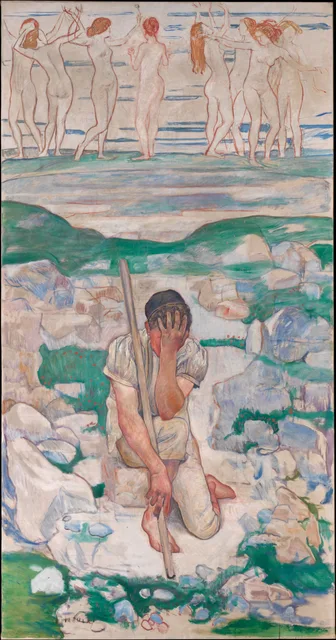
Questions to think about
- Look for itHow many women can you count in the dream at the top?
- Why?Why do you think Hodler hid the shepherd's face behind his hand instead of showing his expression?
- What about you?The shepherd lives on hard, rocky ground and dreams of something out of reach. When people with very little money have big dreams, is it fair to tell them to be realistic?
Same period
Painted around the same time,
somewhere else
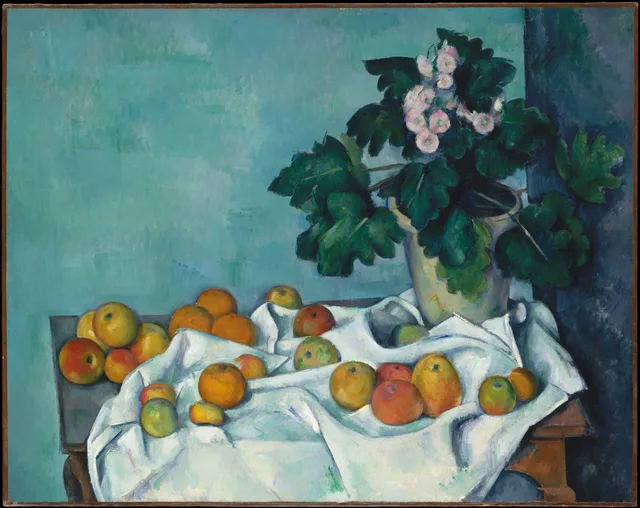 Still Life with Apples and a Pot of PrimrosesPaul Cézanneca. 1890
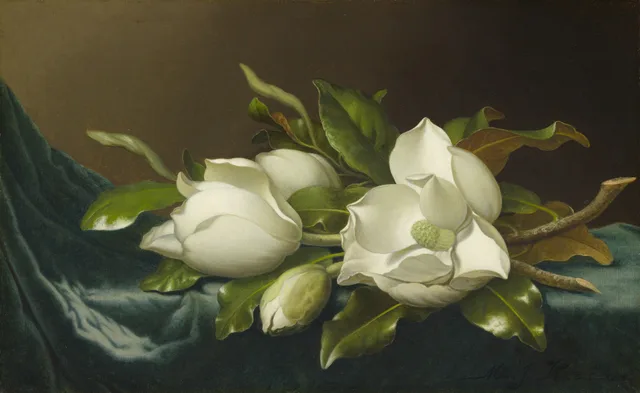 Magnolias on Light Blue Velvet ClothMartin Johnson Heade1885–95
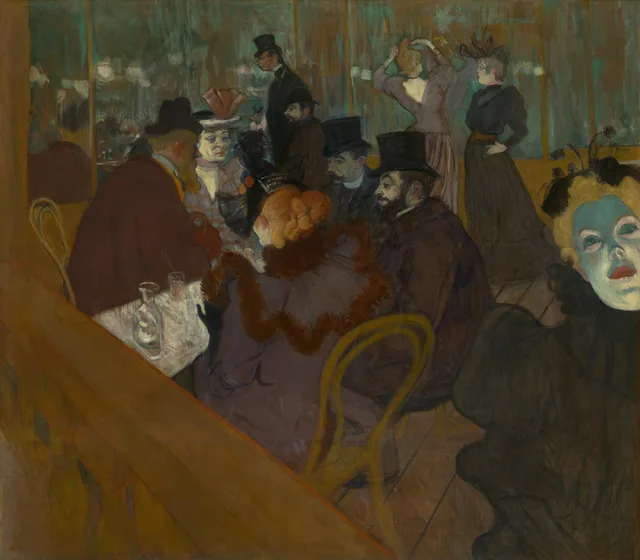 At the Moulin RougeHenri de Toulouse-Lautrec1892–95
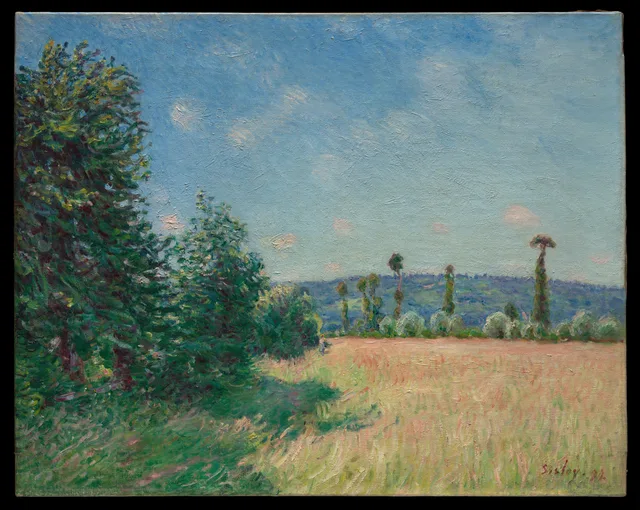 Sahurs Meadows in Morning SunAlfred Sisley1894
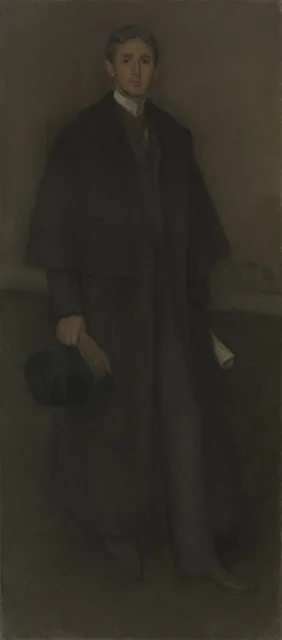 Arrangement in Flesh Color and Brown: Portrait of Arthur Jerome EddyJames McNeill Whistler1894
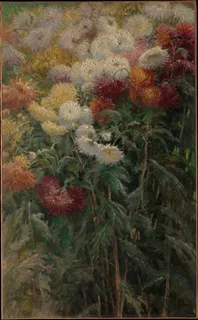 Chrysanthemums in the Garden at Petit-GennevilliersGustave Caillebotte1893
Too good to keep to yourself
This painting,
for someone who comes to mind
They open it at full size
and see every brushstroke.
About this work
- Artist
- Ferdinand Hodler · 1853–1918
- Date
- 1896
- Medium
- Oil on canvas
- Size
- 250.2 × 130.5 cm
- Collection
- The Metropolitan Museum of Art
- Image
- Original long edge 3880px · shown at 2560px
- Original
- View on the museum's website ↗