 Pyeongye
At a glance
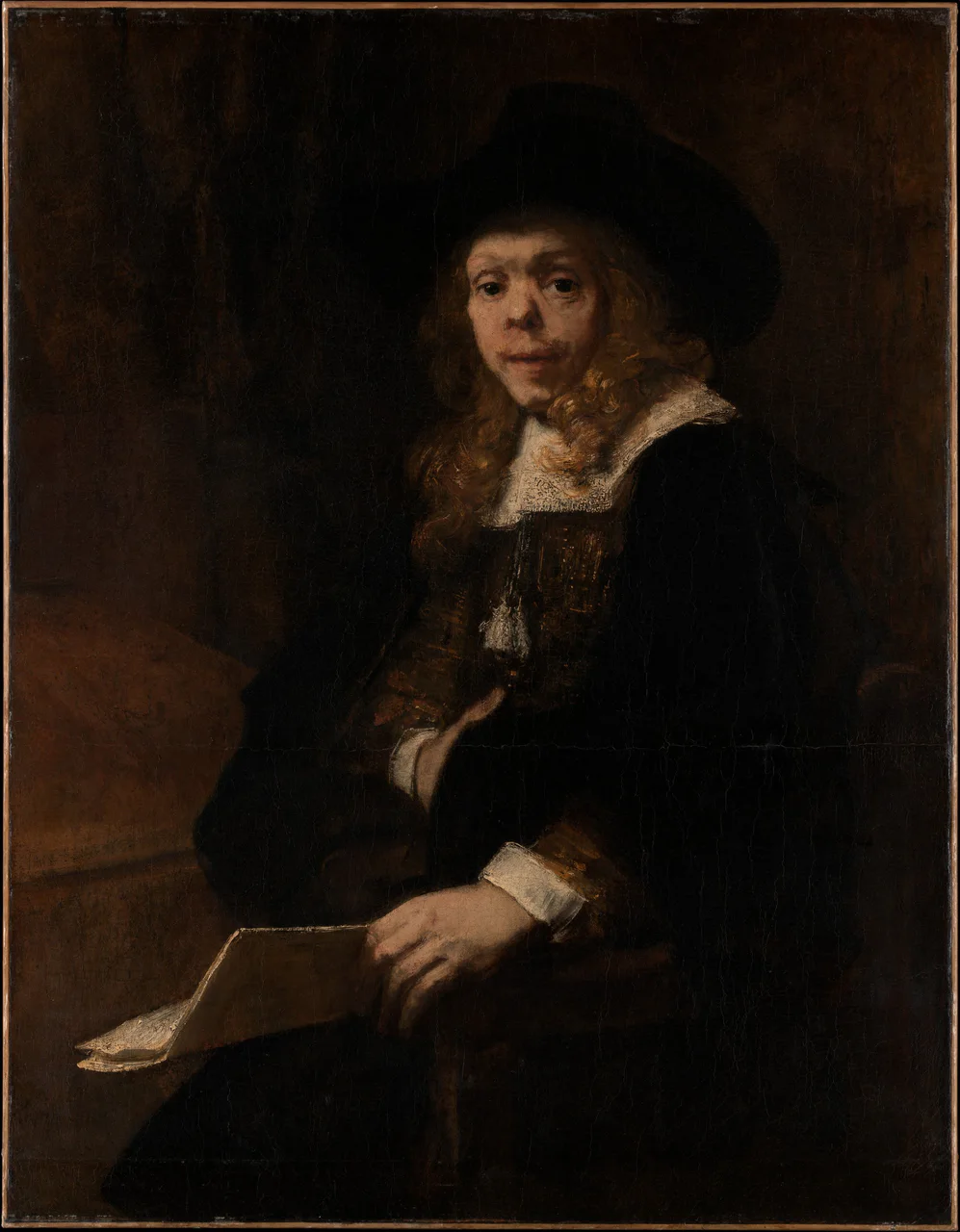
- The young painter Gerard de Lairesse sits in a wide black hat, his long curls falling to his shoulders, with a folder of papers in his hand.
- Rembrandt van Rijn painted him in oil on canvas around 1665 to 1667, when Rembrandt was about sixty.
- An aging master paints a newcomer to the city without flattering him, and that honesty is what holds your gaze.
Reading the picture
4 places to look closer
Tap a number on the painting to jump to its note, or a close-up to see that spot in the whole picture.
Zoom in on the face. The bridge of the nose is sunken, and the skin around the nostrils looks red and raw. Lairesse is known to have had a disease from birth that changed the shape of his face, especially his nose. Rembrandt did not hide it. He painted the two dark eyes that look straight at us clearly and steadily.
Look where the collar meets the hair. The white lace collar is built from thick paint, scratched and scored as if with the tip of a tool. Tawny curls tumble over it in broad strokes. Up close you see lumps of paint before you see any lace pattern.
Now zoom in on the tassel hanging at the center of his chest. It is only a few gray-white dabs clumped together in the dark. Step back, though, and it reads as knotted thread. Rough brushwork like this runs through Rembrandt's late paintings.
Drop down to the hand. One hand grips a half-open folder, and the white edges of the paper catch the light. Brushstrokes stay visible across the back of the hand. The folder looks like a portfolio, the kind artists used to carry drawings and prints.
When it was painted
Around 1665, a young painter from Liège, in today's Belgium, turned up in Amsterdam. Gerard de Lairesse was in his mid-twenties. He found work with the art dealer Gerrit van Uylenburgh. That name meant something to Rembrandt. About thirty years earlier, when Rembrandt first moved to Amsterdam, he had lodged in the house of Gerrit's father, Hendrick, and he married Hendrick's young relative Saskia.
Now Rembrandt was fifty-nine. His bankruptcy in 1656 had cost him his grand house and his collection, and he was living in a modest home on the Rozengracht. In 1663 his companion Hendrickje Stoffels had died.
Rembrandt did not flatter his young visitor. The Met explains that Lairesse probably suffered from congenital syphilis, and that Rembrandt painted its marks on his face without hiding them.
Lairesse soon made his name in Amsterdam with bright, classical paintings. Then, around 1690, he went blind and had to stop painting. The talks on art he gave to other painters afterward were published in 1707 as a thick book on painting. In it, he mocked Rembrandt's heavy paint, comparing it to mud on the canvas.
Rembrandt died in 1669, just a few years after this portrait. Much later the painting belonged to Robert Lehman, and it came to the Met with his collection in 1975.
Look again at the hand holding the portfolio and the eyes meeting yours. The young man who would one day call Rembrandt's paint mud is preserved here in that very paint.
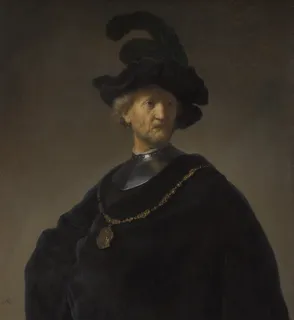
Questions to think about
- Look for itUnder the brim of the hat, can you find where the shadow ends and the lit part of the face begins?
- Why?Why do you think Rembrandt painted Lairesse's nose as it was, instead of softening it?
- What about you?Today a phone app can smooth out any face in seconds. When you share a picture of yourself, how much do you want people to see you as you really are?
Same period
Painted around the same time,
somewhere else
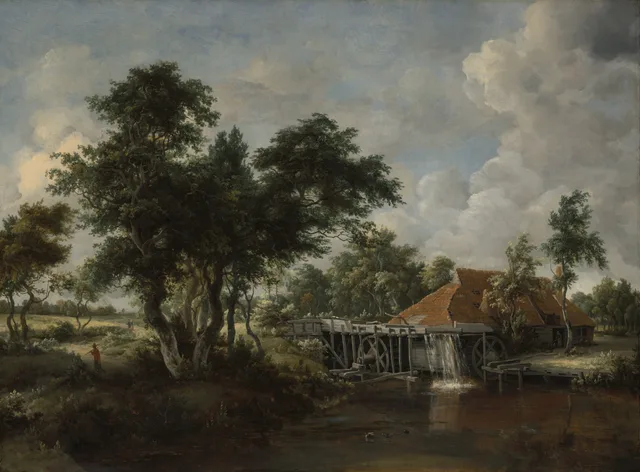 The Watermill with the Great Red RoofMeindert Hobbemac. 1665
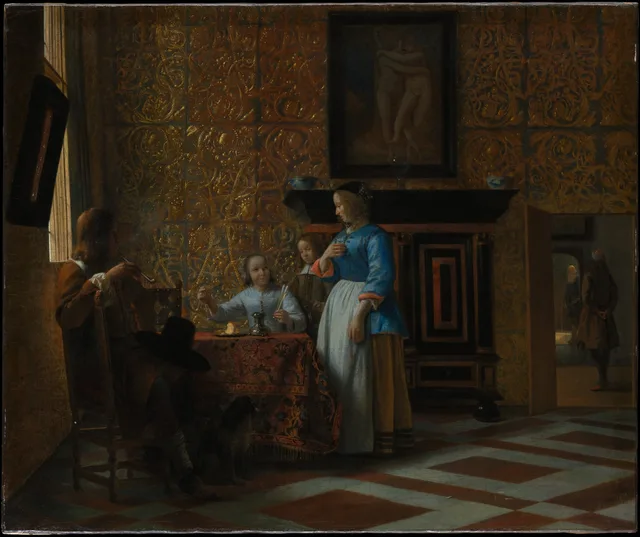 Leisure Time in an Elegant SettingPieter de Hoochca. 1663–65
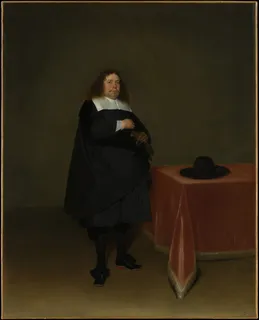 Burgomaster Jan van Duren (1613–1687)Gerard ter Borch the Youngerca. 1666–67
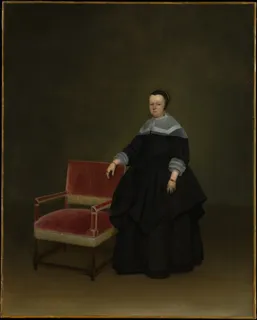 Margaretha van Haexbergen (1614–1676)Gerard ter Borch the Youngerca. 1666–67
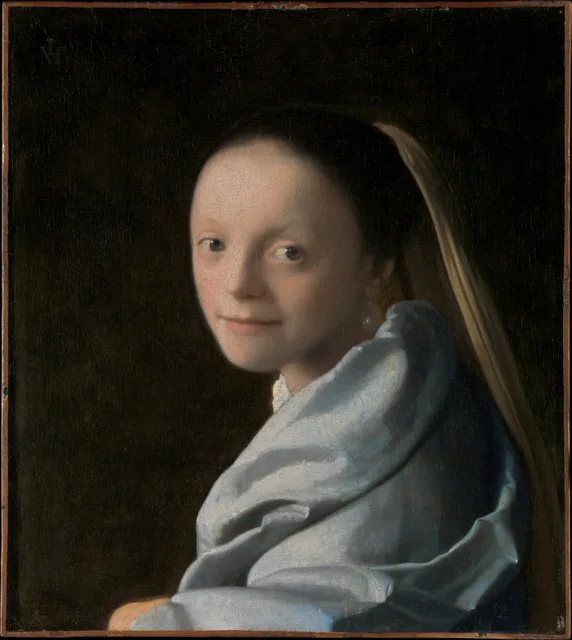 Study of a Young WomanJohannes Vermeerca. 1665–67
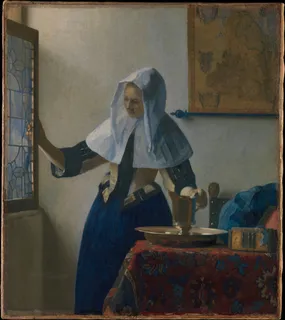 Young Woman with a Water PitcherJohannes Vermeerca. 1662
Too good to keep to yourself
This painting,
for someone who comes to mind
They open it at full size
and see every brushstroke.
About this work
- Artist
- Rembrandt · 1606–1669
- Date
- 1665–67
- Medium
- Oil on canvas
- Size
- 112.7 × 87.6 cm
- Collection
- The Metropolitan Museum of Art
- Image
- Original long edge 3814px · shown at 2560px
- Original
- View on the museum's website ↗