 Pyeongye
Artwork · 17th century · Wang Hui
LeoTurn on Magnifier at the lower right and move slowly across the painting.
Full screen opens it edge to edge.Tap the painting to fill the screen.
Spread two fingers to look closer.
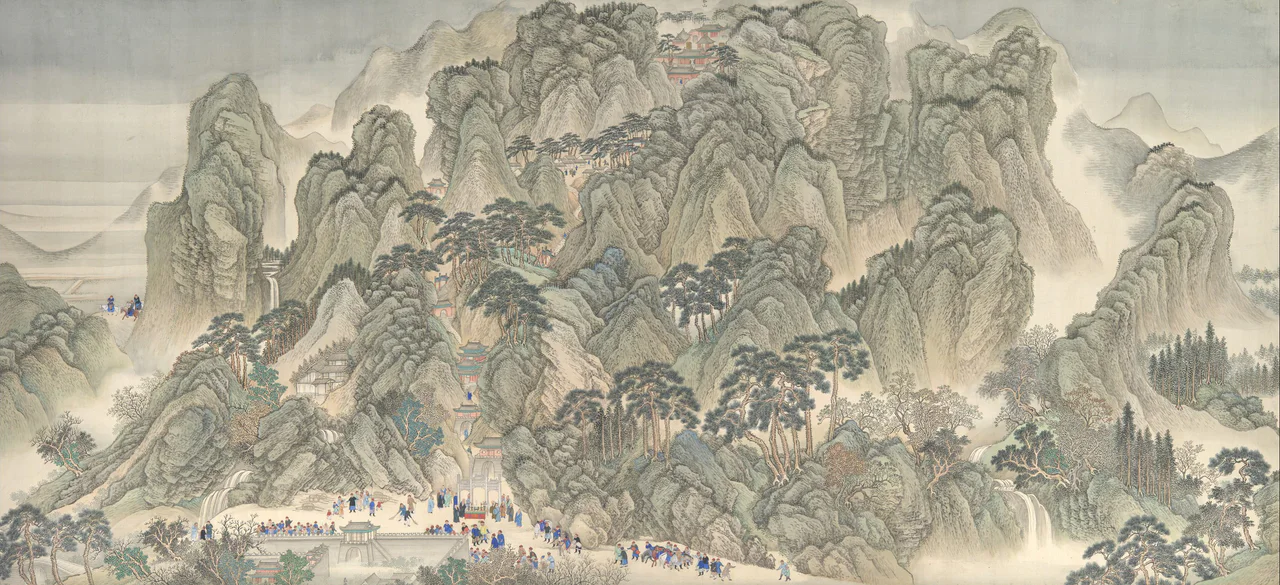
The Kangxi Emperor's Southern Inspection Tour, Scroll Three: Ji'nan to Mount Tai
Wang Huidatable to 1698Handscroll; ink and color on silk67.9 × 1393.8 cm
At a glance
- A long silk handscroll recording one stretch of the Kangxi Emperor's tour of southern China: the road from Ji'nan in Shandong to Mount Tai.
- Painted by a team of court artists led by Wang Hui, and datable to 1698.
- Nearly 14 meters long, it fills mountains and temples with crowds of tiny people, each one busy with something.
Reading the picture
5 places to look closer
Tap a number on the painting to jump to its note, or a close-up to see that spot in the whole picture.
Zoom in on the open terrace above the wall at the bottom. Two men are sweeping the ground with brooms. Beside a stone gateway, ritual vessels sit on a red table, and officials in blue robes and red hats stand in rows. It feels like the rush before an important guest arrives.
A little to the right, a group on horseback passes under a cliff. Riders in red hats sit on white and brown horses, with attendants walking alongside. One man carries a red bundle in his arms. This is just one small piece of a very long procession.
Follow the valley up from the middle left. Gates with red walls and blue-green roofs rise one above another, and people in blue climb the stairs between them. The path up the mountain is painted like a pilgrimage route.
Zoom in near the top peak. Among clouds and pines sits a large temple with red walls. A long stone stair leads up to it, and a tiny figure stands in a doorway. The road that began in the courtyard below finally arrives here.
Zoom in on the waterfall at the lower right. The water breaks over rock ledge after rock ledge and vanishes into white mist below. Twisting trees cling to the cliffs above it. In this corner, with no procession at all, the scroll looks like a classic Chinese landscape painting.
When it was painted
In 1689 the Kangxi Emperor, then in his mid-thirties, set out on his second tour of the south. He went to check the dikes and canals of the Yellow River and the Grand Canal, and to meet the scholars and townspeople of the rich southern provinces face to face. His route ran through Shandong to Mount Tai, the sacred peak where emperors had long offered sacrifices to Heaven and Earth.
When the journey was over, the court decided to record it in paint. The job went to Wang Hui, a landscape painter from Changshu in the south. Born in 1632, he was already well past fifty and famous. He moved to Beijing, led a team of painters, and produced twelve enormous handscrolls.
Here is a surprise. According to The Metropolitan Museum of Art, Wang Hui never visited Mount Tai himself. He built these paths and temples from maps and woodblock prints. The Met credits the scroll to Wang Hui and his assistants, and reads its clear blue-and-green landscape as a way of showing the emperor's kindly rule.
The court honored him with a four-character phrase meaning landscapes clear and radiant. When the work was done, Wang Hui chose not to stay at court and went home to Changshu. The twelve scrolls were later scattered, and this third one entered the Met in 1979. In 2008 the museum borrowed that same phrase as the title of its Wang Hui exhibition.
Now look again at the courtyard at the very bottom. The painter never climbed this mountain, yet the two men sweeping that courtyard feel close enough to touch.
Questions to think about
- Look for itHow many people on horseback can you find?
- Why?In a picture about an emperor's journey, why do you think the painters made the mountains and waterfalls so big and the people so small?
- What about you?Even today, streets get swept and tables set before a leader visits. Who are those preparations really for?
Same period
Painted around the same time,
somewhere else
Too good to keep to yourself
This painting,
for someone who comes to mind
They open it at full size
and see every brushstroke.
About this work
- Artist
- Wang Hui · 1632–1717
- Date
- datable to 1698
- Medium
- Handscroll; ink and color on silk
- Size
- 67.9 × 1393.8 cm
- Culture
- China
- Collection
- The Metropolitan Museum of Art
- Image
- Original long edge 3001px · shown at 2560px
- Original
- View on the museum's website ↗