 Pyeongye
Artwork · 18th century · Stipple Master
LeoTurn on Magnifier at the lower right and move slowly across the painting.
Full screen opens it edge to edge.Tap the painting to fill the screen.
Spread two fingers to look closer.
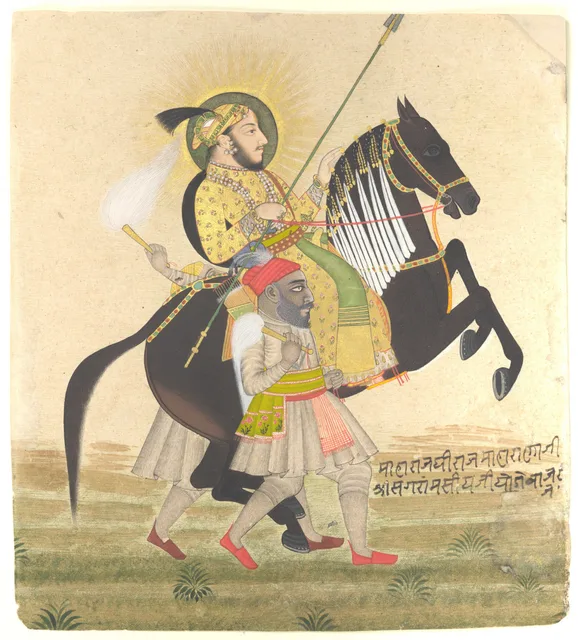
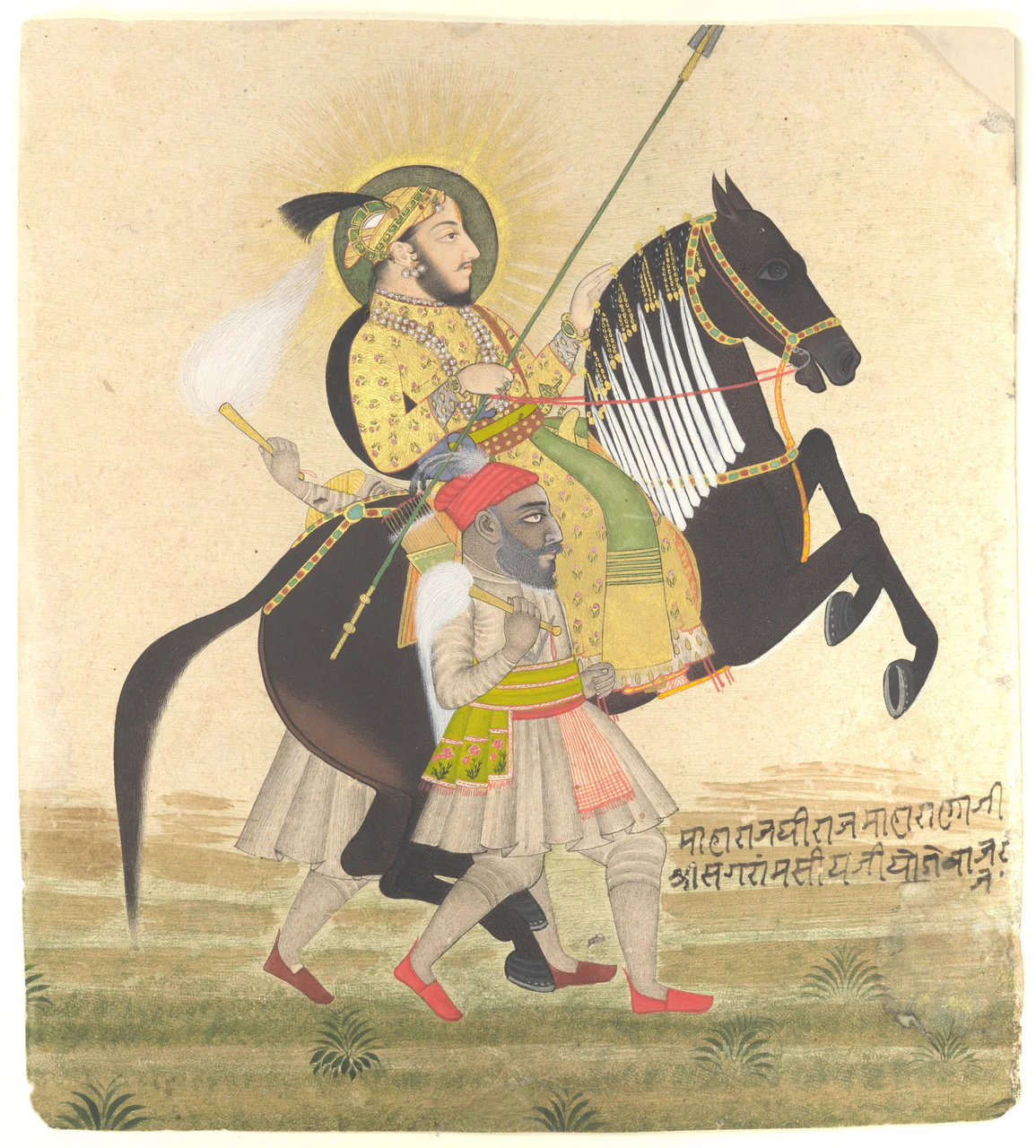
Maharana Sangram Singh Riding a Prize Stallion
Stipple Masterca. 1712Ink, opaque watercolor, gold, and Basra pearls on paper21 × 19 cm
At a glance
- Maharana Sangram Singh of Mewar rides a rearing black stallion with a lance in hand, while two attendants walk alongside.
- A Mewar court artist known as the Stipple Master painted it around 1712 with ink, opaque watercolor, gold, and pearls.
- On a sheet only about 20 centimeters across, he included everything from the king's pearl earrings to the nails in the horse's shoes.
Reading the picture
5 places to look closer
Tap a number on the painting to jump to its note, or a close-up to see that spot in the whole picture.
Look at the king's face. Golden rays burst out from a green halo behind his head. A black plume rises from his turban. The pearls in his earrings and necklaces seem to stand up off the paper, and the museum's record lists Basra pearls among the materials.
Zoom in on the horse's head. Long white tassels hang down its neck, and little gold ornaments dangle along the mane. The bridle is set with green and red stones. A large, clear eye looks straight ahead.
Find the attendant walking in front, beside the horse. He wears a red turban and carries a fly whisk with white hair over his shoulder. Get close to his beard and the shadows on his face. They are built from tiny dots and short strokes packed together. Painting with dots is called stippling, and that is how this artist got his name.
Look at the horse's raised front legs. Under each hoof is a silver horseshoe, with the nail heads marked as little dots. A horse that carried the king was cared for down to the last detail.
Read the writing at the lower right. Two lines in an Indian script name the rider. You can find the title Maharana and the name Sangram Singh. It works like a label telling us who is in the picture.
When it was painted
In 1710, Mewar had a new king. Sangram Singh II took the throne after his father, Amar Singh II, and ruled until 1734. Mewar was a kingdom in what is now southern Rajasthan, with its capital at Udaipur. This portrait was made around 1712, a couple of years into the new reign.
The man holding the brush was no newcomer at court. The museum dates his working life to about 1690 to 1715. In the 1690s he painted for Amar Singh, who was then still a prince. He stayed on into the reign of Amar Singh's son. In other words, he painted father and son, one king after the other.
His way of painting was unusual in Mewar. According to the museum, this kind of stippling, building up shadow from tiny dots, is otherwise unknown in Rajput painting, though it has earlier examples at the Mughal and Deccan courts. The museum describes it as a cross between nim qalam, the Mughal technique of tonal ink drawing, and watercolor. His real name is uncertain. The museum lists the name Jai Ram, followed by a question mark.
A ruler on horseback belonged to a long tradition of royal portraiture in India. The rearing horse and the attendants with fly whisks were ways of showing a king's standing. The royal house of Mewar traced its line back to the sun.
The Met acquired the painting in 2004.
Now look again at the face of the attendant in front. Those tiny dots, so rare in other Rajput paintings, shape his beard and the shadows on his cheek. They remember the painter for us, even though his name is lost.
Questions to think about
- Look for itHow many places can you find where pearls were used?
- Why?Why do you think the painter left the background nearly empty and spent so much care on the figures?
- What about you?This artist is remembered only by his work, not his name; is there something you would like to leave behind even if no one remembered that you made it?
Same period
Painted around the same time,
somewhere else
Too good to keep to yourself
This painting,
for someone who comes to mind
They open it at full size
and see every brushstroke.
About this work
- Artist
- Stipple Master · 1680–1725
- Date
- ca. 1712
- Medium
- Ink, opaque watercolor, gold, and Basra pearls on paper
- Size
- 21 × 19 cm
- Culture
- India (Rajasthan, Mewar)
- Collection
- The Metropolitan Museum of Art
- Image
- Original long edge 3871px · shown at 2560px
- Original
- View on the museum's website ↗