Pyeongye
Painters · 17th century
Wang Hui
1632–1717
A landscape painter from Changshu who learned by copying old masters one by one, and who, near sixty, led the team that put an emperor's journey south onto twelve giant scrolls.
Scenes from a life
The life of Wang Hui,
scene by scene
- 1651Changshu
It started with a folding fan. In 1651, in Changshu, the painter Wang Jian picked up a fan painted by a nineteen-year-old named Wang Hui and was struck by it.
Wang Jian, then in his fifties, was already a respected artist. That same year he took the young man under his wing and introduced him to Wang Shimin, a scholar-painter with a great collection of Song and Yuan paintings, and to the poet Wu Weiye. For a village painter from the foot of Mount Yu, a door had just swung open.
- 1660sTaicang
Wang Shimin invited Wang Hui to his family villa in Taicang. The house was full of old scrolls, and the young painter sat in front of them and copied, picture after picture. He stayed on for years as a guest and retainer.
Wang Shimin did more than open his own storeroom. He helped Wang Hui get into many of the finest private collections in the region. Several of those collectors later became his most important patrons. All his life, Wang Hui kept making versions of old paintings, and he signed and dated them.
- 1685Beijing
In 1685 the Manchu nobleman Singde invited Wang Hui to Beijing. Singde was an imperial bodyguard and a celebrated young poet. That summer, at about thirty, he died.
The Met suggests that this invitation may well have been a first step toward a far bigger imperial job that came to Wang Hui a few years later.
- 1691Beijing
In 1691 a summons came from Beijing. The Kangxi Emperor wanted a picture record of his second Southern Inspection Tour, the long trip south he had made in 1689. The man who recommended Wang Hui for the work was his own pupil Song Junye, a court official who also took part in the work.
Wang Hui, almost sixty, took charge of a team of painters. The set grew to twelve handscrolls and took about seven years. He never climbed Mount Tai himself. He built its paths and temples from maps and woodblock prints.
- 1698Changshu
In 1698 the twelve scrolls were finally done. The court honored Wang Hui with four characters, 山水淸暉, roughly "landscapes clear and radiant." He did not stay on at court. He went home to Changshu, hung the four characters in his studio, and began calling himself the Master of Clear Radiance.
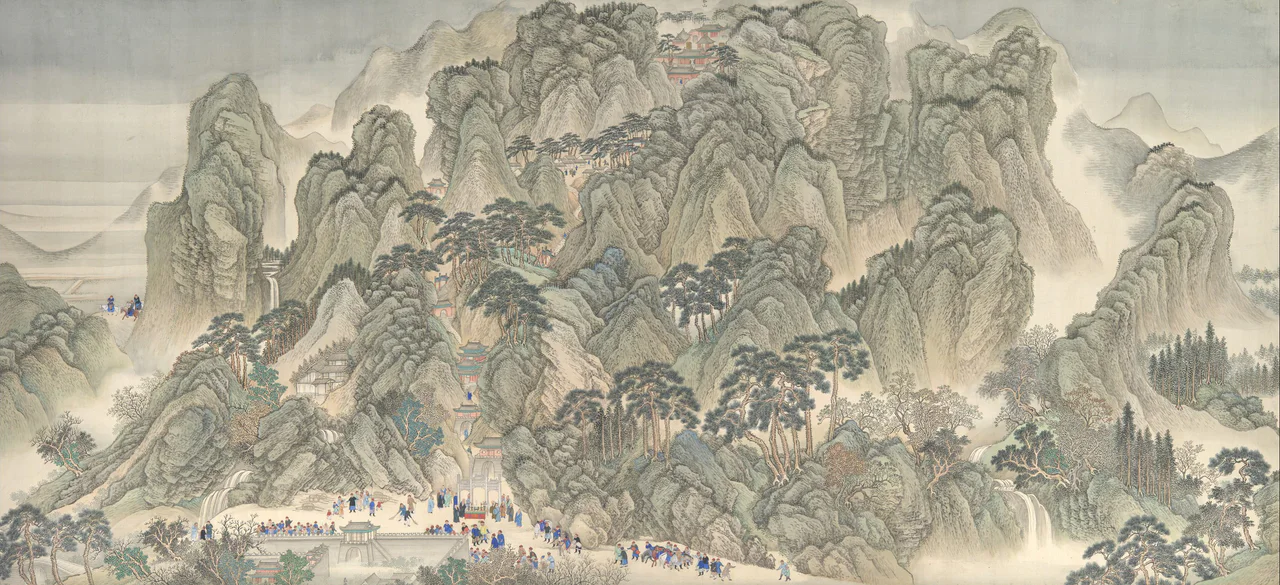
Look at this part of The Kangxi Emperor's Southern Inspection Tour, Scroll Three: Ji'nan to Mount Tai. In a courtyard at the bottom, two men sweep the ground with brooms. Under a white stone gateway, ritual vessels stand on a red table. Men in blue robes and red hats gather nearby, and stone steps climb toward a red-walled temple among the clouds.
 Painted around this timeThe Kangxi Emperor's Southern Inspection Tour, Scroll Three: Ji'nan to Mount Tai
- 1717Changshu
Wang Hui died in 1717, at eighty-five. The twelve scrolls his team made were later scattered. Some remain in the Palace Museum in Beijing, and this third scroll entered the Metropolitan Museum of Art in New York in 1979.
In 2008 the Met mounted a large exhibition of his work. Its title, Landscapes Clear and Radiant, came from the same four characters he had hung in his studio back home. Next time you open this scroll, look first for the two little men with their brooms.
In their own words
以元人筆墨,運宋人丘壑,而澤以唐人氣韻,乃為大成。
Use the brush and ink of the Yuan masters to move the mountains and valleys of the Song, then steep it all in the spirit of the Tang. Only then is the work complete.
People around them
- Wang Jianthe painter who admired his fan in 1651, took him on as a pupil, and introduced him to Wang Shimin.
- Wang Shiminthe teacher who let him copy the old paintings in his collection and opened doors to other collectors.
- Song Junyehis pupil, a court official who recommended him for the Southern Inspection Tour and worked on the scrolls.
- Wu Lia painter born the same year in Changshu, who also studied with Wang Jian and Wang Shimin.
- Yun Shoupinga close friend and fellow painter, best known for his flowers.
Works
Paintings by
Wang Hui on Pyeongye
More paintings by this artist will be added.