 Pyeongye
Artwork · 15th century · Filippino Lippi
LeoTurn on Magnifier at the lower right and move slowly across the painting.
Full screen opens it edge to edge.Tap the painting to fill the screen.
Spread two fingers to look closer.
At a glance
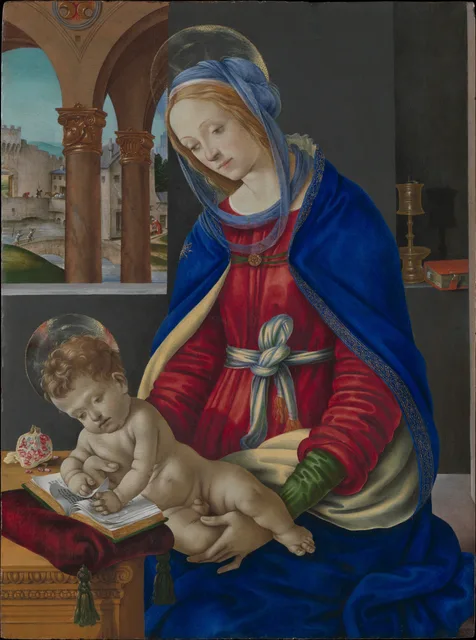
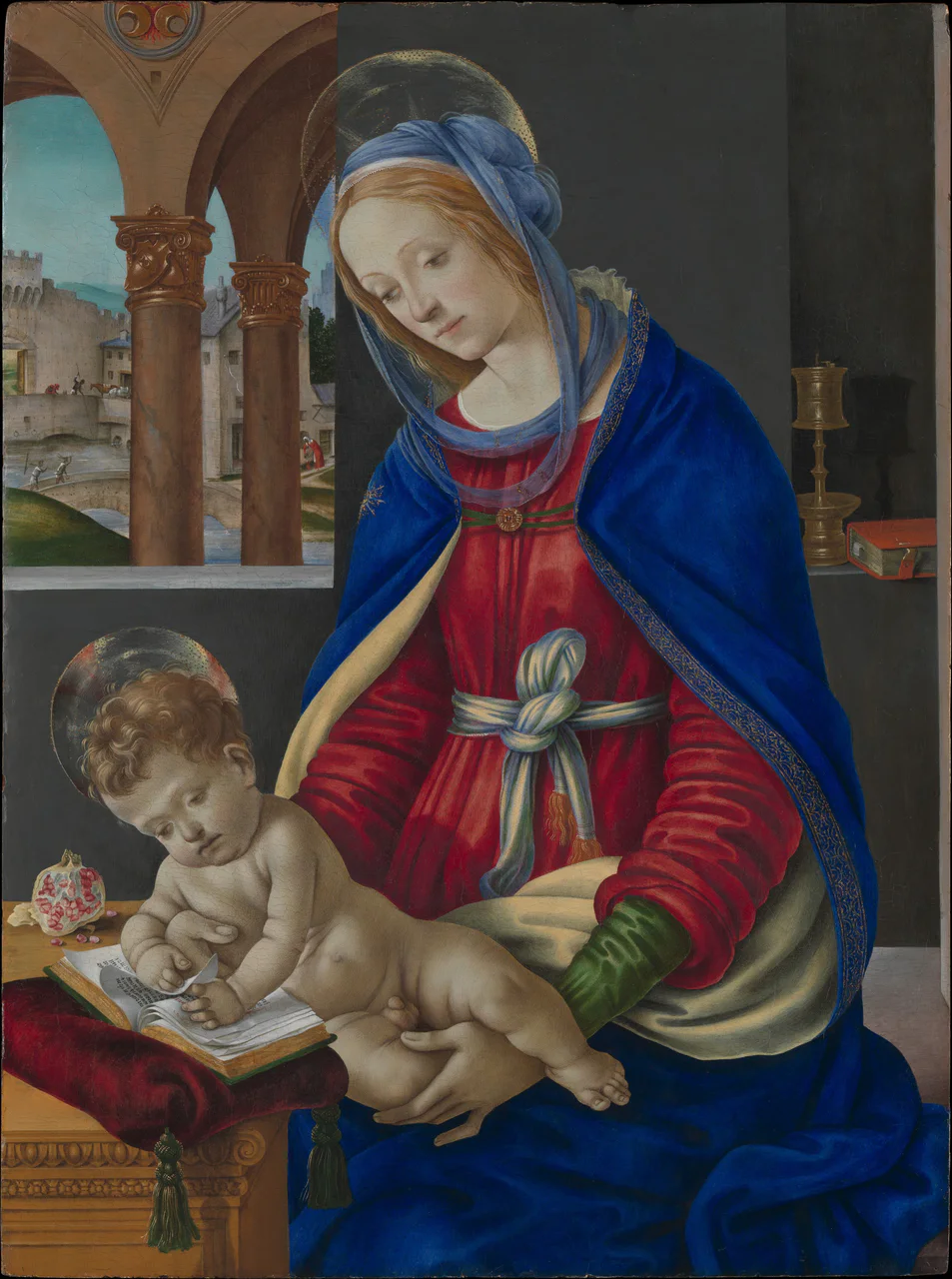
- The Virgin, in a red dress and a deep blue cloak, holds the Christ Child on her lap while he turns the pages of a book.
- Filippino Lippi painted it in Florence around 1483–84, in tempera, oil, and gold on a wooden panel.
- Tiny stories hide everywhere, from the brass candlestick indoors to the travelers crossing a bridge outside.
Reading the picture
5 places to look closer
Tap a number on the painting to jump to its note, or a close-up to see that spot in the whole picture.
Zoom in on Mary's face. Her eyelids are half lowered as she looks down at the child. A thin blue veil lies over her reddish-gold hair, and you can see the hair through it. The fine web of cracks across her skin is what happens when paint dries and hardens for more than five hundred years.
Now look at the baby's hands. He has pinched a single page and is about to turn it. The book is written in black and red lettering. On the table beside him, a split pomegranate spills its red seeds. Painters often used the pomegranate as a sign of Christ's resurrection.
Look out the window on the left. Between the columns you see a walled town, a river, and a stone bridge. A man with a bundle on his back walks across the bridge. Above him, on the road, a man with a long pole passes some horses. Outside Mary's quiet room, an ordinary day goes on.
Zoom in on the very top of the vault above the window. Two golden crescent moons are painted there. Three crescents formed the coat of arms of the Strozzi, a wealthy Florentine family. That is why the painting is thought to have been made for them.
Move to the shelf on the right. A brass candlestick stands next to a book with a red cover. The candlestick throws a long shadow on the wall behind it, and the book even has its leather strap and clasp. That is a lot of care for a spot no bigger than your palm.
When it was painted
Filippino's very birth was a scandal. His father, Fra Filippo Lippi, was a friar and a celebrated painter. His mother, Lucrezia Buti, had been a nun. Filippino was born around 1457 in Prato, and his father died in 1469 in Spoleto, in the middle of painting the cathedral there.
The boy, about twelve, went on to train with Botticelli, who had himself been a pupil of Fra Filippo. In the 1480s, Filippino was trusted with a big job. In the Brancacci Chapel of the Carmine church in Florence, he finished the wall paintings Masaccio had left incomplete half a century before.
The man who ordered this picture was the banker Filippo Strozzi. His family had clashed with the Medici and been banished from Florence. Filippo made a fortune in banking in Naples and was allowed home only in 1466. He set out to rebuild the family's standing by commissioning fine works of art.
Painter and patron kept working together. In 1487 Strozzi hired Filippino to fresco the family chapel in the church of Santa Maria Novella. Strozzi died in 1491 without seeing it finished, and the chapel was not completed until 1502.
Centuries later the picture crossed the Atlantic. The collector Jules Bache bought it from the dealer Duveen in 1928, and it came to The Metropolitan Museum of Art with his collection in 1949. Around 2010 a Met conservator removed a thick, discolored varnish, and underneath the colors turned out to be deep and well preserved.
So look again at Mary's deep blue cloak and red dress. For years those colors sat under that dull, discolored film. And the crescent moons glinting in the vault above the window are the mark of a patron who wanted his family's name to shine again.
Questions to think about
- Look for itHow many people and animals can you count in the view outside the window?
- Why?Why would the painter put the patron family's emblem right above the Virgin and Child?
- What about you?A rich family paid for this picture and left its mark on it. How do you feel when companies today pay for museums or concerts and put their names on them?
Same period
Painted around the same time,
somewhere else
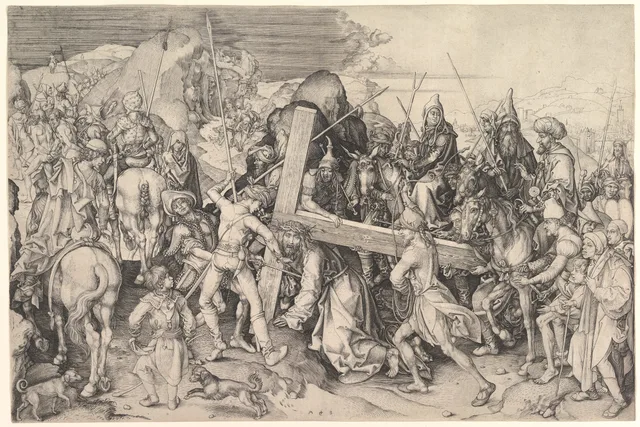 Christ Carrying the CrossMartin Schongauerca. 1475–80
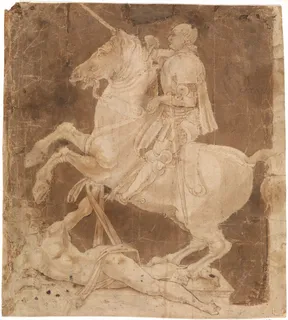 Study for the Equestrian Monument to Francesco SforzaAntonio Pollaiuoloearly to mid 1480s
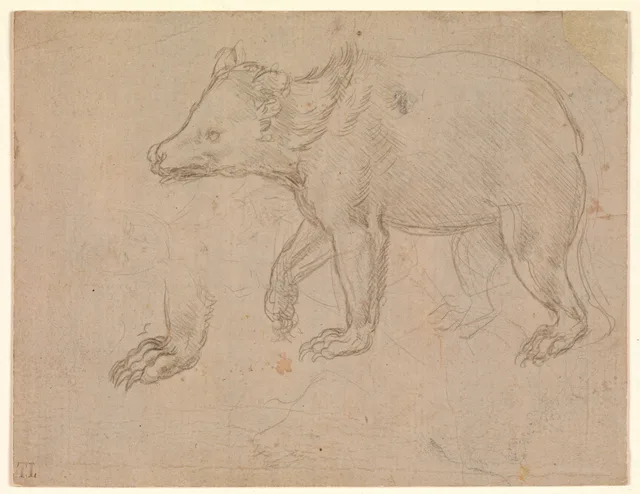 A Bear WalkingLeonardo da Vincica. 1482–85
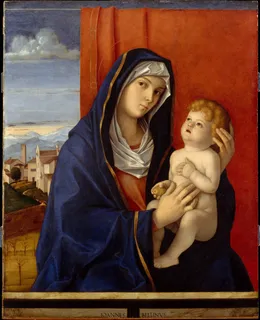 Madonna and ChildGiovanni Bellinilate 1480s
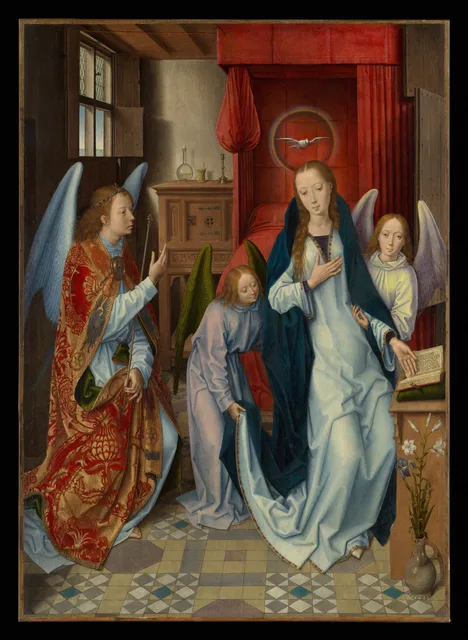 The AnnunciationHans Memling1480–89
 Madonna and ChildBenvenuto di Giovannica. 1475–85
Too good to keep to yourself
This painting,
for someone who comes to mind
They open it at full size
and see every brushstroke.
About this work
- Artist
- Filippino Lippi · 1457–1504
- Date
- ca. 1483–84
- Medium
- Tempera, oil, and gold on wood
- Size
- 81.3 × 59.7 cm
- Collection
- The Metropolitan Museum of Art
- Image
- Original long edge 3859px · shown at 2560px
- Original
- View on the museum's website ↗