 Pyeongye
Artwork · 19th century · Edouard Manet
LeoTurn on Magnifier at the lower right and move slowly across the painting.
Full screen opens it edge to edge.Tap the painting to fill the screen.
Spread two fingers to look closer.
At a glance
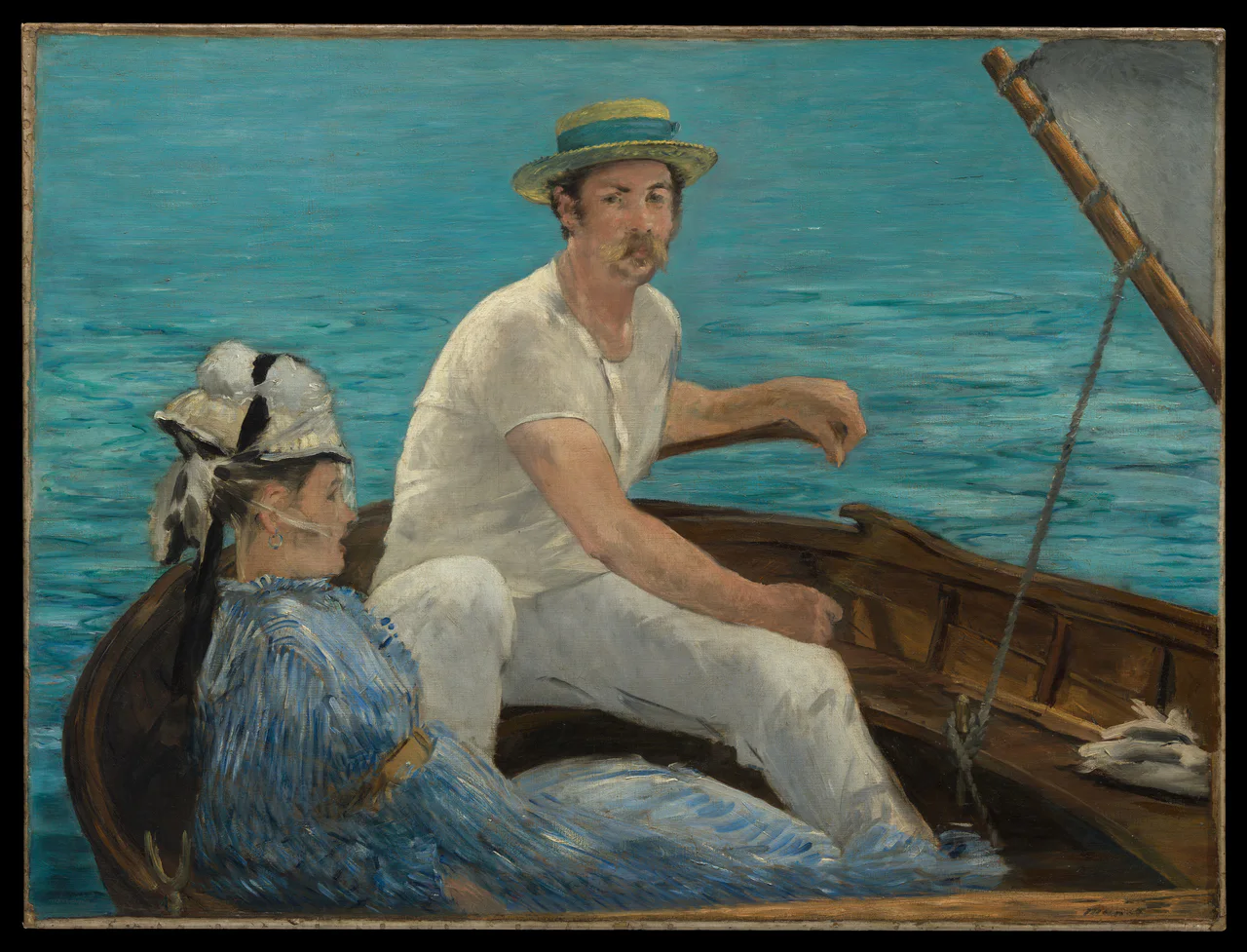
- A man in white and a straw hat steers a small sailboat, while a woman in a blue striped dress leans back beside him, looking out at the water.
- Edouard Manet painted it in oil in the summer of 1874, on the Seine near Paris.
- There is no sky and no riverbank, only turquoise water behind them, so it feels as if we are sitting in the same boat.
Reading the picture
4 places to look closer
Tap a number on the painting to jump to its note, or a close-up to see that spot in the whole picture.
Zoom in on the man's face. His straw hat has a turquoise band, and he wears a thick mustache. He looks straight at us. It is as if he has just noticed that we climbed aboard.
Look at the woman's hat. Black ribbons trail from a white bonnet, and a thin veil blows across her face. The veil is just a few strokes of white paint, yet you can see her cheek and nose through it. A small hoop earring glints at her ear.
Move down and zoom in on her dress. Quick blue and white strokes pile up to make the stripes. Up close it looks less like cloth and more like moving water.
Zoom in on the upper right. A gray sail tied to a wooden spar leans at an angle, and a rope runs down into the boat. The top of the sail is cut off by the edge of the canvas. Manet does not show us the whole boat. He crops it, the way you would see it if you were sitting inside.
When it was painted
In the summer of 1874, Manet was forty-two. He spent the season at his family's property at Gennevilliers, on the Seine. Across the river, in Argenteuil, lived Claude Monet, and Manet often joined Monet and Renoir there.
That spring, Monet and his friends had held the group show later known as the first Impressionist exhibition. Manet was close to them, but he stayed out of it and kept sending his work to the official Salon. Still, that summer he set up his easel outdoors in bright daylight, just as his friends did. He painted Monet at work in his little studio boat, and he painted the Monet family resting in their garden.
On the day Manet painted the Monet family, Renoir happened to arrive and painted the same scene right beside him. The two pictures are now in two museums: Manet's at the Met, and Renoir's at the National Gallery of Art in Washington.
The man at the tiller has long been identified as Rodolphe Leenhoff, Manet's brother-in-law. He was the brother of Manet's wife, Suzanne, and a painter himself. Who the woman is remains an open question.
Five years later, Boating hung at the Salon of 1879, alongside In the Conservatory. The painter Mary Cassatt admired it greatly. In 1895, when it was with the dealer Paul Durand-Ruel, she urged her friends the Havemeyers to buy it. Louisine Havemeyer's bequest brought it to the Met in 1929.
Look again at the background, all water and no sky. The summer Manet spent by the river with his friends lives on in that single sheet of turquoise.
The painter
Edouard Manet
1832–1883
When painting this, the artist was about 42 years old
All paintings by Edouard Manet →More by the same painter
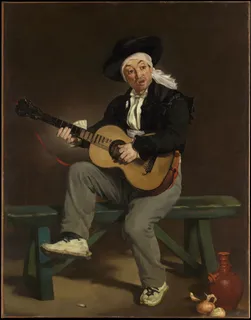
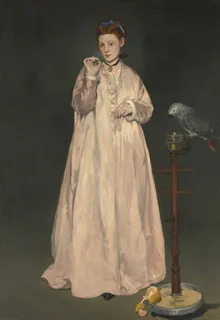
Questions to think about
- Look for itCan you find what each of the man's hands is holding?
- Why?Why do you think Manet left out the sky and the riverbank and filled the background with water?
- What about you?A hundred and fifty years ago, Parisians went out on the river on weekends to rest. Do we have enough time today to step away from work and simply rest?
Same period
Painted around the same time,
somewhere else
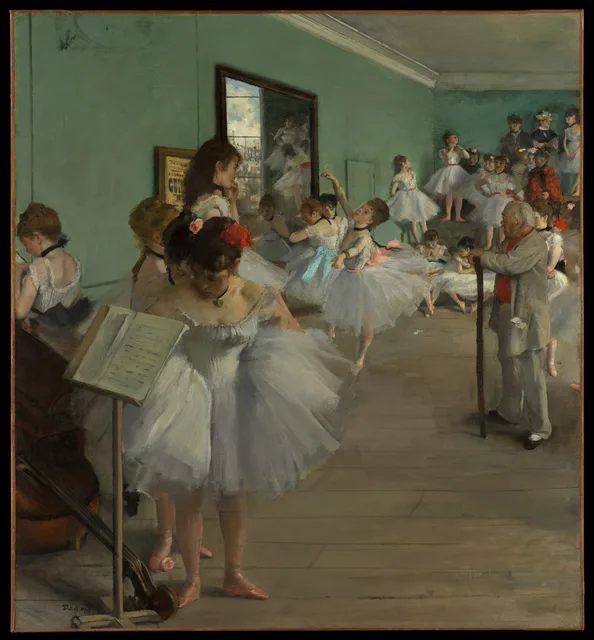 The Dance ClassEdgar Degas1874
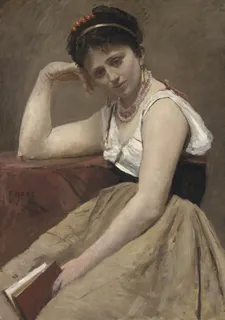 Interrupted ReadingCamille Corotc. 1870
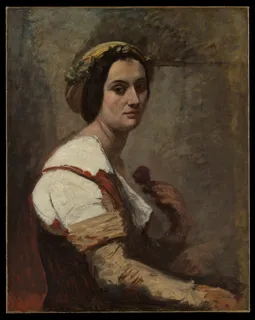 SibylleCamille Corotca. 1870
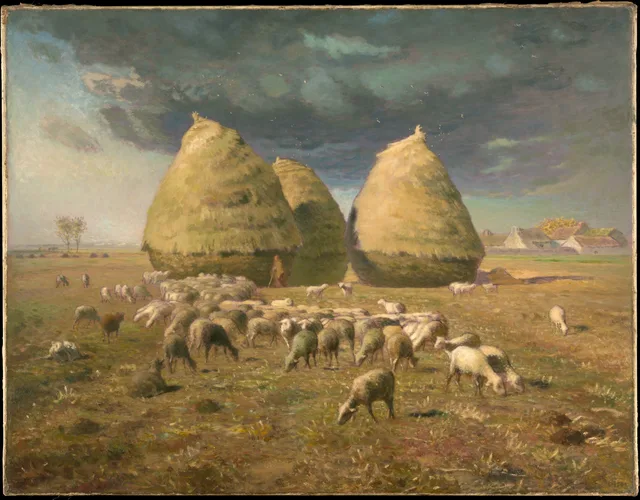 Haystacks: AutumnJean-François Milletca. 1874
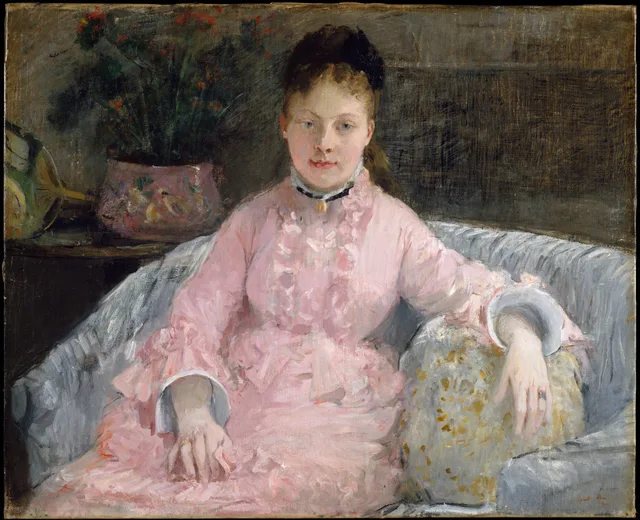 The Pink Dress (Albertie-Marguerite Carré, later Madame Ferdinand-Henri Himmes, 1854–1935)Berthe Morisotca. 1870
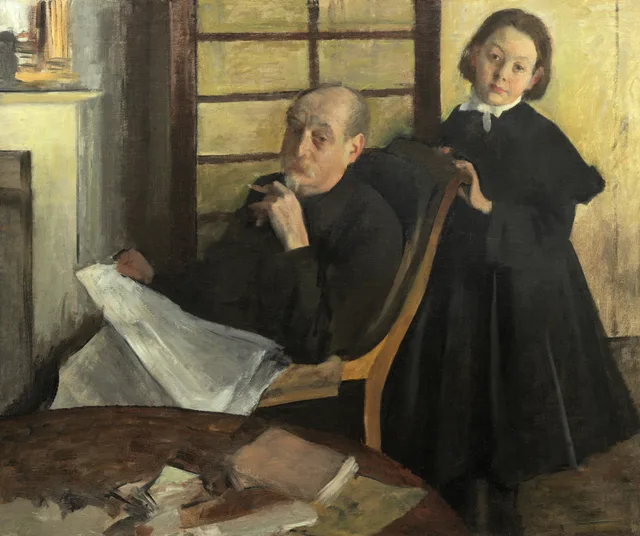 Henri Degas and His Niece Lucie Degas (The Artist's Uncle and Cousin)Edgar Degas1875–76
Too good to keep to yourself
This painting,
for someone who comes to mind
They open it at full size
and see every brushstroke.
About this work
- Artist
- Edouard Manet · 1832–1883
- Date
- 1874
- Medium
- Oil on canvas
- Size
- 97.2 × 130.2 cm
- Collection
- The Metropolitan Museum of Art
- Image
- Original long edge 4000px · shown at 2560px
- Original
- View on the museum's website ↗