Pyeongye
Painters · 17th century
Jacob van Ruisdael
1628–1682
A seventeenth-century Dutch landscape painter who piled clouds like mountains over flat fields, dunes and broken castles.
Scenes from a life
The life of Jacob van Ruisdael,
scene by scene
- 1648Haarlem
In 1648 a young man named Jacob van Ruisdael is entered in the Haarlem painters' guild. He is about twenty. He has already been dating his work for two years. His earliest dated paintings and etchings carry the year 1646.
Painting ran in the family. His father, Isaack, was a painter. His uncle, Salomon van Ruysdael, was a well-known Haarlem landscape painter of rivers and ferry boats. Who actually taught Jacob is not recorded.
- 1650sBentheim
Around 1650, Ruisdael crosses the border into Germany with his fellow painter Nicolaes Berchem. Their goal is the castle of Bentheim. Arnold Houbraken, who wrote lives of Dutch artists in the early 1700s, called Berchem a great friend of Ruisdael. The castle turns up in the work of both men.
Ruisdael went on to paint Bentheim more than a dozen times. The real castle sits on a modest rise above the plain. In his pictures it crowns a tall, wooded mountain. He was not copying the view. He was building a grander one.
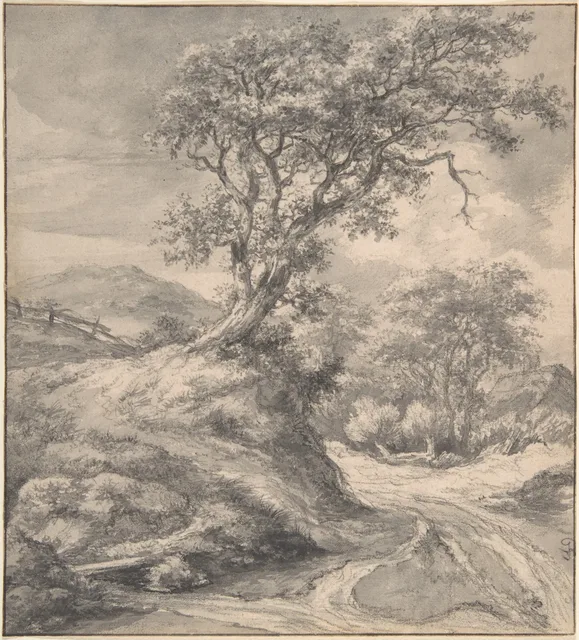
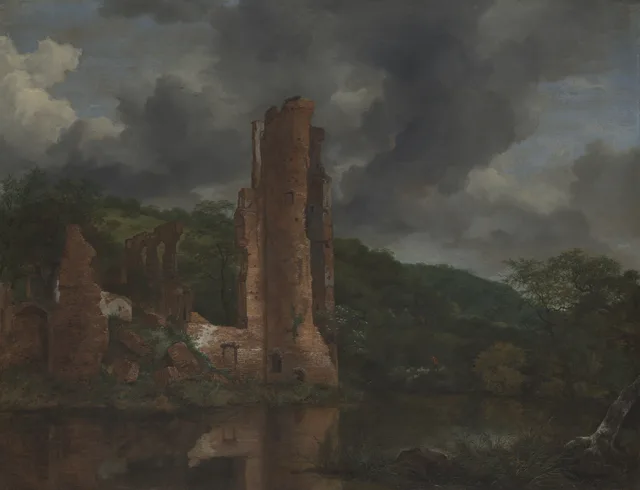
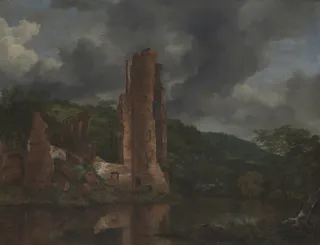
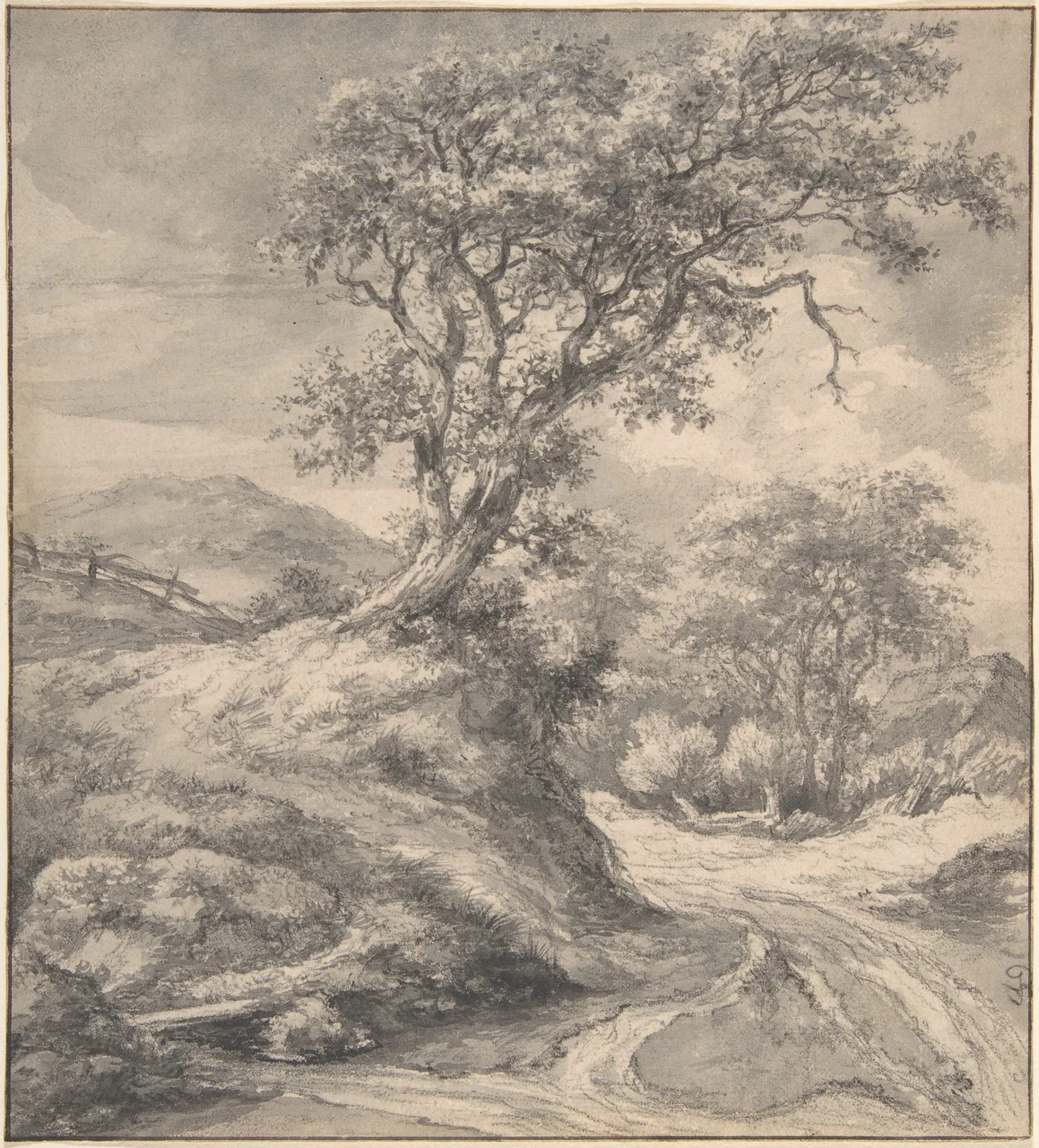
In Holland itself, he found another broken castle. Egmond Castle had been burned in 1573, during the revolt against Spain, by Dutch troops who did not want the enemy to use it. About eighty years later Ruisdael set its red brick tower under a heavy, dark sky. In the same years he drew a twisted oak on a sandy dune in black chalk and gray wash.
Painted around this timeLandscape with the Ruins of the Castle of Egmond - 1657Amsterdam
In the summer of 1657, Ruisdael is baptized into the Dutch Reformed Church. He is around twenty-eight. He had grown up a Mennonite, in a faith that baptizes adults. Now he joins the country's official church instead.
By then he had left Haarlem. Around 1656 he settled in Amsterdam, a crowded port full of ships and merchants. There were more buyers for paintings there, too.
- 1660Amsterdam
On July 8, 1660, Ruisdael stands before an Amsterdam notary to speak about a young man. Meindert Hobbema, he states, had served and learned with him for several years. That one document is how we know Hobbema was his pupil.
The next June, in another notarial record, Ruisdael gave his age as thirty-two. It is the only record of when he was born, which is why his birth year is still given as 1628 or 1629. When Hobbema married in 1668, Ruisdael was there as a witness.
- 1667Amsterdam
In 1667, Ruisdael is ill, and he makes a will. In fact he makes two that year. The one dated May 27 says he was born in Haarlem and now lives on the Kalverstraat in Amsterdam.
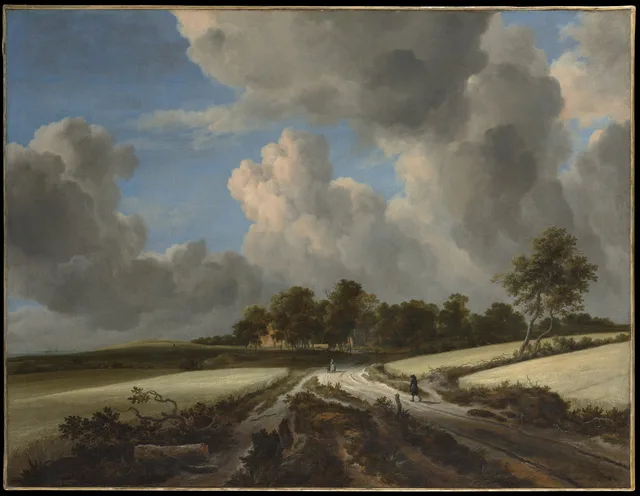
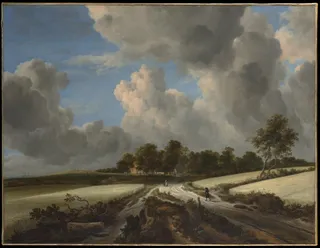
He never married. His wills looked after a half-sister and his father, Isaack, who was in need. Ruisdael recovered and kept painting for another fifteen years. Wheat Fields, with its golden grain and towering clouds, dates from around 1670.
Painted around this timeWheat Fields - 1682Haarlem
On March 14, 1682, Ruisdael is buried in the Church of St. Bavo in Haarlem, the city where he was born. He had been recorded in Amsterdam as late as that January.
For a long time people said he died poor in a Haarlem almshouse. In the twentieth century the scholar Hendrik Wijnman checked the records. The man in the almshouse was his cousin, Jacob Salomonsz van Ruysdael.
Ruisdael's skies have since traveled far. The clouds over the road in Wheat Fields are still rising.
People around them
- Isaack van RuisdaelHis father, a painter, named in his 1667 will.
- Salomon van RuysdaelHis uncle, a Haarlem painter known for river views.
- Nicolaes BerchemA Haarlem painter and friend who traveled with him to Bentheim around 1650.
- Meindert HobbemaHis pupil in Amsterdam, and later a landscape painter in his own right.
- Jacob Salomonsz van RuysdaelHis cousin, who died in a Haarlem almshouse and was long confused with him.
Works