 Pyeongye
Artwork · 19th century · Henri de Toulouse-Lautrec
LeoTurn on Magnifier at the lower right and move slowly across the painting.
Full screen opens it edge to edge.Tap the painting to fill the screen.
Spread two fingers to look closer.
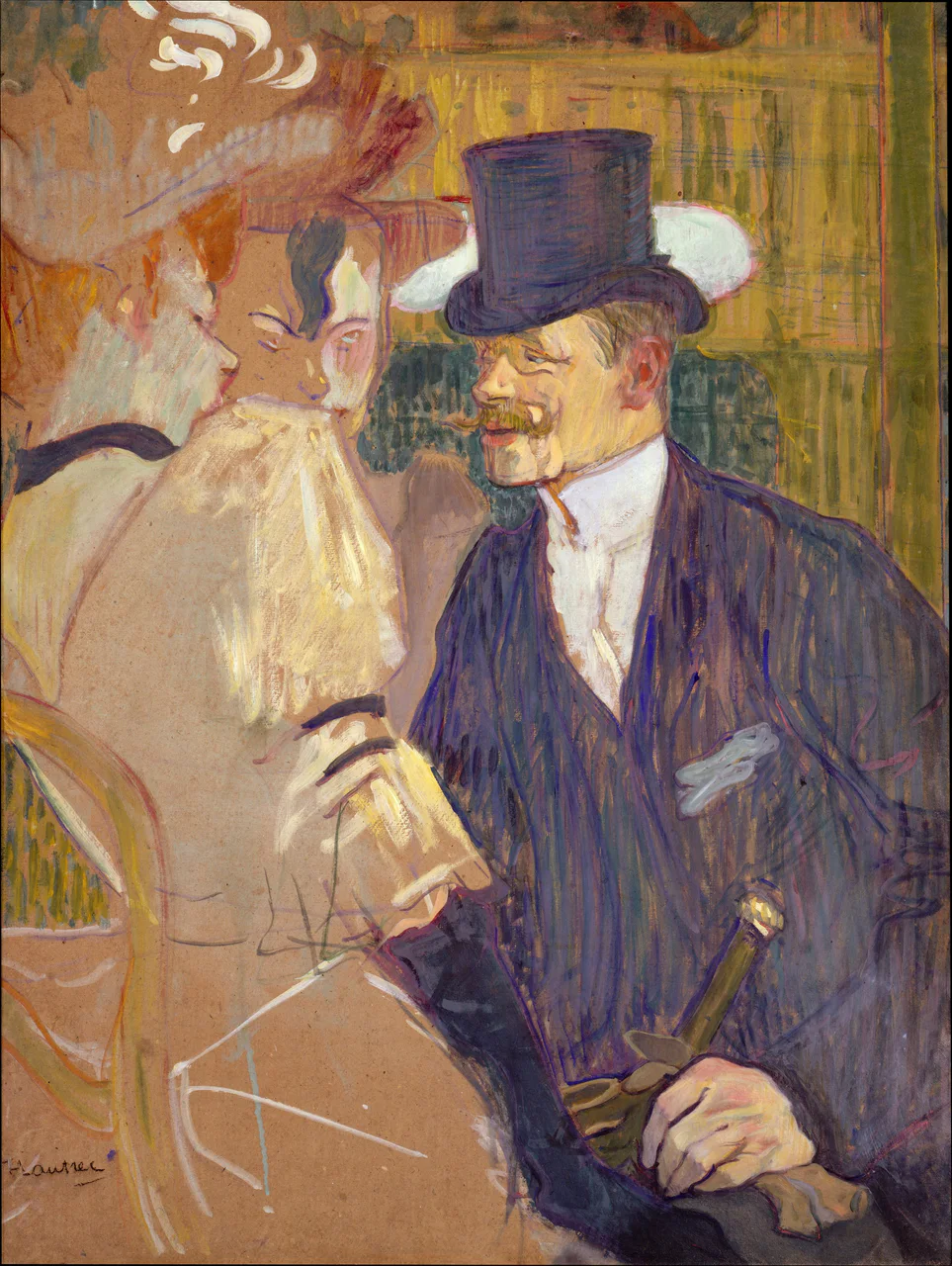
The Englishman (William Tom Warrener, 1861–1934) at the Moulin Rouge
Henri de Toulouse-Lautrec1892Oil on cardboard85.7 × 66 cm
At a glance
- At the Moulin Rouge, a Paris dance hall, an English gentleman in a tall top hat is face to face with two women, as if striking up a conversation.
- Henri de Toulouse-Lautrec painted it in oil on cardboard in 1892.
- He left much of the brown cardboard bare and added quick strokes on top, catching one moment of a noisy night.
Reading the picture
5 places to look closer
Tap a number on the painting to jump to its note, or a close-up to see that spot in the whole picture.
Zoom in on the man's face. His skin is painted in yellow and lime green, and his ear in red. Under a mustache with upturned ends, his mouth hangs a little open. With narrowed eyes, he sneaks a sideways look at the women.
Look at the women's faces on the left. The one with dark bangs keeps her head lowered and slides her eyes toward the man. The woman in front of her is seen only in profile. Patches of bare cardboard show through her face, and a few purple lines are enough for brows and nose.
Zoom in on the lower left. Here the brown cardboard is left completely bare. A few white lines flick across it, hinting at a chair or a table. Even unfinished, the scene still reads.
Look at the man's hand at the lower right. He holds a cane and a pair of gloves together in one hand. The back of his hand is pink and yellow, with purple lines for shadow. Against his dark violet coat, the hand seems to glow.
Zoom in on the lower left corner. The signature Lautrec is scrawled there in black, with a short stroke underneath it.
When it was painted
In 1892 Toulouse-Lautrec was in his late twenties, living in Montmartre and painting its bars, cabarets, and dance halls. He came from an old aristocratic family in Albi, in the south of France. But as a young teenager he broke both thighbones, one after the other, and his legs never grew again.
One of his regular haunts was the Moulin Rouge, which had opened in 1889. In 1891 he designed an advertising poster for it, Moulin Rouge: La Goulue. It was his first poster, and once it went up on the walls of Paris, his name was everywhere.
The man in the top hat is his friend, the English painter William Tom Warrener. Warrener was born in Lincoln, England, studied at the art school there, and then came to Paris. That same year, Toulouse-Lautrec turned this scene into a color lithograph called The Englishman at the Moulin Rouge, and this painting on cardboard was made to prepare it. The Met owns that print as well.
What came after was brief for one of them. Toulouse-Lautrec died in 1901, at thirty-six, while Warrener lived until 1934. The painting came to the Metropolitan Museum in 1967 as a bequest from the collector Adelaide Milton de Groot. In 1974 it traveled to an exhibition at the Usher Gallery in Lincoln, Warrener's hometown.
Now look at his face again: cheeks in yellow and green, a red ear, a mustache curled upward. Even while painting a friend, Toulouse-Lautrec did not hide the giddy night behind the gentleman's polished pose.
The painter
Henri de Toulouse-Lautrec
1864–1901
When painting this, the artist was about 28 years old
All paintings by Henri de Toulouse-Lautrec →More by the same painter
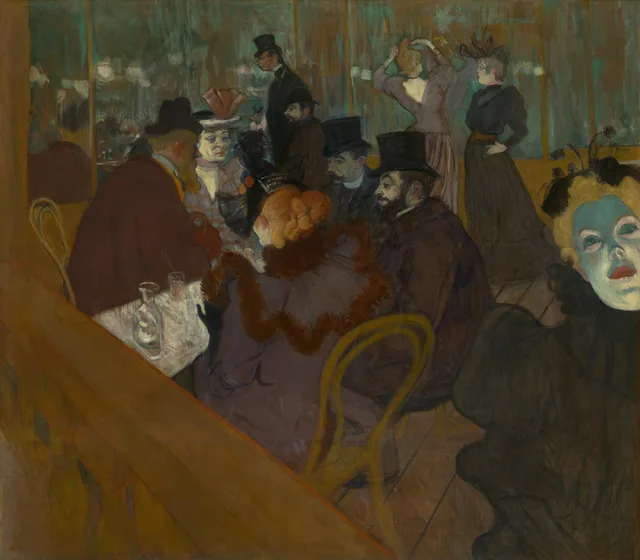
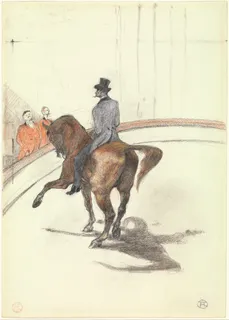
Questions to think about
- Look for itCan you find the handkerchief, just a few light blue strokes, on the chest of the man's coat?
- Why?Why do you think Toulouse-Lautrec left the women's faces and the background partly unpainted?
- What about you?We still have moments when we start talking to a stranger somewhere new, so what do we look at in the other person when deciding whether to approach?
Same period
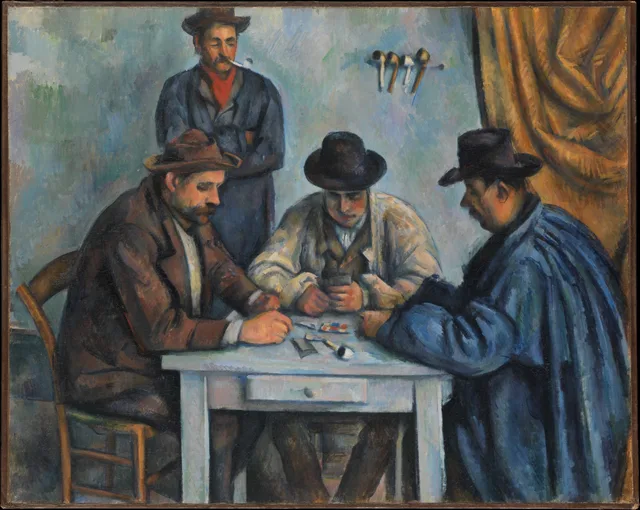
Painted around the same time,
somewhere else


Too good to keep to yourself
This painting,
for someone who comes to mind
They open it at full size
and see every brushstroke.
About this work
- Artist
- Henri de Toulouse-Lautrec · 1864–1901
- Date
- 1892
- Medium
- Oil on cardboard
- Size
- 85.7 × 66 cm
- Collection
- The Metropolitan Museum of Art
- Image
- Original long edge 3719px · shown at 2560px
- Original
- View on the museum's website ↗