 Pyeongye
Artwork · 19th century · Henri de Toulouse-Lautrec
LeoTurn on Magnifier at the lower right and move slowly across the painting.
Full screen opens it edge to edge.Tap the painting to fill the screen.
Spread two fingers to look closer.
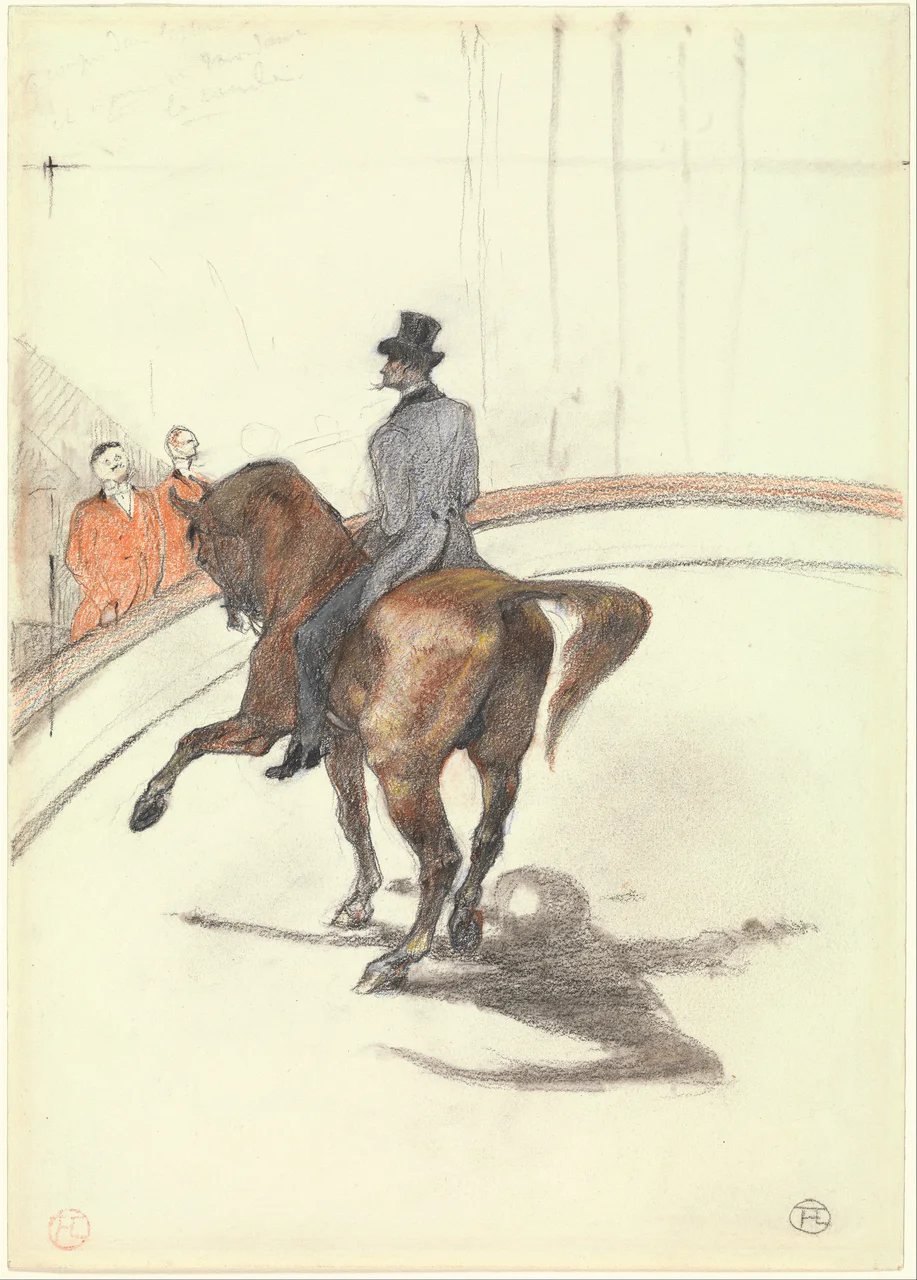
At the Circus: The Spanish Walk (Au Cirque: Le Pas espagnol)
Henri de Toulouse-Lautrec1899Graphite, black and colored pastel, and charcoal on off-white heavy wove paper35 × 25 cm
At a glance
- In a circus ring, a rider in a top hat guides his horse as it steps forward with one front leg thrown high and straight.
- The Paris artist Henri de Toulouse-Lautrec drew it in 1899 with graphite, black and colored pastel, and charcoal.
- He made it while locked in a mental clinic, rebuilding a circus he could not see from memory alone.
Reading the picture
5 places to look closer
Tap a number on the painting to jump to its note, or a close-up to see that spot in the whole picture.
Zoom in on the rider's face. Under the tall black top hat, a mustache sticks out as if caught in a breeze. A little red pastel is rubbed into the cheek. The gray tailcoat is blue pastel crossed with loose black lines.
Follow the horse's raised front leg. It does not bend at the knee. It reaches straight out and hangs in the air. This is the Spanish walk of the title, a show-ring move in which the horse lifts and stretches each front leg in turn. The hoof is pressed in dark, so it seems to carry weight.
Look past the ring fence on the left. Two men in red-orange coats stand there, and one of them is grinning with his mouth open. Their faces are just circles and a few lines. Even so, you can read the look of people enjoying a show.
Check the ground under the horse. The shadow of horse and rider stretches off to the right. Lautrec laid his charcoal on its side and rubbed it wide, leaving one white hole in the middle. That shadow turns empty paper into packed sand.
Find the small circle in the lower right corner. Inside it, the letters H, T, and L are joined together. This is the monogram Toulouse-Lautrec made from his initials.
When it was painted
In late February 1899, Toulouse-Lautrec was thirty-four and living inside a private clinic in Neuilly, just outside Paris. Years of heavy drinking had wrecked his body and mind, and his family had placed him there. There was no circus in the clinic. There were no horses.
He drew them anyway. From memory, he called up the Cirque Fernando in Montmartre, a place he had gone to for years, and set it down in colored pencil and pastel. By spring he had made thirty-nine circus sheets. This Spanish walk is one of them.
The drawings had a job to do. Doctors at the time treated memory loss as a sign of his illness. A man who could rebuild a ring, a horse, and a rider this clearly, with nothing in front of him, was making a case that his mind was sound. He left the clinic on May 17.
Horses had been part of his life since childhood. His father, Count Alphonse, loved riding and hunting, and his first teacher, René Princeteau, was an animal painter known for horses. Lautrec broke both thighbones in his early teens and could never ride freely after that, but he never stopped drawing horses.
The recovery did not last. He died in September 1901 at his mother's château of Malromé, at thirty-six. His friend and dealer Maurice Joyant kept his drawings safe. This sheet later entered the collection of the New York collector Robert Lehman, which came to the Metropolitan Museum in 1975.
Look again at the shadow under the horse. In a clinic with nothing to look at, he remembered even the shape of a shadow stretched across the sand.
The painter
Henri de Toulouse-Lautrec
1864–1901
When painting this, the artist was about 35 years old
All paintings by Henri de Toulouse-Lautrec →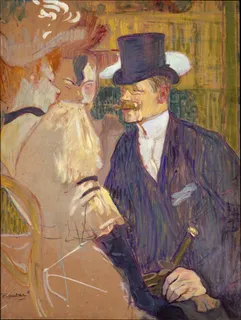
Questions to think about
- Look for itCan you find the pencil lines standing up like posts in the empty space behind the ring?
- Why?Why do you think Lautrec left the seats almost blank and saved his color for the horse and rider?
- What about you?Locked in a clinic, the artist used drawings to prove he was all right. Is it fair that people with mental illness so often have to prove they are fine before others will trust them again?
Same period
Painted around the same time,
somewhere else
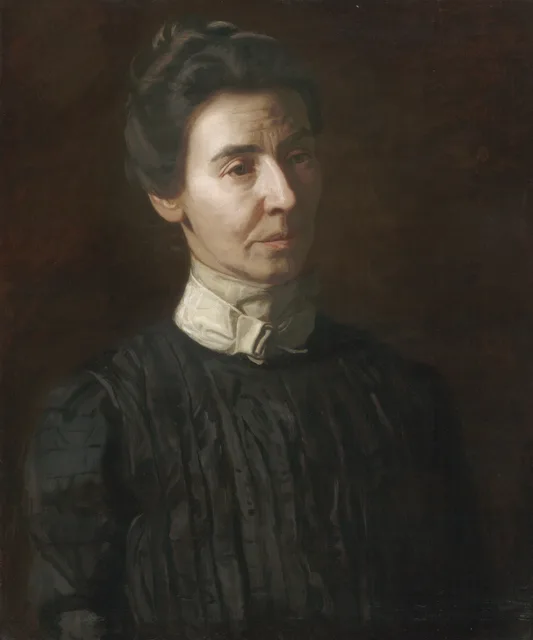 Portrait of Mary Adeline WilliamsThomas Eakins1899
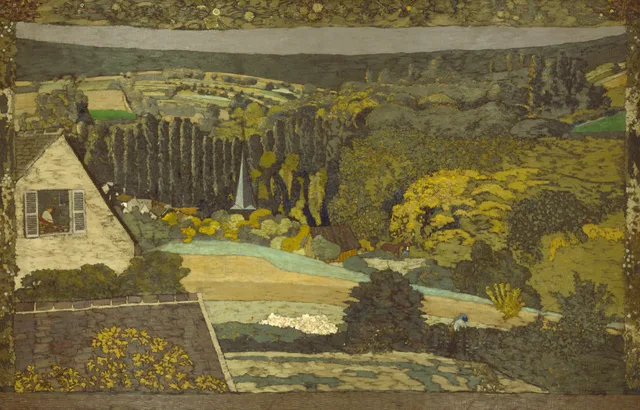 Landscape: Window Overlooking the WoodsÉdouard Jean Vuillard1899
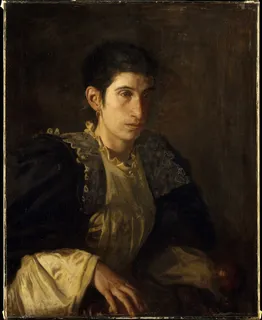 Signora Gomez d'ArzaThomas Eakins1901–2
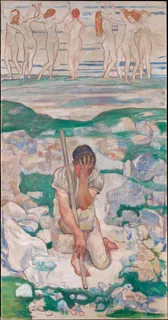 The Dream of the Shepherd (Der Traum des Hirten)Ferdinand Hodler1896
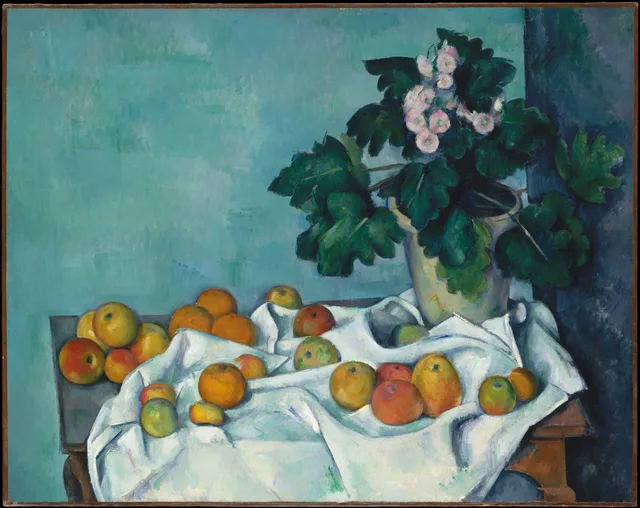 Still Life with Apples and a Pot of PrimrosesPaul Cézanneca. 1890
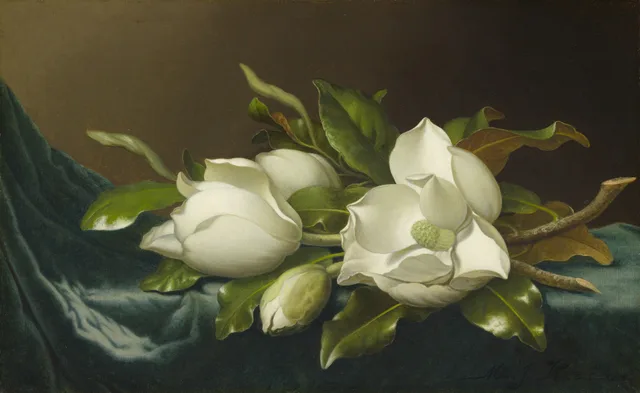 Magnolias on Light Blue Velvet ClothMartin Johnson Heade1885–95
Too good to keep to yourself
This painting,
for someone who comes to mind
They open it at full size
and see every brushstroke.
About this work
- Artist
- Henri de Toulouse-Lautrec · 1864–1901
- Date
- 1899
- Medium
- Graphite, black and colored pastel, and charcoal on off-white heavy wove paper
- Size
- 35 × 25 cm
- Collection
- The Metropolitan Museum of Art
- Image
- Original long edge 3867px · shown at 2560px
- Original
- View on the museum's website ↗