 Pyeongye
Artwork · 18th century · Joseph Wright
LeoTurn on Magnifier at the lower right and move slowly across the painting.
Full screen opens it edge to edge.Tap the painting to fill the screen.
Spread two fingers to look closer.
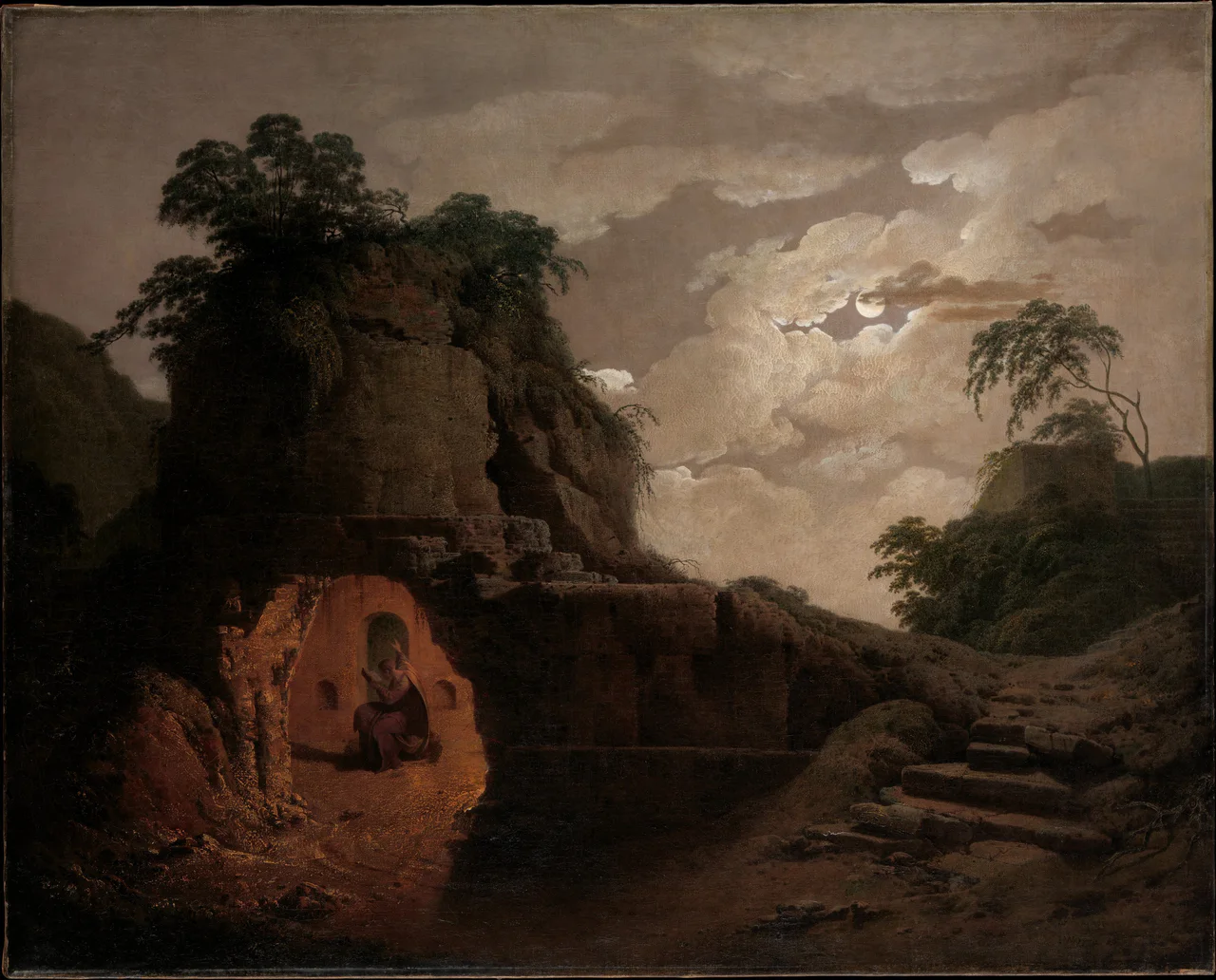
Virgil's Tomb by Moonlight, with Silius Italicus Declaiming
Joseph Wright1779Oil on canvas101.6 × 127 cm
At a glance
- On a moonlit night, inside an ancient tomb overgrown with trees, a man holds open a book and raises his arm as he recites poetry.
- Joseph Wright, a painter from Derby in England, painted it in 1779.
- Two kinds of light share the canvas: the cool light of the moon and a warm glow inside the tomb.
Reading the picture
5 places to look closer
Tap a number on the painting to jump to its note, or a close-up to see that spot in the whole picture.
Zoom into the sky at upper right. A round moon slips out through a break in the clouds. A thin strip of cloud drifts across its face. The cloud edges around it shine white.
Look at the mouth of the tomb at lower left. Outside it is dark, but the inner wall glows orange. Small arched niches are cut into that wall. Some light other than the moon seems to fill this space.
Zoom into the man inside the tomb. Wrapped in a cloak, he sits holding an open book in one hand and lifts his other arm high. It is the gesture of someone reading poetry aloud. According to the title, he is the Roman poet Silius Italicus.
Look at the top of the tomb. Trees and brush grow thickly on the old stones. A building made by people is slowly turning into a hill. The tips of the branches show black against the night sky.
Drop down to the lower right. A few worn stone steps lead upward, with broken blocks lying beside them. A faint trace of moonlight catches their edges. Where do you think this path leads?
When it was painted
In the summer of 1773, Joseph Wright got married. He was thirty-eight. Late that year he and his wife set out for Italy. Back in Derby he was known for candlelit scenes, faces glowing out of the dark. Now he was going to see the ruins of ancient Rome for himself.
In the autumn of 1774 he reached Naples. There he saw Vesuvius erupting, a sight he would paint again and again for years. Naples also had an old Roman tomb long said to belong to Virgil, the poet of the Aeneid. It had long been a favorite stop for travelers to the city.
The man in this painting has his own story. Silius Italicus was a Roman poet of the first century AD who bought the land where the tomb stood. His contemporary, Pliny the Younger, wrote in a letter that Silius kept Virgil's birthday more faithfully than his own, and visited the tomb as if it were a temple.
Back in England, Wright tried in 1775 to set himself up as a portrait painter in the spa town of Bath. It did not work out, and in 1777 he went home to Derby.
In 1779 he sent this picture to the Royal Academy exhibition in London, where visitors could be expected to recognize the famous tomb at once. He went on to paint the tomb several more times. The Metropolitan Museum acquired this canvas in 2013.
Now look again at the orange glow inside the tomb at lower left. The small figure with his arm raised is the same Silius that Pliny described. More than sixteen hundred years later, an English painter back from Naples brought that old devotion back to life under the moon.
The painter
Joseph Wright
1734–1797
When painting this, the artist was about 45 years old
All paintings by Joseph Wright →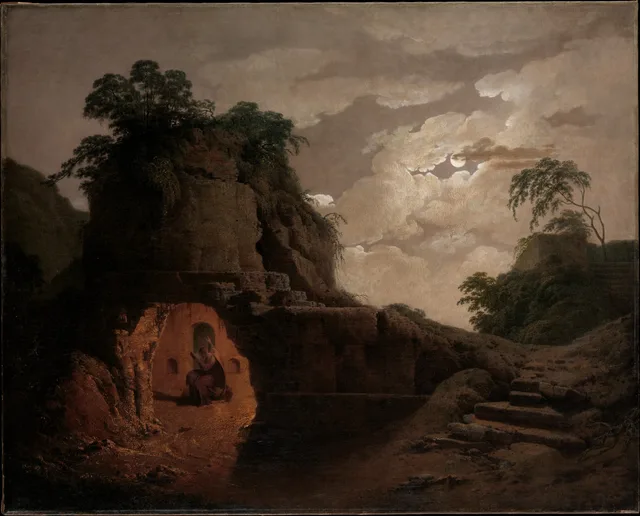
Questions to think about
- Look for itHow many small niches can you count in the wall of the tomb?
- Why?Why do you think Wright painted the inside of the tomb in warm colors so different from the moonlight?
- What about you?Silius bought the ground where a poet he admired was buried, just to honor him. Is there a person or a work you would want to honor like that today?
Same period
Painted around the same time,
somewhere else
 Night Rain at the Double-Shelf Stand, from the series Eight Parlor Views (Zashiki hakkei)Suzuki Harunobuca. 1766
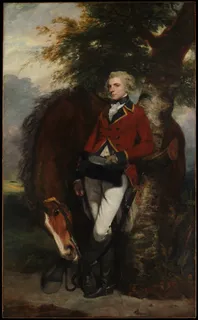 Captain George K. H. Coussmaker (1759–1801)Sir Joshua Reynolds1782
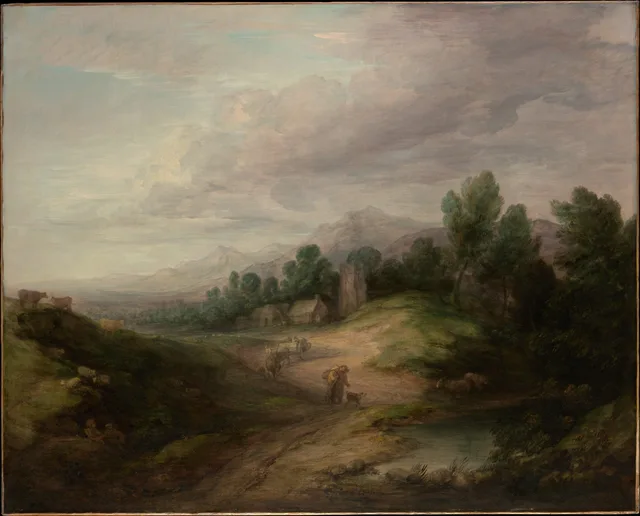 Wooded Upland LandscapeThomas Gainsboroughprobably 1783
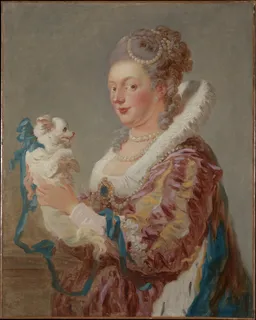 Marie Emilie Coignet de Courson (1716–1806) with a DogJean Honoré Fragonardca. 1769
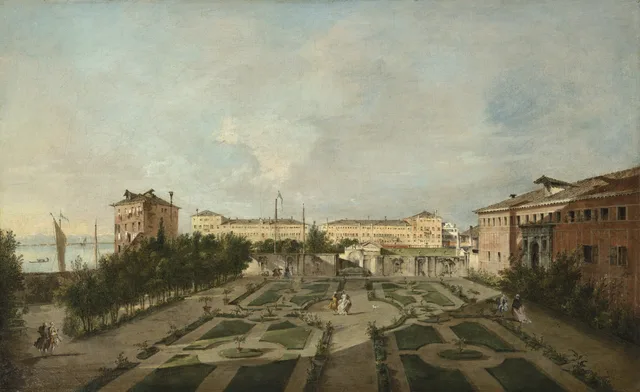 The Garden of Palazzo Contarini dal ZaffoFrancesco GuardiLate 1770s
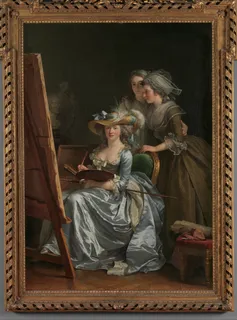 Self-Portrait with Two Pupils, Marie Gabrielle Capet (1761–1818) and Marie Marguerite Carraux de Rosemond (1765–1788)Adélaïde Labille-Guiard1785
Too good to keep to yourself
This painting,
for someone who comes to mind
They open it at full size
and see every brushstroke.
About this work
- Artist
- Joseph Wright · 1734–1797
- Date
- 1779
- Medium
- Oil on canvas
- Size
- 101.6 × 127 cm
- Collection
- The Metropolitan Museum of Art
- Image
- Original long edge 3915px · shown at 2560px
- Original
- View on the museum's website ↗