 Pyeongye
Artwork · 18th century · Jean Honoré Fragonard
LeoTurn on Magnifier at the lower right and move slowly across the painting.
Full screen opens it edge to edge.Tap the painting to fill the screen.
Spread two fingers to look closer.
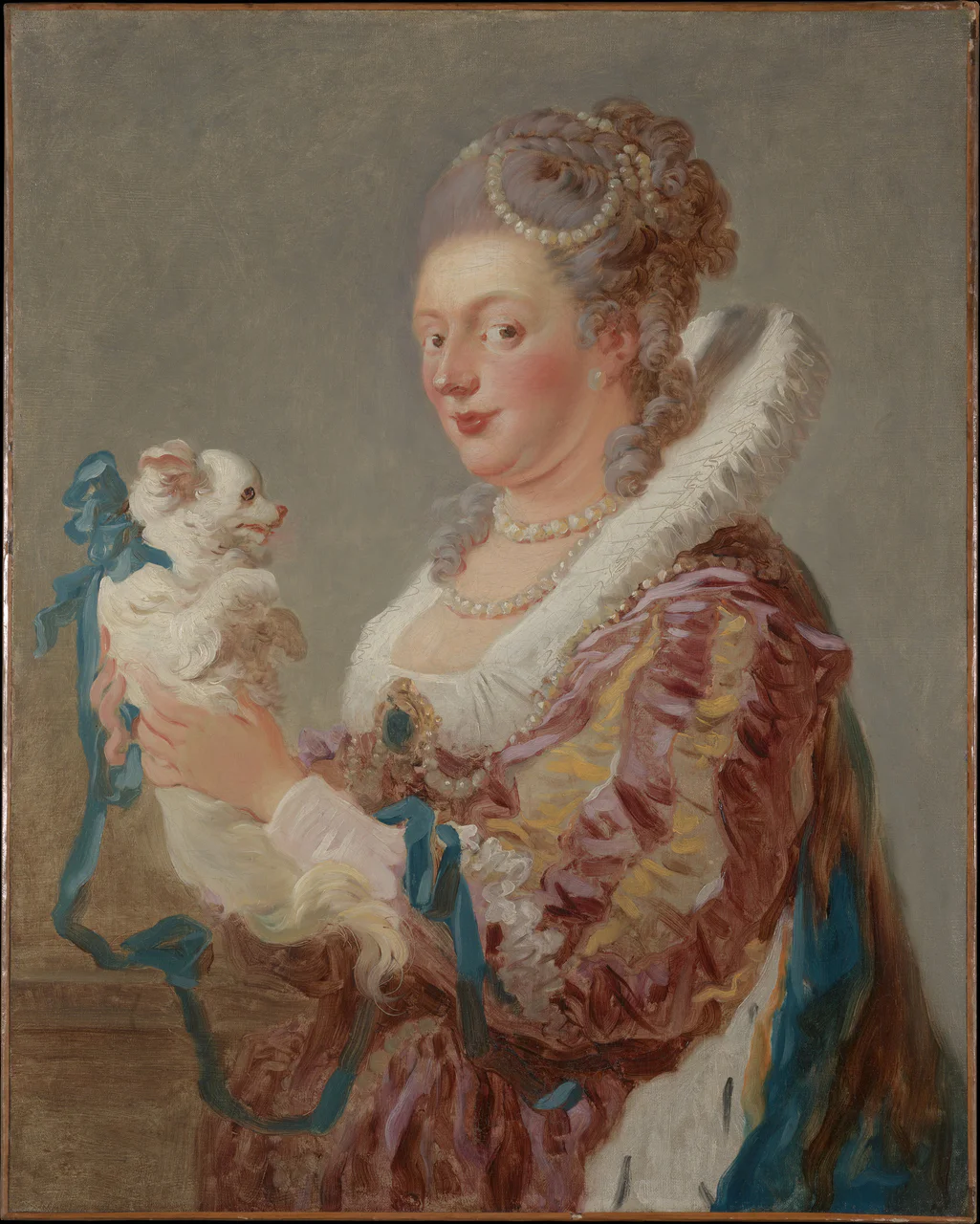
Marie Emilie Coignet de Courson (1716–1806) with a Dog
Jean Honoré Fragonardca. 1769Oil on canvas81.3 × 65.4 cm
At a glance
- A woman with pearls in her hair and a huge ruffled collar holds up a little white dog and glances back at us.
- Jean Honoré Fragonard painted it in oil on canvas around 1769.
- The lace, fur, and ribbons are painted with fast, swinging strokes, and the closer you get, the clearer the path of the brush becomes.
Reading the picture
5 places to look closer
Tap a number on the painting to jump to its note, or a close-up to see that spot in the whole picture.
Start with the dog on the left. Its white fur is made of curling strokes, and the inside of its ear is pink. With its shiny brown eye and open red mouth, it looks ready to bark. A blue ribbon tied at its neck trails all the way down the canvas.
Now look at the woman's face. Her cheeks are flushed and the corners of her mouth turn up. Her body faces the dog, but her eyes slide sideways toward us. If we go by the birth year in the title, she was a little past fifty here.
Zoom in on the top of her head. Her hair is piled high and wound with several strands of pearls. Each pearl is a round blob of paint finished with one dot of white. Two more strands of pearls hang at her throat.
Look at the white ruff rising behind her shoulder. Thin lines are scribbled across its zigzag folds. They look as if something pointed, like the end of a brush, was dragged through the wet paint. A few quick moves give the feel of stiff lace.
Zoom in on the lining of her cloak at the lower right. On the white fur sits a black, tail-shaped mark. That is the pattern painters use for ermine, the white winter fur of the stoat. Beside it, a blue fabric pours down in broad, open brushstrokes.
When it was painted
In 1769 Fragonard was thirty-seven and busy in Paris. That summer he married Marie-Anne Gérard, a young painter who, like him, came from the town of Grasse in the south of France. Before the year was out, their daughter Rosalie was born. A few years earlier a grand history painting had won him the approval of the Royal Academy, but he now put most of his energy into bright pictures for private collectors.
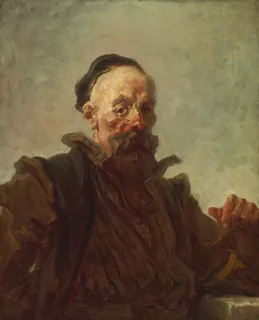
Around this time he painted a striking run of portraits. He dressed people he knew in showy costumes from long-gone centuries, like the big ruff here, and painted them from the waist up with fast, slashing strokes. Today these pictures are called his fantasy figures. An old label on the back of one of them says it was painted in 1769 in a single hour.
For a long time the woman in this picture had no name. She was simply the woman with a dog. Then, in 2012, a sheet of Fragonard sketches turned up at an auction in Paris. It held eighteen tiny drawings of figures, and nearly every one had a name written beside it. One of them was labeled with the name Courson.
That sheet let the Met identify the sitter as Marie Emilie Coignet de Courson, an aristocratic hostess who ran a salon. In 2017 the National Gallery of Art in Washington brought the sheet and many of the fantasy figures together in one exhibition. The Met had bought this painting long before, in 1937.
Here is one more odd coincidence. The title tells us Madame de Courson died in 1806, and Fragonard died that same year. Look at her eyes one last time. With the dog held high, she still throws us that sideways glance, caught in a few quick strokes more than 250 years ago.
More by the same painter
Questions to think about
- Look for itCan you follow the blue ribbon from the dog's neck and see where it ends?
- Why?Why do you think Fragonard painted the face fairly carefully but swept through the clothes and fur so fast?
- What about you?This woman chose to be remembered holding her dog. Many people today use a photo with their pet as a profile picture. What do our pets say about how we want others to see us?
Same period
Painted around the same time,
somewhere else
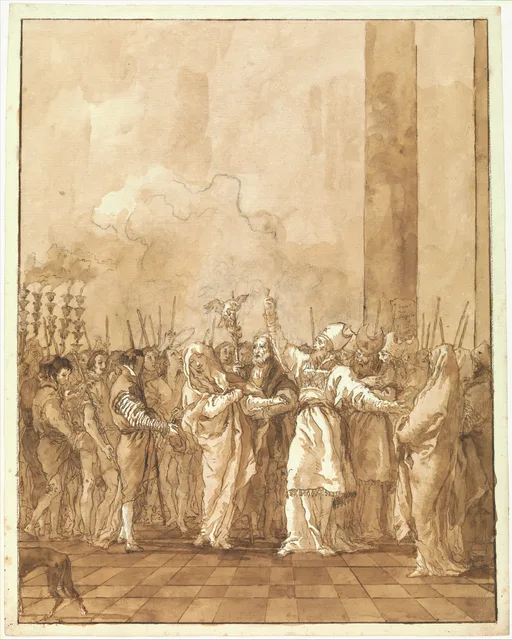 The Betrothal of the VirginGiovanni Domenico Tiepoloca. 1770
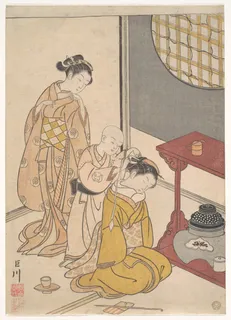 Night Rain at the Double-Shelf Stand, from the series Eight Parlor Views (Zashiki hakkei)Suzuki Harunobuca. 1766
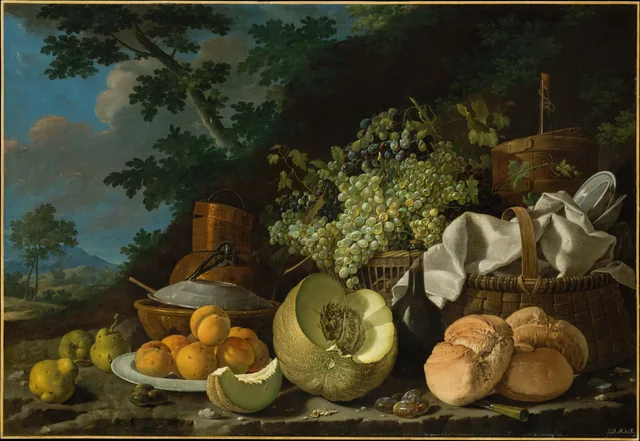 The Afternoon Meal (La Merienda)Luis Meléndezca. 1772
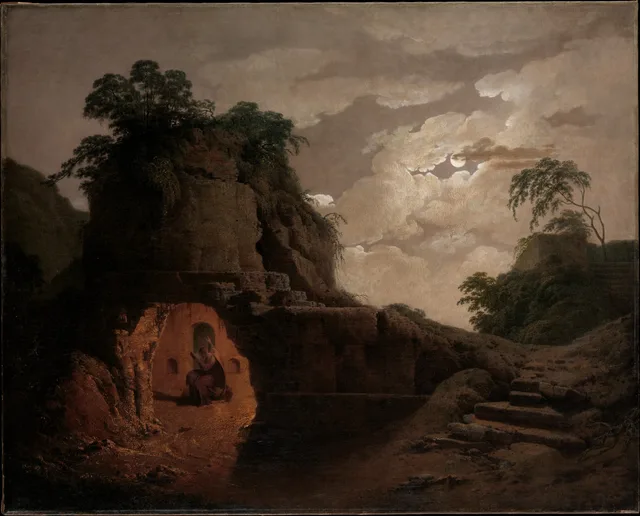 Virgil's Tomb by Moonlight, with Silius Italicus DeclaimingJoseph Wright1779
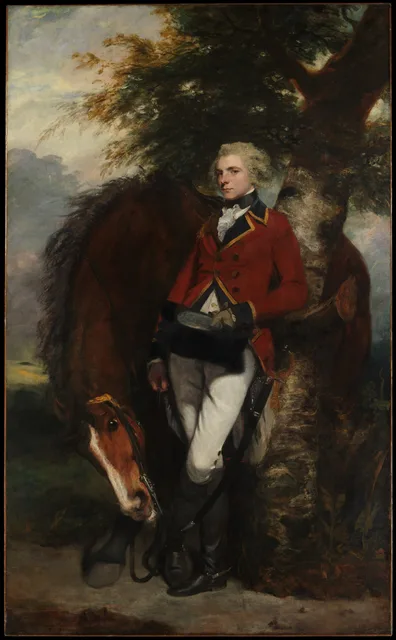 Captain George K. H. Coussmaker (1759–1801)Sir Joshua Reynolds1782
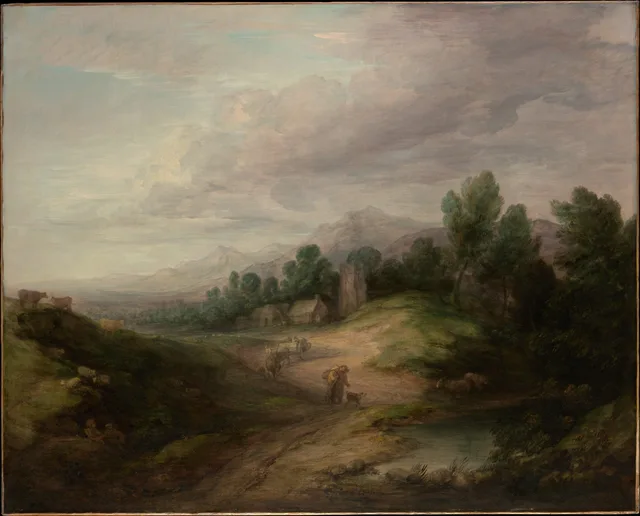 Wooded Upland LandscapeThomas Gainsboroughprobably 1783
Too good to keep to yourself
This painting,
for someone who comes to mind
They open it at full size
and see every brushstroke.
About this work
- Artist
- Jean Honoré Fragonard · 1732–1806
- Date
- ca. 1769
- Medium
- Oil on canvas
- Size
- 81.3 × 65.4 cm
- Collection
- The Metropolitan Museum of Art
- Image
- Original long edge 4000px · shown at 2560px
- Original
- View on the museum's website ↗